Automated Inline Monitoring of Perfusion Mammalian Cell Culture Using MIR Spectroscopy with Single-Point Calibration

Amgen
Developer of Treatment Drugs for Serious Diseases

This article is excerpted from the paper "Automized inline monitoring in perfused mammalian cell culture by MIR spectroscopy without calibration model building" published by researchers from Amgen. For more details, please refer to the original article.
Process Analytical Technology (PAT) Plays a Key Role in the Automation of the Biopharmaceutical Industry. In recent years, spectroscopic methods such as Raman spectroscopy or mid-infrared (MIR) spectroscopy have gained increasing recognition for inline monitoring of bioprocesses due to their ability to simultaneously measure various molecules. However, their reliance on labor-intensive model calibration poses implementation challenges. In this study, a novel single-point calibration was evaluated across 22 mammalian cell perfusion (PER) processes with two different scales and four different products. This calibration required a reference point prior to using MIR spectroscopy for inline monitoring of glucose and lactate in bioprocesses. Concentration predictions for all PER runs resulted in a root mean square error (RMSE) of 0.29 g/L for glucose and 0.24 g/L for lactate. For comparison, traditional partial least squares regression (PLSR) models were used, trained with spectral data from six bioreactor runs involving two different scales and three products. The overall accuracy of these models (RMSE of 0.41 g/L for glucose and 0.16 g/L for lactate) fell within the accuracy range of the single-point calibration. This demonstrates the potential of single-point calibration as a method to make spectroscopy more accessible for bioprocess development.
The global pharmaceutical market is a rapidly evolving and highly innovative industry. Over the past decade, the demand for accelerated product development has continued to grow. In 2004, the U.S. Food and Drug Administration (FDA) launched the Process Analytical Technology (PAT) initiative to ensure product robustness and high quality. The market offers various dedicated sensors for continuous monitoring of Critical Process Parameters (CPP), ensuring consistent control of product quality attributes during biopharmaceutical manufacturing. The focus on automation and digitalization in bioprocessing requires adequate PAT solutions to enable automated inline monitoring and control strategies.
Commonly used sensors for monitoring CPP include pH, temperature, and dissolved oxygen, among others. However, the measurement of further CPP (such as metabolite or nutrient concentration) is mostly conducted through daily offline sample analysis. Due to the limited amount of bioprocess information associated with this method, the implementation of appropriate countermeasures and the achievement of deeper process understanding are highly restricted. Spectroscopic methods such as Raman spectroscopy or infrared spectroscopy are promising tools for detailed online or inline CPP monitoring, thus contributing to better understanding and control of bioprocesses. These non-invasive methods do not require sample preparation and can be easily sterilized together with the bioreactor (BR), making them ideal choices for inline sensors. Spectroscopic techniques can simultaneously predict nutrients and metabolites. Near-infrared, mid-infrared (MIR), and Raman spectroscopy have sufficiently demonstrated their capability for inline monitoring of glucose and lactate in Chinese hamster ovary (CHO) cell cultures. Control strategies based on these methods can optimize product titer, cell growth, and glycosylation patterns.
The barriers to widespread use of spectroscopic methods are high costs, lack of disposable components, and reliance on laborious calibration model building, which is very time-consuming and requires expertise in chemometrics for data evaluation. Calibration models often depend on the operational conditions of the calibration setup. The need for reliable calibration models is one of the biggest challenges for the widespread use of spectroscopic methods in the biopharmaceutical field. To build robust models using standard multivariate methods such as Partial Least Squares Regression (PLSR), large datasets, spectroscopic methods, and knowledge of data analysis are required. This necessitates increased personal, product, and time resources. Moreover, the prediction and accuracy of most models are highly dependent on the dataset and mode used, thus they are generally non-transferable. A potential strategy to reduce the extensive workload of calibration model building and data generation is to use universal calibration models to predict parameters when changing cell lines, media, and operational settings. However, these algorithms require large amounts of data from multiple batches and modes to build the model.
In this study, MIR spectroscopy was developed for direct inline monitoring of glucose in CHO perfusion (PER) processes. A novel single-point calibration requiring only one initial reference point was created and tested for the two main components (glucose and lactate) in the bioprocess. To evaluate its robustness, the method was assessed using a cell line expressing four different products at two different scales and compared with conventional PLSR models. Glucose and lactate were chosen as parameters for single-point calibration due to their importance in cell culture processes. The aim of this study was to develop and propose a simple ready-to-use method based on MIR spectroscopy for CHO PER processes that can be used without prior knowledge of spectroscopy.
For detailed experimental procedures and result analysis, please refer to the original text.
Perfusion Culture and Cell Lines
Use four stable CHO cell lines expressing non-glycosylated bispecific constructs (Molecule A, B, C, D) from pooled and clonal cell banks. Cells were recovered and expanded to generate sufficient cell mass, ultimately inoculated into 2 and 10 L scale PER bioreactors (BR).
The PER process can be defined through three procedural steps. The first phase is a 3-day cell accumulation batch phase. In the second 9-day phase, an alternating tangential flow (ATF) filtration system (Repligen) is connected with a polysulfone filter (Cytiva) and a chemically defined medium (PER-Medium) to increase cell density and accumulate the product. The collected filtrate is free of cells and product (waste). The perfusion rate is gradually increased to up to 1 bioreactor volume per day (RV/d). In the third phase, during days 12-15 of the perfusion cell culture process, the product is harvested using tangential flow filtration. On day 12, the ATF filter is switched from a 30 kDa cutoff membrane to a 750 kDa membrane, allowing the product to pass through while retaining the cells within the reactor. In addition to PER-Medium, a 50% glucose solution is added to the bioreactor (BR) as needed to maintain glucose levels above the critical concentration.
The temperature setpoint and agitation are controlled by a distributed control unit, while the reactor pH setpoint is automatically controlled by the addition of carbon dioxide or sodium carbonate. For each cell line used, the culture temperature, pH, and dissolved oxygen setpoints are identical. Once the specified cell density is reached, a temperature adjustment is performed. To minimize foam formation, antifoaming agents are added to the PER-Medium as needed.
All measurements were performed using the multichannel MIR Fourier Transform Infrared (FTIR) spectrometer Monipa (IRUBIS GmbH).
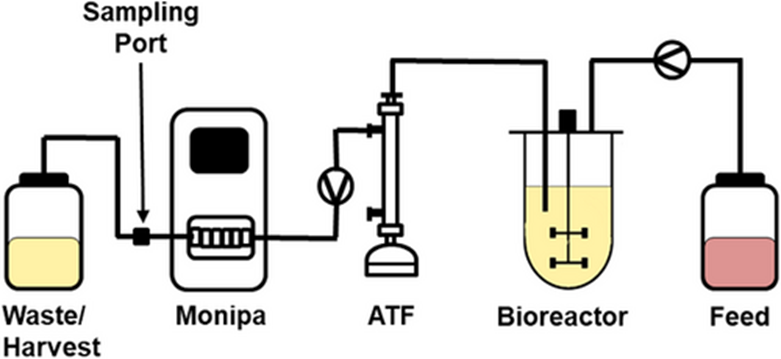
Schematic diagram of Monipa integrated into the perfusion process. This setup incorporates alternating tangential flow (ATF) and a peristaltic pump. Additionally, an extra sampling port is directly connected after Monipa.
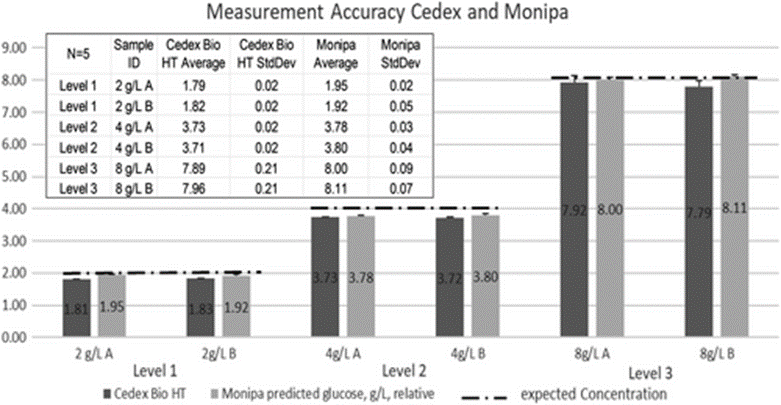
Comparison of Internal Equipment Errors Between Two Systems (Monipa and Cedex Bio HT) Using Three Different Concentrations (2, 4, and 8 g/L) of Glucose Solution.
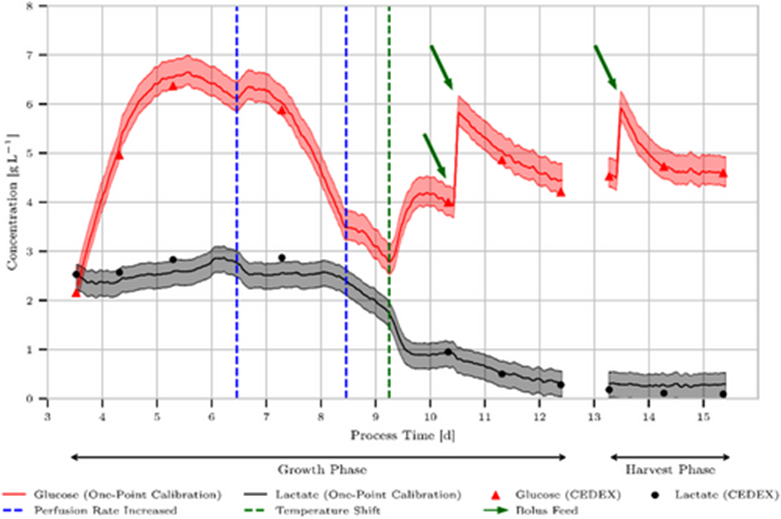
A single-point calibration model (Molecule C) run using a 2 L bioreactor predicts glucose and lactate concentrations (in g/L) throughout the process. The single-point calibration predictions are represented by the red line (glucose) and the black line (lactate). For both lines, the prediction uncertainty of the single-point calibration is included, calculated as the root mean square error (RMSE) across all 22 runs. Reference values for glucose concentration (red triangles) and lactate (black dots) were measured using the Cedex Bio HT. Changes in perfusion rate (blue dashed line), temperature shift (green dashed line), and bolus feeding (green arrows) are shown. On Day 12, an alternating tangential flow (ATF) switch was performed; due to insufficient data on that day, monitoring of the process was paused and resumed on Day 13 with morning samples.
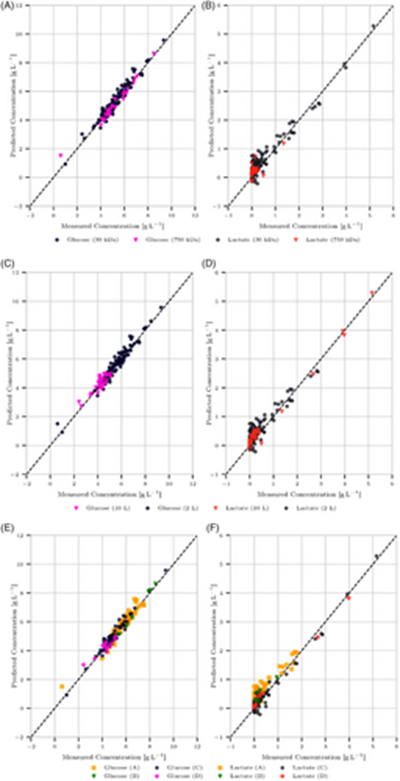
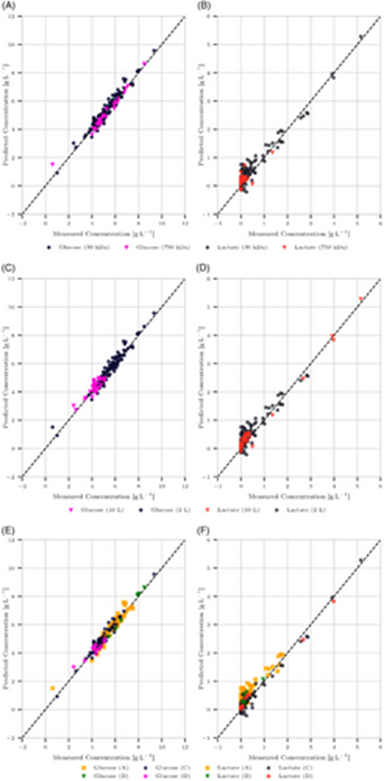
Predictive Evaluation of Glucose and Lactate Concentrations for Different Alternating Tangential Flow (ATF) Filter Pore Sizes (A, B), Scales (C, D), and Molecules (E, F). The dashed line illustrates the ideal correlation between predicted and measured concentrations.
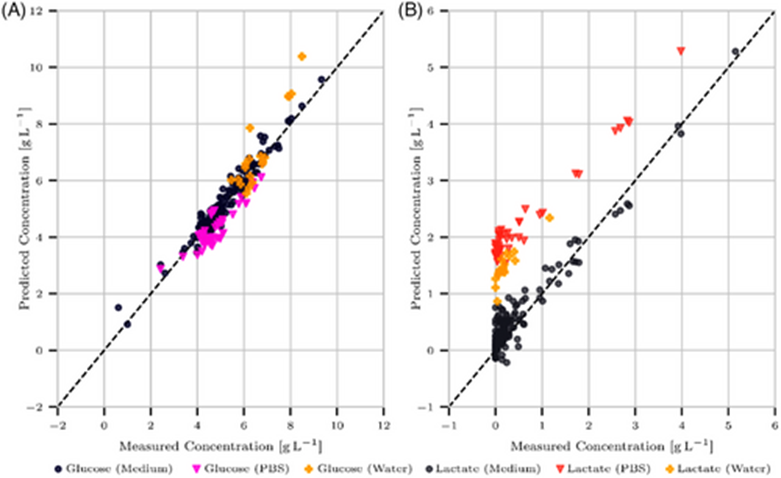
Evaluation of Single-Point Calibration Models for Glucose (A) and Lactate (B) Using Different Reference Measurements. The ideal linearity between single-point calibration predictions and CEDEX Bio HT measured concentrations is represented by the dashed line passing through the origin. Comparing different reference measurements, the most accurate lactate concentration prediction was achieved when the medium was used as the reference measurement.
Prediction of Partial Least Squares Regression (PLSR) Model with Single-Point Calibration for Glucose Concentration (A) and Lactic Acid Concentration (B). The dashed line illustrates the ideal correlation between predicted concentration and measured concentration.
Summary
In this study, a novel single-point calibration method using the MIR spectroscopy system Monipa was thoroughly investigated, and its performance was compared with the standard multivariate method PLSR. The concentrations of glucose and lactate were monitored inline over 22 runs, with varying scales and products. The results demonstrated that its performance in terms of accuracy and robustness was comparable to the PLSR method. Additionally, no significant impact on the accuracy of this method was observed under changing conditions, proving its potential as a universal method for real-time monitoring of CHO PER processes. The proposed single-point calibration helps reduce implementation barriers for PAT technology in bioprocessing. The algorithm leverages the characteristics of mid-infrared spectroscopy to lower the technical complexity. Combined with a robust mid-infrared spectrometer, this method has the potential to make spectroscopy more accessible to users with limited chemometric knowledge, thereby possibly facilitating broader adoption of the technology within the industry. It can help reduce material and labor costs since it does not rely on prior test runs to collect data for model building. The MIR spectroscopy system Monipa can be directly applied in process development, potentially enhancing its utility in early-stage development. During production, this method could serve as a reliable basis for robust glucose control. With real-time continuous monitoring of glucose concentration changes, this information can assist in optimizing feeding strategies, for example, by correlating glucose feed with lactate concentration in the reactor.
However, in practice, single-point calibration depends on reliable reference analysis or a known initial concentration. Therefore, scientists should be aware of the standard deviation of the reference analysis to understand the upper and lower limits of their process.
Single-point calibration is expected to become a universal application for all process steps in cell culture, from early development to production scale.
H.Marienberg, N.Desch, V.Mozin, et al., Automized inline monitoring in perfused mammalian cell culture by MIR spectroscopy without calibration model building. Engineering in Life Sciences, 2023.
Scan the WeChat QR code, add the editor of the Biologics Circle, and those who meet the requirements can join.
Biological Products WeChat Group!
Please indicate: Name + Research Direction!


All articles reprinted by this official account are intended to convey more information, with the source and author clearly indicated. Media or individuals who do not wish to be reprinted can contact us at cbplib@163.com, and we will immediately delete the content. All articles represent the views of the author and do not represent the position of this website.