GSK Eyes $2B Acquisition in Respiratory and Immune Diseases: Spotlight on Chinese Biotechs Quidel Bio and ConnoMed

GSK
Pharmaceutical R&D Manufacturer

Qyuns
Developer of Biologics for Autoimmune and Allergic Diseases

Keymed Biosciences
Innovative Biopharmaceutical Developer
PREFACE
Preface
At the end of 2023, in addition to major transaction events, there were also milestones. On December 22, AstraZeneca announced the acquisition of Gracell Biotechnologies for $1.2 billion.
As the first biotech acquisition by an MNC in China, this transaction has also sparked considerable rational reflection within the industry. One key point is the current capital winter,A new exit path has been opened up. In addition, the potential of China's innovative drug industry is gradually being tapped, enablingGain recognition from MNCs and gradually step onto the global stage。
As a milestone, Gracell Biotechnologies has set a precedent for being wholly acquired by an MNC in China's biotech industry. Although it is uncertain when the second case will occur, this time the buyer is highly likely to be GSK.
01
GSK Accelerates Respiratory and Immunology Disease Layout

According to The Times,GSK Chief Commercial Officer Luke MielsPublicly stated last Saturday,Will concentrate on transactions worth $2 billion within the next six months, thereby expanding the drug pipeline. Meanwhile, in the report, Miels specifically emphasized that GSK is focused on "one to two highly targeted products."
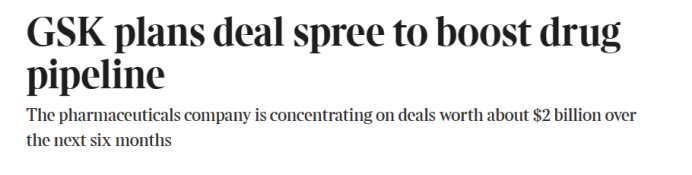 Source: The Times
And just a few days ago, GSK also mentioned on foreign media websites that it is undergoing a significant organizational restructuring in China, which will begin next year.Establish Three Core Business Departments: Special Drugs, Vaccines, and Respiratory. Among them, the development of the respiratory business began several months ago. In April, GSK announced the acquisition of BELLUS Health for a total value of 1.6 billion pounds (2 billion US dollars). BELLUS Health's pipeline contains only one potential BIC drug, camlipixant, used to treat adult refractory chronic cough.
At this time, the same conditions were put forward by GSK again, indicating that GSK is accelerating its efforts to enrich its pipeline. After all, by 2027, Dolutegravir, one of the company's best-selling products, will face patent expiration, posing a sales risk of $6.2 billion. In addition, the market for another blockbuster product, Shingrix, will also face the risk of saturation. Therefore,GSK needs to increase investment in R&D and commercialization to ensure robust growth in future performance.。
GSK's heavy investment in the respiratory and autoimmune disease fields is based on its years of deep cultivation. The respiratory field, which has a history of up to 50 years, is the largest revenue contributor for GSK. Products such as Nucala for severe asthma treatment and Trelegy for COPD treatment have achieved significant success. Long-term efforts in the respiratory field have also given GSK extensive experience and strength in the development and marketing of such drugs.
02
Which biotechs in China have potential?

Let's look at GSK's acquisition terms,The preferred company focuses on respiratory and immune diseases, with 1 or 2 new drugs.From the $2 billion acquisition amount proposed by GSK, it is still unrealistic to buy a newly listed drug with this sum of money. Therefore, the focus can only be shifted to...Companies in the clinical research stageAt the same time, if calculated at a 100% premium, this company currentlyThe company's market value should be less than 1 billion US dollars.。
Besides, considering the characteristics of Genetech being acquired by MNC,The technology of one's own products needs to be sufficiently advanced.. As the second largest disease market in China, the autoimmune field is also a hotspot for popular products. Another major reason why Gracell Biotechnologies is highly regarded is itsPlatform Technology Value。
Based on the above requirements, what biotech companies in China have the potential from an analytical perspective?
Quanxin Bio
As a clinical-stage biopharmaceutical company focused on biologics for autoimmune and allergic diseases, the company currently has no products on the market but owns nine pipeline products covering four major disease areas: dermatology, rheumatology, respiratory, and gastroenterology. It has established six core technology platforms, including an innovative structural antibody development platform, PK/PD analysis platform, process development and pilot-scale platform, formulation screening platform, antibody characterization and analytical identification platform, and GMP manufacturing platform.Possesses complete technical capability for independently developing innovative structural monoclonal antibodies。
Among them, QX005N, as the core product of Quanxin Biotechnology, is currently in Phase II clinical trials for both atopic dermatitis (AD) and prurigo nodularis (PN) indications, with Phase III clinical communication about to be initiated. In the respiratory field, its potential cannot be underestimated either, as the Phase II clinical trial for chronic rhinosinusitis with nasal polyps (CRSwNP) is proceeding smoothly.
Kang Nuoya
The company focuses on the fields of autoimmune diseases and oncology. With continuous investment in research and development and an experienced R&D team, the company has developed multiple technology platforms, including a novel T-cell redirecting bispecific antibody platform (nTCE), an innovative antibody discovery platform, a biological evaluation platform, and a high-throughput screening platform for high-yield antibody drug expression cells.
In ongoing projects,CM310 is the first domestically produced L-4Ra antibody in China.. Currently, pivotal clinical trials for the treatment of various types of allergic diseases are underway, particularly showing superior efficacy and safety compared to Dupilumab in the clinical trials for atopic dermatitis. Additionally,CM326 is the first domestically produced TSLP monoclonal antibody to enter clinical trials in China., used for treating eosinophil-dependent and -independent inflammatory diseases, exhibits significantly superior biological activity in inhibiting TSLP-induced cell proliferation and activation compared to similar comparable products.
For the above two biotechs,Although they have the potential to be valued by MNCs, it does not mean they have the willingness or plans to be acquired.It also has strong self-research and commercialization capabilities. Regardless of the path it takes, in the field of respiratory and autoimmune diseases, which have received extensive attention from the market and capital, it will possess unique competitive advantages.
MARY
Summary
As the year draws to a close, multinational companies have kicked off a wave of mergers and acquisitions. BMS made two consecutive acquisitions of Karuna Therapeutics and Rayzebio within two days. In contrast, in China, LianTuo recently received an acquisition offer from Concentra Biosciences.
This wave of acquisitions not only reflects the MNCs' proactive response to new market trends, but also shows their strategic adjustments through mergers and acquisitions in the face of growing market demand, thereby maintaining a competitive edge. For China's biotech industry, this is also a new period of development opportunities.
Scan the WeChat QR code, add the editor of Antibody Circle, and those who meet the requirements can join the Antibody Circle WeChat group!


All articles reproduced in this official account are intended to convey more information, with the source and author clearly stated. Media or individuals who do not wish to be reprinted may contact us (cbplib@163.com), and we will immediately delete the content. All articles represent the views of the author and do not represent the position of this site.