

Faricimab (Vabysmo®) Gains New Indication in China for Neovascular Age-Related Macular Degeneration, Offering New Hope for Patients

Roche
Oncology Drug Research, Development, and Manufacturing

On January 3, 2024, Roche announced that the China National Medical Products Administration (NMPA) officially approved the ophthalmic injection bispecific antibody, Luoshijia.®(Vabysmo®, Generic Name: Faricimab) for the treatment of neovascular age-related macular degeneration (nAMD). Roche®Is the world's first dual-pathway innovative treatment drug for fundus diseases[2], with its dual mechanism of action targeting both angiopoietin-2 (Ang-2) and vascular endothelial growth factor A (VEGF-A), along with its sustained advantages, can inhibit neovascularization while enhancing vascular stability, improving long-term visual benefits and quality of life for patients. This follows the recent approval for diabetic macular edema (DME), Roche's®The second indication approved in China is expected to provide a new treatment option for Chinese patients with nAMD.
Age-related macular degeneration (AMD) is one of the leading causes of severe and irreversible vision loss worldwide.[3]In China, a study targeting people with visual impairment and blindness from 1990 to 2019 showed that the number of people with moderate to severe vision loss and blindness caused by AMD were 2.28 million and 320,000, respectively.[4]。With the development of aging process in China's society, the number of AMD patients in China is expected to increase to 55.19 million by 2050.[5], the socioeconomic burden caused by AMD will further increase.
Neovascular Age-Related Macular Degeneration (nAMD), also known as exudative or wet AMD, occurs when abnormal growth of choroidal neovascularization (CNV) enters the macular area of the retina, causing leakage and bleeding. This interferes with retinal function and ultimately leads to rapid vision loss or even blindness. Statistics show that approximately 20 million people worldwide are affected by nAMD, which is one of the leading causes of vision loss in individuals over 60 years old.
Roche®Principal Investigator of the Phase III Clinical Study in China for nAMD, Professor Chen Youxin from Peking Union Medical College Hospital, stated: "In the pathogenesis of nAMD, the key factors leading to choroidal neovascularization are not only the abnormal increase of VEGF-A acting on vascular endothelial cells, which generates new blood vessels, but also the elevation of Ang-2 (angiopoietin-2) acting on pericytes, causing vascular leakage. In the traditional single-pathway era, the improvement of retinal fluid in nAMD patients with only VEGF inhibition was not ideal; more than half of nAMD patients still had retinal fluid after treatment with traditional single-pathway drugs. Additionally, the current anti-VEGF therapies require long-term and frequent intravitreal injections, affecting patient compliance and increasing the economic burden on patients. There is an urgent clinical need to further explore drugs that are mechanism-innovative, effectively eliminate retinal fluid, and can help patients achieve sustained benefits."
Roche®This approval is mainly based on the positive results of the global Phase III clinical studies TENAYA and LUCERNE.[6]. Compared with the current situation where more than half of the patients still have retinal fluid after single-pathway drug injection, studies show that Roche's product®Heavy-hitting during the loading period, achieving approximately 80% of nAMD patients receiving Lucentis.®The effusion was eliminated after treatment. Approximately 60% of nAMD patients received Luoshijia.®The treatment dosing interval can reach up to 16 weeks, with approximately 80% of patients achieving 12 weeks or more. The long maintenance period without recurrence allows patients to achieve stable disease control with fewer treatments. Additionally, Roche's product, Lucentis,®Results from a 1-year study of the Chinese subpopulation of patients with nAMD showed[7]: Roche®In the personalized treatment group, 87.3% of patients could achieve a dosing interval of 12 weeks or more, and 67.3% of patients reached 16 weeks, with proportions higher than those in the global study. The overall safety and tolerability data were consistent with the global data.
As the first innovative bispecific antibody specifically designed for intravitreal injection, Roche's product®It can simultaneously target and inhibit the key pathogenic factors Ang-2 and VEGF-A that cause various retinal diseases, making a bold breakthrough based on existing anti-VEGF treatments. It strongly and specifically binds to and inhibits both pathways, enhancing vascular stability while reducing fundus leakage.
Dr. Li Xin, Head of Roche's Global Pharma Development Center in China, stated: "We are very pleased to see another significant indication of Faricimab successfully approved in China. From ushering in the era of anti-VEGF treatments for retinal diseases in 2006, to today launching Faricimab, the world’s first bispecific antibody drug for ophthalmology, Roche has always been committed to enhancing long-term vision benefits and improving the quality of life for patients with retinal diseases. We will also continue our efforts to advance the development of new molecular entities or indications in ophthalmology, striving to bring more innovative medicines to patients in China."
Ms. Bian Xin, President of Roche Pharmaceuticals China, stated: "Retinal diseases are becoming the leading cause of blindness among the elderly in China. The '14th Five-Year Plan' for National Eye Health in China has also added retinal diseases as a key focus for prevention and treatment. The consecutive approvals of faricimab for the treatment of DME and nAMD, two major types of retinal diseases, reflect the Chinese government's high level of attention to retinal diseases. Roche will adhere to the concept of 'acting on the needs of patients first,' and work together with all partners to continuously expand the accessibility of faricimab, create comprehensive solutions for the diagnosis and treatment of retinal diseases, and reduce the burden and blindness rate caused by retinal diseases in China."
China is Roche®The 90th country to be approved, within the past two years, Roche®Globally, it has already helped more than 2.5 million patients. Roche has been deeply involved in the ophthalmology field for many years. Over 20 years ago, it successfully developed and launched the world's first, as well as China’s first, intravitreal anti-VEGF injection drug. After 20 years of relentless exploration and effort, Roche once again successfully developed Luoshi Jia.®, has finally stepped into the spotlight in the Chinese market.
As the first and currently only bispecific antibody in the field of ophthalmology, Roche's Vabysmo®The DME indication was approved in China in December 2023, and the RVO indication is currently under review. Roche Ophthalmology boasts a robust product pipeline; in addition to the already approved and currently under-review indications, more than ten molecular entities are expected to enter clinical trials. Through continuously refreshed technology, Roche aims to collaborate with experts to advance the prevention and treatment of retinal diseases in China.
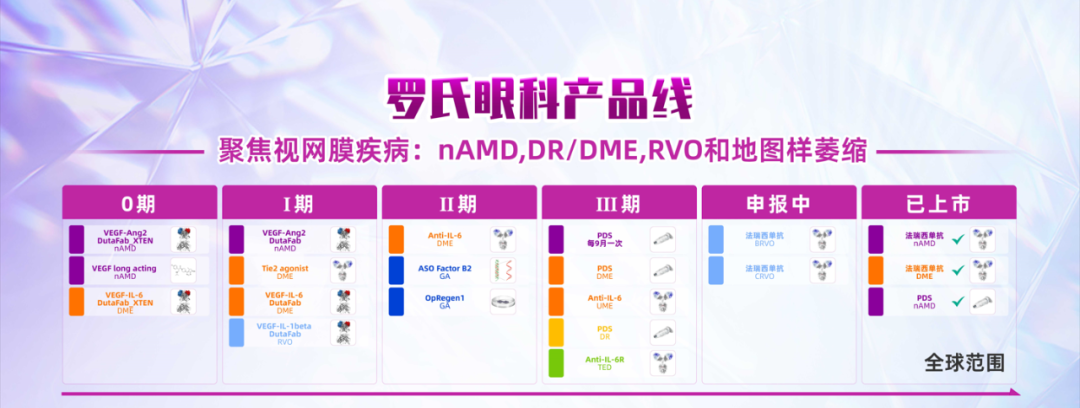 Roche Ophthalmology Pipeline (Global)
- Scroll up and down to view the reference materials -
[1]Eye (2021) 35:1305–1316
[2]Faricimab is the first bispecific antibody designed for intraocular use. In January 2022 faricimab received its first approvals(Drugs (2022) 82:825–830 https://doi.org/10.1007/s40265-022-01713-3)
[3]Wong WL, Su X, Li X, et al. Global prevalence of age‑related macular degeneration and disease burden projection for 2020 and 2040: a systematic review and meta‑analysis[J]. Lancet Glob Health, 2014, 2(2):e106‑e116. DOI: 10.1016/S2214‑109X(13)70145‑1.
[4]Xu T, Wang B, Liu H, et al. Prevalence and causes of vision loss in China from 1990 to 2019: findings from the global burden of disease study 2019[J]. Lancet Public Health, 2020, 5(12): e682‑e691. DOI: 10.1016/S2468‑2667(20) 30254‑1.
[5]Song P, Du Y, Chan KY, et al. The national and subnational prevalence and burden of age‑related macular degeneration in China[J]. J Glob Health, 2017, 7(2): 020703. DOI: 10.7189/jogh.07.020703.
[6]Khanani AM et al. Faricimab in nAMD and DME:Lates Updates Presented at the Angiogenesis, Exudation, and Degeneration 2023 Virtual Congress. February 10-11,2023.
[7]Youxin Chen, et al. 2023 EURETINA. Free Paper # CA231397
Copyright © 2023 PHARMCUBE. All Rights Reserved.
Welcome to forward, share, and reasonably cite. When citing, please clearly indicate the source of the article.For reprint, please leave a message or send a message to the WeChat Official Account backend, and indicate the name and ID of the official account.
Disclaimer: The information in this WeChat article is for general reference only and should not be directly used as decision-making content. PharmaCube assumes no responsibility for any loss incurred by any party due to the use of the content herein.