Ribo Therapeutics Secures Over $2 Billion Partnership with Boehringer Ingelheim for siRNA-Based NASH/MASH Therapy
Ribo Life Science
Small Nucleic Acid Drug Developer

On January 3, the multinational pharmaceutical company Boehringer Ingelheim announced that it had reached a cooperation agreement with Suzhou Ribo Life Science Co., Ltd. and its Swedish subsidiary Ribocure to jointly develop innovative small nucleic acid therapies for the treatment of non-alcoholic or metabolic dysfunction-associated steatohepatitis (NASH/MASH).
This collaboration will closely integrate Ribo's leading experience in early research and clinical development in the siRNA drug field with Boehringer Ingelheim's commitment to improving the quality of life for patients with cardiovascular, renal, and metabolic (CRM) diseases.
According to the agreement, in addition to receiving an upfront payment, Ribo will be entitled to milestone payments based on the conduct of clinical studies, drug registration, and commercial success, as well as tiered sales royalties for marketed products, with a total transaction value exceeding 2 billion US dollars in this multi-target collaboration project.
It is estimated that more than 440 million people worldwide suffer from NASH, an inflammatory liver disease caused by the accumulation of fat in the liver. Over time, NASH can lead to liver fibrosis and tissue scarring, and many patients may further develop cirrhosis and related severe complications, including liver failure or liver cancer. Currently, there are no drugs approved for the treatment of NASH. Patients with NASH urgently need new effective treatment options to prevent the progression of NASH and maintain and restore liver function.
Small nucleic acids refer to oligonucleotide molecules, including small interfering nucleic acids (siRNA), antisense nucleic acids (ASO), microRNAs (miRNA), and nucleic acid aptamers (Aptamer). Small nucleic acid drugs, composed of nucleotides, represent a completely new category of drugs that are entirely different from small molecule drugs and antibody drugs. The main types of small nucleic acid drugs are siRNA drugs and antisense nucleic acid drugs, both of which primarily target mRNA in the cytoplasm. Through base-pair complementarity, they recognize and inhibit target mRNA, regulating protein expression to achieve therapeutic effects. Ribo Life Science's small nucleic acid drug products mainly include siRNA drugs, ASO drugs, and nucleic acid aptamer drugs.
siRNA is a class of short, double-stranded RNA molecules that can bind to AGO proteins to form the RNA-induced silencing complex (RISC). One strand is degraded, while the other strand binds and cleaves target gene messenger RNA (mRNA) through base-pair complementarity, blocking the expression of the target protein, thereby achieving the purpose of treating related diseases. The mechanism by which siRNA inhibits protein expression is called RNA interference (RNAi), the discovery of which was awarded the 2006 Nobel Prize in Physiology or Medicine. This work was ranked by Science magazine as the top scientific advancement globally in 2001 and 2002.
Ribo Life Science is committed to the continuous innovation of key technologies in small nucleic acid pharmaceuticals. Currently, the company's liver-targeted delivery technology and second-generation modification technology have fully matured, supporting four varieties entering the clinical stage.
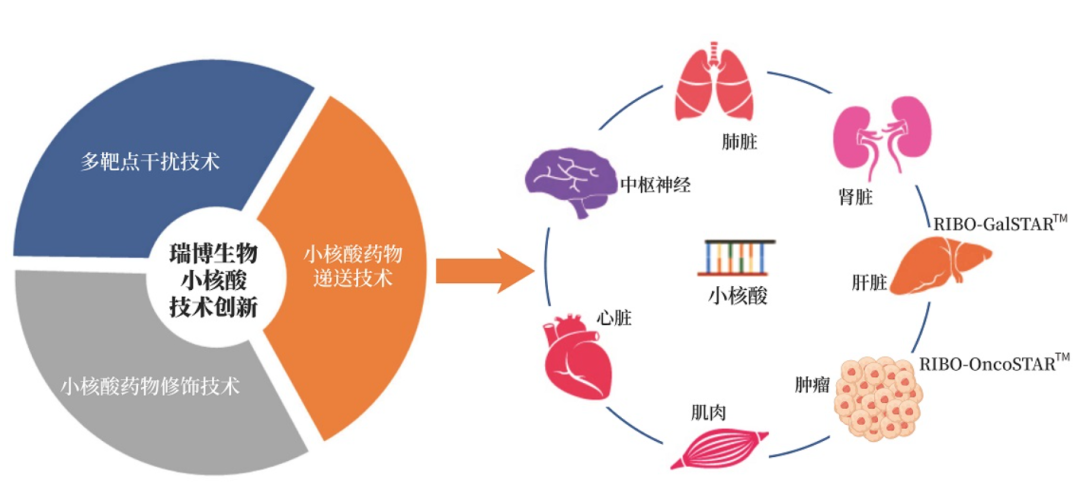
Small nucleic acid drug modification technology is a core technology crucial for enhancing the efficiency, longevity, and safety of small nucleic acid drugs. Without proper modification, small nucleic acids are highly susceptible to degradation, may experience significantly reduced activity, or can exhibit varying degrees of off-target effects and/or immunogenicity.
RSC2.0 Small Nucleic Acid Chemical Modification TechnologyIt is a nucleic acid modification platform technology developed by Ribo Life Science based on systematic research into the degradation mechanisms of siRNA, sequence activity, and off-target patterns. This technology has been granted patents by key jurisdictions such as the United States, Canada, and Australia, making Ribo Life Science one of the few companies globally to have obtained platform-level patent authorization for modification technologies.
The small nucleic acid liver delivery technology based on GalNAc (N-acetylgalactosamine) ligands is currently the primary supporting platform for global small nucleic acid pharmaceuticals. GalNAc is a specific ligand of the asialoglycoprotein receptor (ASGPR), which has high affinity and rapid internalization capability for GalNAc groups. After the conjugated molecule of GalNAc and siRNA specifically binds to ASGPR on the surface of hepatocytes, it enters the endosome of the hepatocyte. The siRNA can escape from the endosome into the cytoplasm, thereby achieving hepatocyte-specific siRNA targeted delivery.
RIBO-GalSTARTMIt is a small nucleic acid liver-targeted delivery technology independently developed by Ribo Life Science., which has obtained patent authorization from important jurisdictions such as China and the United States for this technology, and has been applied to the development of various liver-targeting nucleic acid drugs (four of which have entered clinical stages, with the most advanced one already in Phase II clinical trials).
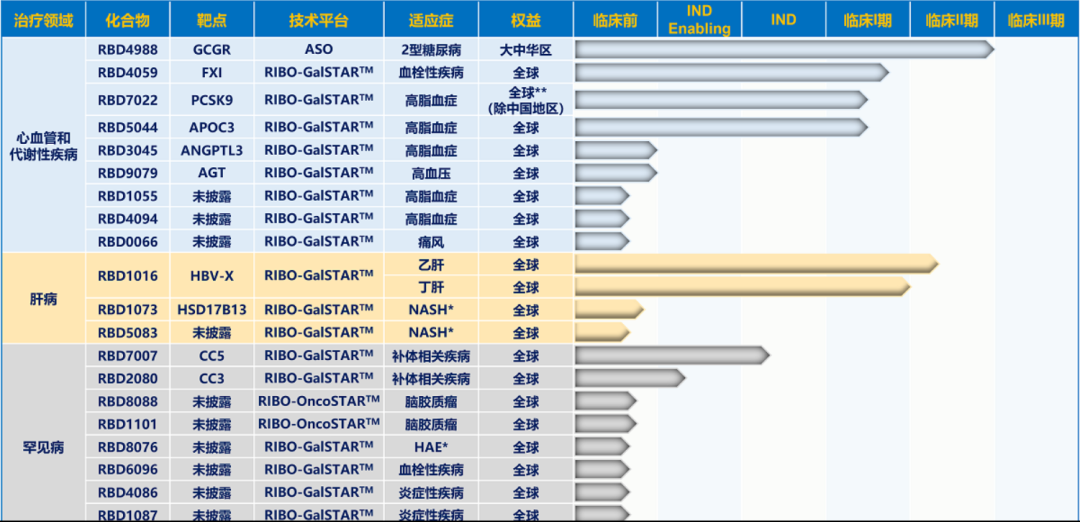
Currently, Ribo has a total of three pipelines in the field of liver diseases, among which RBD1016 for the treatment of hepatitis B and hepatitis D is the most advanced (Phase 2 clinical trials). This drug is the first GalNAc-conjugated siRNA drug developed based on Ribo's RIBO-GalSTARTM liver-targeting delivery technology aimed at treating hepatitis B. Non-clinical studies have shown that RBD1016 has Best-In-Class potential. In clinical studies, RBD1016 demonstrated good safety and expected GalNAc-siRNA pharmacokinetic characteristics. Efficacy data from hepatitis B patients showed that RBD1016 exerts consistent and long-lasting suppression on HBsAg, HBV DNA, HBV RNA, and HBcrAg.
Both candidate drugs for the treatment of NASH, RBD1073 and RBD5083, are in the preclinical stage.
The collaboration with Ribo Life Science is not the first time Boehringer Ingelheim has purchased small nucleic acid drugs. Six years ago,Boehringer Ingelheim &DicernaSigned another small nucleic acid drug agreement, Dicerna's main candidate drug also targets non-alcoholic steatohepatitis. According to the agreement, Dicernaa will receive an upfront payment and milestone payments totaling $201 million from Boehringer Ingelheim, plus final sales royalties.
Dicerna's proprietary RNAi technology platform (named GalXC™) aims to drive the development of the next generation of RNAi-based therapies that silence driver genes of liver diseases. Therapies based on GalXC are initiated by the Dicer enzyme, the natural starting point of RNAi within human cells. Using the GalXC technology platform, Dicerna can directly conjugate N-acetylgalactosamine sugars to the extended region of proprietary Dicer substrate short interfering RNA (DsiRNA) molecules, achieving various conjugated delivery structures that flexibly and efficiently bind to target ligands while stabilizing the RNAi duplex.
In the same year, Boehringer Ingelheim and MiNA Therapeutics, a company with top-tier technology in the RNA activation therapy field, jointly announced that they had reached a collaboration and licensing agreement for the research of novel compounds targeting liver fibrosis diseases, including non-alcoholic fatty liver disease, based on MiNA's small activating RNA (saRNA) therapeutic platform. The collaboration and licensing agreement covers up to three target research projects, with a potential transaction value of up to 307 million euros excluding royalties.
saRNA has been shown to activate the transcription of specific genes and lead to the upregulation of proteins with therapeutic potential. Boehringer Ingelheim and MiNA aim to identify targets through this new collaboration to restore hepatocyte metabolic function in patients with non-alcoholic fatty liver disease and prevent the formation of fibrotic tissue. Boehringer Ingelheim will leverage this partnership to rapidly design, analyze, and develop novel compounds, creating potential opportunities for integration with the company’s other non-alcoholic fatty liver disease-related pipelines.
Reference Source:
1. Ribo Life Science Official Website
2.https://www.biospace.com/article/boehringer-inks-potential-2b-deal-with-ribo-targets-nash-with-sirna-therapies-/
3.https://www.prnasia.com/story/194119-1.shtml?bsh_bid=1870885686


Reprint please contact BioValley and indicate the source in a conspicuous position.
﹀