Leman Biotech Submits IPO Filing for Metabolically Enhanced IL-10-Secreting CAR-T Therapy Achieving ~100% Complete Response at Ultra-Low Doses

XtalPi
Computation-Driven Innovative Drug R&D Provider
T cell exhaustion in the tumor immune microenvironment has always been a significant challenge for CAR-T in solid tumors. Professor Tang Li's team, the founder of Lai Mang Bio, plans to address this issue for HER2-CAR-T by creating a highly metabolically fit environment. Moreover, this CAR-T therapy requires only 1-5% of the traditional dose, which is expected to reduce the cost and time of CAR-T production.
The relevant findings were published on January 2 in the Nature sub-journal, Nature Biotechnology, and were featured and specifically reported in the Research Briefing - Nature Biotechnology.
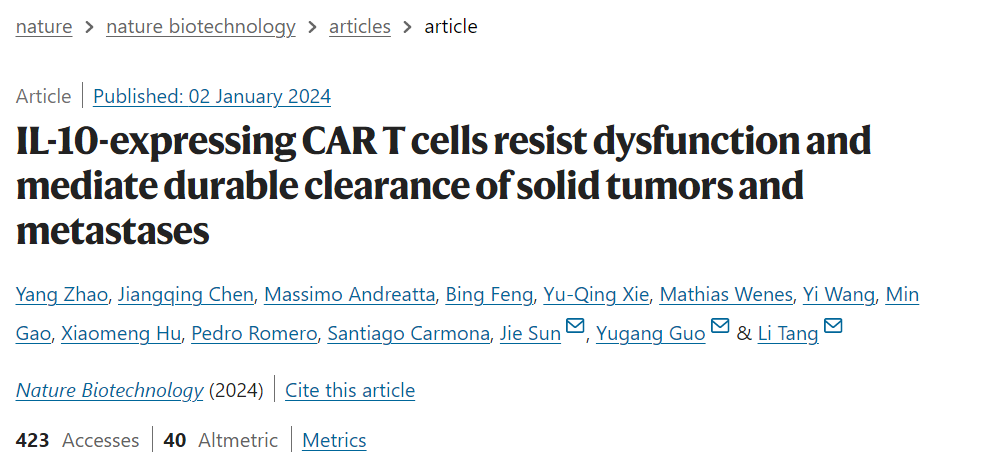
It is reported that the application of this technology in liquid tumors has achieved considerable success. In the ongoing investigator-initiated trials (IIT), it was previously disclosed that there have been at least...11NamePatients with relapsed or refractory lymphoma or relapsed or refractory acute leukemia achieved complete remission through this technology, with a success rate of nearly 100%, and none of the patients experienced any adverse effects.Common side effects of CAR-T therapy, such as significant cytokine storms or neurotoxicityThe company's official account provides detailed introductions for almost every case of CR.
This article will provide a brief introduction to this metabolism-enhanced CAR-T technology.
How Does IL-10 CAR-T Create a Metabolically Favorable Environment?
Metabolic fitness is essential for T cell survival and function.
Among them, the exhaustion of T cells is related to mitochondria, which control metabolism. Mitochondrial dysfunction caused by mitochondrial depolarization and oxidative stress enhances the phenotypic and epigenetic exhaustion programs of tumor-infiltrating T cells.
Moreover, the weakening of mitochondrial oxidative phosphorylation (OXPHOS) further suppresses T-cell proliferation and promotes exhaustion.
In earlier studies, CAR-T generally required interleukins such as IL-2 or IL-15 to enhance metabolic and antitumor immunogenicity. Here, however, the researchers used IL-10.
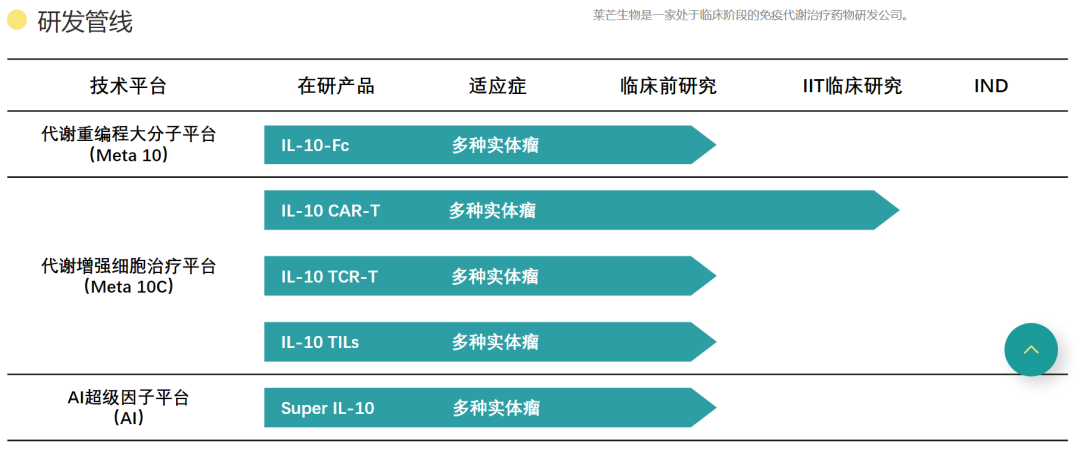
In earlier studies by the team, it was found that administering IL-10-Fc fusion protein in vivo could reprogram the OXPHOS (oxidative phosphorylation) metabolism of T cells within tumors, restoring their proliferative potential and cytotoxic activity, and enhancing mitochondrial respiration capacity.
This concept was eventually applied to cell therapies such as CAR-T. By designing a CAR-T, TCR, or TILs therapy capable of secreting IL-10-Fc, the exhaustion of T cells in these therapies can be avoided. Layman Biotech's pipeline is indeed designed this way. Moreover, since the company collaborated with XtalPi during its establishment, AI drug discovery has also been integrated into this technology platform.
Professor Tang Li's research started with how to improve HER2 CAR-T. The infusion of unmodified HER2 CAR-T failed to control established solid tumors, due to the dysfunction of T cells caused by the tumor microenvironment on solid tumors.
So, there are two approaches to improving HER2 CAR-T next:One is the combination of HER2-CAR-T and IL-10, and the other is to design a HER2-CAR-T that can directly secrete IL-10.From a design perspective, the researchers adopted a strategy based on the second-generation 41BB co-stimulatory CAR-T, adding a cleavable 2A peptide to the CD3ζ tail and attaching mouse IL-10, enabling high levels of IL-10 secretion in vivo. (As shown in the figure below)
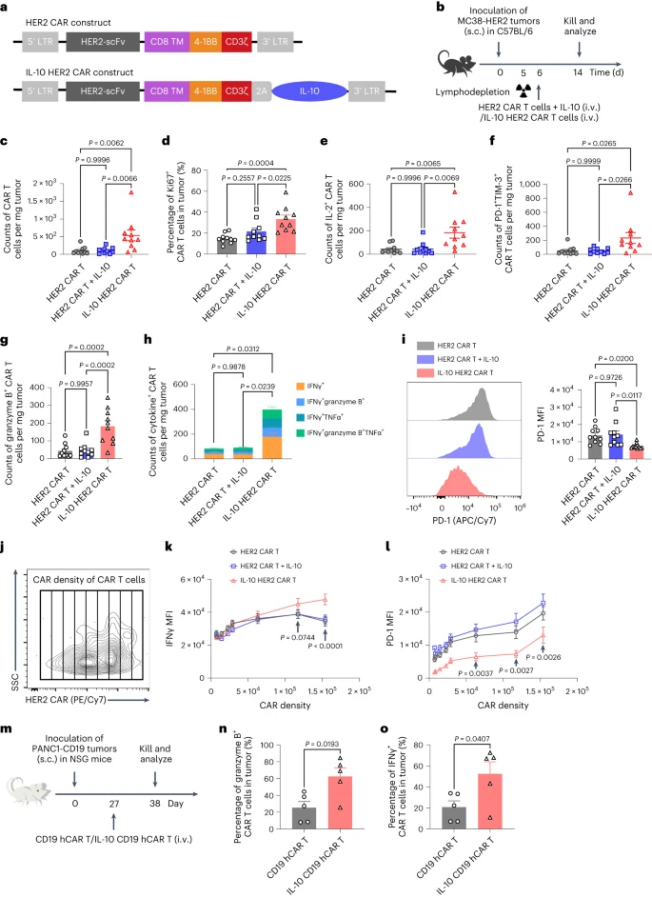
In contrast, the combination therapy of IL-10+HER2 CAR-T outperforms HER2 CAR-T monotherapy in reactivating exhausted CAR T cells. The density heterogeneity of IL-10-secreting CAR-T corresponds to a significant disparity in IL-10 levels. This suggests that IL-10 secreted by CAR-T may naturally accumulate within the tumor region, whereas intravenously administered IL-10 is not as efficient.Therefore, combination therapy is not as effective as HER2 CAR-T secreting IL-10.
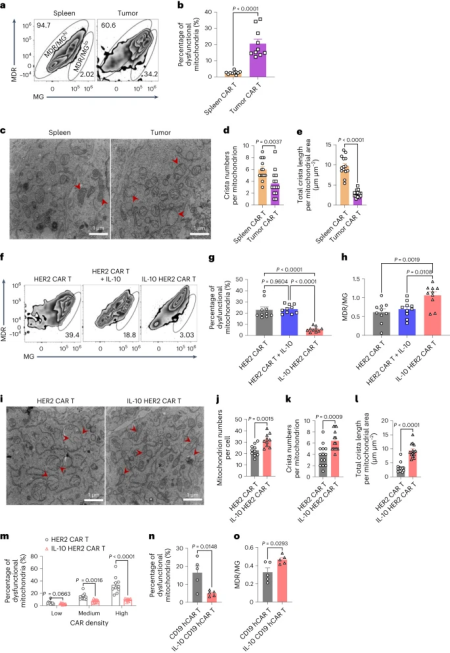
Moreover, CAR T cells expressing IL-10 are able to maintain mitochondrial fitness. The research team observed mitochondrial structures in both CD19 CAR-T and HER2 CAR-T in two separate groups. Results commonly showed that antigen stimulation might cause mitochondrial dysfunction in CAR T cells, while the expression of IL-10 could maintain mitochondrial fitness in CAR T cells. (As shown in the figure below)
Metabolomics research revealed significant differences in metabolism between IL-10-HER2-CAR-T and conventional HER2 CAR-T: intratumoral IL-10 HER2 CAR T cells showed significantly increased levels of phosphoenolpyruvate, an intermediate in pyruvate production, and succinate, an intermediate in the tricarboxylic acid cycle. This indicates that HER2 CAR-T cells secreting IL-10 indeed reprogrammed the oxidative phosphorylation of tumor-infiltrating T cells. This reprogramming is characterized by dependency on the mitochondrial pyruvate carrier (MPC), and CAR-T cells secreting IL-10 also performed better than the original CAR-T at the transcriptional level.
Interestingly, the researchers also found that,This metabolism-enhanced IL-10 CAR-T cell can also induce stem cell-like immune memory responses: After researchers reintroduced tumor cells into the treated mouse models, these cells were unable to reconstruct tumors or show any malignancy. Therefore, this type of CAR-T is also expected to perform better in terms of persistence and preventing recurrence. (As shown in the figure below)
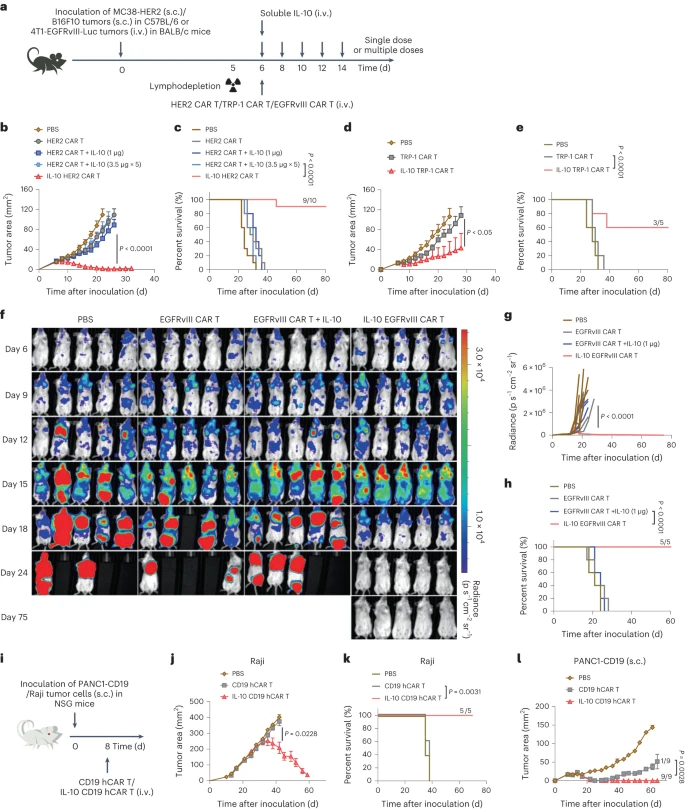
Overall, the study provides a unique solution for the application of CAR-T in solid tumors from the special perspective of metabolic enhancement. The next step for the team may be to reduce costs, as CAR-T secreting IL-10 requires only 5% of the traditional dose to achieve the same therapeutic effect, which also implies a reduction in both process and time. Patients can have their blood drawn on the first day and receive the CAR-T product quickly by the second day.
Moreover, in terms of safety, the secreted IL-10 may have a minimal effect on the expansion or activation of CAR T cells, thus posing a lower risk of inducing systemic toxicity. Therefore, the safety aspect can be clinically validated to determine if it is superior to traditional CAR-T therapies.
Reference Source:
The tweet is used to convey knowledge. If there are any questions about copyright, etc., please contact PharmaExpress within 30 days of the publication of this article.
Original content is prohibited from being reproduced on other platforms without authorization.
Questions can be sent.Email to yong_wang@pku.edu.cn for more information.
©2021 PharmaExpress. All rights reserved.