$320 Million Bet: IL-15 Agonist N-803 Nears Breakthrough with FDA Resubmission

ImmunityBio
Developer of Immunotherapy Products
Recently, Oberland Capital reached a $320 million agreement with ImmunityBio, including $300 million in royalty financing and $20 million in equity investment.
According to the press release, by the close of December 29, 2023, ImmunityBio had received total proceeds of $210 million, including $200 million in royalty-backed financing and $10 million in equity investment. An additional $100 million in royalty-backed financing will be contingent upon whether Anktiva (N-803) receives approval from the U.S. FDA.
N-803 Resubmits for Approval, Reaching the Critical Step Again; Oberland Capital’s High-Profile Entry Shows Strong Confidence in N-803’s Future Potential. With CMC Issues Resolved, Whether N-803 Can Make Further Progress Is Worth Anticipating.
IL-15 Target: Multi-functional Anti-tumor Cytokine
IL-15 is a T-cell growth factor, primarily secreted by monocytes and macrophages. Its mRNA is expressed in various cells and tissues in the human body, such as the heart, lungs, kidneys, muscles, and placenta.
IL-15 has biological functions similar to IL-2. IL-15 stimulates the activation and proliferation of T cells by sharing the γc receptor subunit with IL-2. The anti-tumor properties of IL-15 arise from its stimulatory activity on CD8+ effector T cells. Additionally, IL-15 can activate NK cells, NKT cells, and γδT cells, and induce the proliferation and differentiation of B lymphocytes, as well as increase immunoglobulin secretion. Therefore, IL-15 targeted drugs are also referred to as the new generation of anti-cancer breakthrough.
However, unlike IL-2, IL-15 does not induce apoptosis in activated T cells, can maintain the survival and homeostatic proliferation of memory T cells, does not expand Treg cells, and additionally, IL-15 has no effect on vascular endothelial cells, thus it does not trigger systemic toxic side effects.
IL-15 Monoclonal Antibody: An Urgent Need for Breakthrough
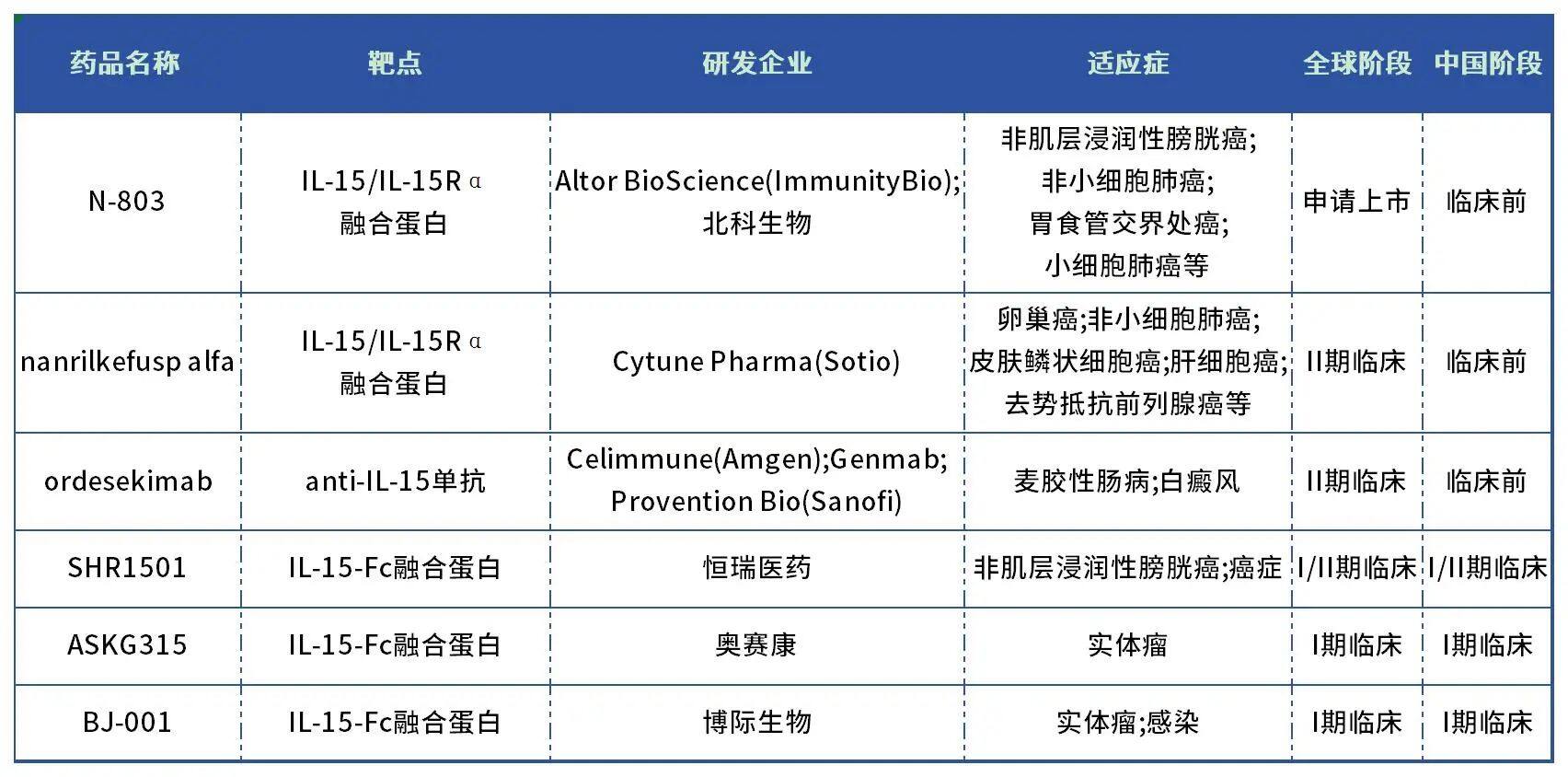
Currently, no IL-15 monoclonal antibody drugs have been approved for marketing globally. The first IL-15 agonist, N-803, was rejected by the FDA due to CMC issues, and ImmunityBio has resubmitted the BLA application to the FDA. Nanrilkefuspalfa was discontinued due to limited efficacy. In China, companies such as Hengrui Medicine, Aosaikang, and Boji Biotechnology are currently conducting research on IL-15.
Table: Global Partial IL-15 Monoclonal Antibody Research Landscape
Data Source: Yaoke Data
(1)N-803(Anktiva)Developed by ImmunityBio, it is a high-affinity IL-15 immunostimulatory fusion protein that promotes the proliferation and activation of NK cells and CD8+ T cells without activating Treg cells. N-803 is under development for multiple tumor indications, including non-muscle invasive bladder cancer, colorectal cancer, and pancreatic cancer.
N-803 completed an open-label, multicenter Phase 3 study—QUILT3.032—in 2022, which aimed to explore the efficacy of intravesical BCG+N-803 in BCG-unresponsive high-grade NMIBC (non-muscle invasive bladder cancer) carcinoma in situ (CIS) cohort and papillary lesion cohort. In the CIS cohort, the study enrolled 81 patients, with a CR rate of 72%. The median duration of response for 3-month responders was 24.1 months, and 60% of patients maintained CR for over 18 months. In the papillary lesion cohort, the study included 73 patients, with 12-month and 18-month disease-free survival rates of 57% and 53%, respectively.
Given the excellent data from QUILT3.032, ImmunityBio submitted an application for market approval to the FDA in 2022. However, it was rejected by the FDA in May 2023 due to deficiencies found during the pre-approval inspection of its third-party contract manufacturer. The FDA stated that resolving the manufacturing issues and updating the safety and efficacy data would allow for resubmission of the application.
In October 2023, the FDA accepted the resubmission of the Biologics License Application (BLA) for N-803 (Anktiva) in combination with Bacillus Calmette-Guérin (BCG), with a PDUFA date of April 23, 2024. Four months later, if N-803 is successfully approved, it will become the world's first IL-15 monoclonal antibody.
In addition to NMIBC, N-803 has also demonstrated certain therapeutic potential in pancreatic cancer. At the 2022 ASCO GI, ImmunityBio disclosed Phase II data of N-803 in combination with standard-of-care chemotherapy, albumin-bound paclitaxel, and PD-L1 t-haNK as a third-line treatment for pancreatic cancer. PD-L1 t-haNK cells are a human-derived allogeneic NK cell line engineered to express chimeric antigen receptors (CAR) targeting PD-L1, originating from NantKwest's proprietary NK-92 (aNK) master cell bank. For patients who had received at least two prior lines of therapy for pancreatic cancer, the mOS of this regimen reached 6.3 months, doubling the historical data. In terms of safety, grade 3 or higher adverse events mainly included anemia, neutropenia, and thrombocytopenia.
(2)nanrilkefuspalfa(SOT101) is a subcutaneously administered IL-15 superagonist fused with the sushi+ domain of the IL-15 receptor α chain, which activates both innate and adaptive immune responses, expands the population of active NK cells and T cells, achieving the effect of killing tumor cells.
On October 13, 2023, SOTIO Biotech announced that it would halt the clinical trials of the IL-15/IL-15Rα fusion protein nanrilkefusp alfa as a monotherapy and in combination with pembrolizumab and cetuximab. The interim clinical data for nanrilkefusp alfa showed insufficient efficacy, which does not support further development in larger randomized trials for these specific indications and combinations. No significant safety issues were identified in any of the trials.
(3)SHR-1501SHR-1501 is a self-developed and intellectual property-owned interleukin-15 (IL-15) fusion protein by Hengrui Medicine. It can stimulate the proliferation of T cells, B cells, and NK cells in the body, playing a role in mobilizing the immune system to eliminate foreign substances (such as tumors). In March 2022, SHR-1501 received the "Drug Clinical Trial Approval Notice" issued by the National Medical Products Administration, approving the initiation of a Phase I/II clinical study involving dose escalation and dose expansion for SHR-1501 injection as monotherapy or combined with Bacillus Calmette-Guérin (BCG) bladder instillation in the treatment of non-muscle invasive bladder cancer (NMIBC).
(4)ASKG315ASKG315 is a recombinant human interleukin-15 prodrug-Fc fusion protein with independent intellectual property rights developed by Aosaikang. Modified through the SmartKine® technology platform, it avoids common issues of traditional cytokines such as excessively short half-life and high toxicity, thereby achieving better drug-like properties. In June 2022, ASKG315 received the clinical trial application acceptance notice.
(5)BJ-001It is the world's first tumor-targeted IL-15 fusion protein independently developed by Boji Biotech with global intellectual property rights. Its structural domain contains targeting molecules that target tumor cells with high expression of integrins such as αvβ3, αvβ5, and/or αvβ6. The IL-15 structure can bind to the IL-2/15Rβγc receptor complex expressed on immune cells (especially NK and T cells), activating the immune system and killing tumors.
Summary
IL-15 is a promising target for cancer and autoimmune diseases, and N-803 is the most promising IL-15 product. Despite being rejected by the FDA, after resolving the CMC issues and resubmitting the application, it is expected to be approved for marketing in 2024, earning the title of "the first." Nanrilkefusp alfa’s development was halted at the end of 2023 due to efficacy concerns. In China, Hengrui Medicine, Aosaikang, and Boji Biotechnology are also catching up, with their respective products all currently in Phase I clinical trials.
Looking forward to global pharmaceutical companies exploring more drug combinations and therapy combinations, bringing new hope to the field of cancer treatment.

Editorial Responsibility: Pea Shooter
Disclaimer: The views expressed in this article are solely those of the author and do not represent the position of Yaozhi Network. We welcome exchanges and supplements in the comment area; if you need to reproduce, please be sure to indicate the author and source of the article. If it involves the content, copyright, and other issues of the work, please leave a message on this platform, and we will handle it promptly.