

Boomics Therapeutics Files for IPO Following $4.165B BD Deal with Novartis

Novartis
Drug Development and Manufacturing
Argo
RNAi Drug Developer
At the very start of 2024, cross-border BD transactions for innovative drugs in China once again exploded.
On the morning of January 8, Argo Biopharma, a rising star in China's small nucleic acid drug industry located in Zhangjiang, Shanghai, announced its first cross-border pipeline deal since its establishment. The agreement was signed with multinational pharmaceutical company Novartis. Under the terms of the agreement, Argo Biopharma granted Novartis the overseas rights to a cardiovascular project currently in Phase 1/2a clinical trials, the global rights to another cardiovascular project in Phase 1 clinical trials, and options for up to two additional cardiovascular projects. The upfront payment for this deal is $185 million, with a total potential value of up to $4.165 billion. With this, since the beginning of the new year, innovative pharmaceutical companies in China have disclosed six major cross-border business development (BD) deals, repeatedly breaking records for total transaction amounts.
In 2021, Argo was founded by several top-tier scientists in the field of small nucleic acid drug development. It quickly grew into one of the most prominent small nucleic acid drug companies in China, successively establishing over 20 R&D pipelines covering a variety of diseases such as cardiovascular conditions, rare diseases, central nervous system disorders, viral hepatitis, and metabolic diseases. Among these, four investigational drugs have entered clinical trial stages, especially the novel hypertension drug targeting AGT, which boasts globally leading progress in its development.
"For companies we are optimistic about, making an investment decision may only take one minute on stage because we have already spent a decade clarifying the market space of niche industries, technological breakthroughs, targets, talent deployment, and more," Qiang Jing, partner at Apricot Capital, told VCBeat. In April 2021, during the angel round of financing for Argo Biopharma, Apricot Capital exclusively invested in this new company. Qiang Jing believes that the current business development (BD) boom is an inevitable result of value investing. "However, BD outcomes should not guide investments," he emphasized. "Trends will always pass, but the laws of industrial development and the logic of value-creating investments remain relatively certain."

Qiang Jing, Managing Partner of Apricot Capital (Source: Photo provided by the interviewee)
VCBeat noticed that, among the six BD deals in the first week of the New Year, four were completed by companies invested in by Apricot Capital.In addition to Argo's BD deal, on January 2, two portfolio companies of Xingze Capital, Yilian Biotech and Allorion Biotech, announced that Yilian Biotech licensed its ADC drug candidate YL211 targeting c-MET to Roche, while Allorion Biotech licensed a novel allosteric inhibitor targeting EGFR L858R mutation to AstraZeneca. A few days later, on January 5, Allorion Biotech made another announcement, licensing ARTS-021, a potential best-in-class selective CDK2 inhibitor, to Avenzo.
Interestingly, whether it is Argo, or Yilian Biotech, or Anrui Biotech, Xingze Capital has joined as the leading investor in the first round.The model of incubation investment and scientist/entrepreneur startups is becoming a vital source of high-quality innovative drug resources in China, as well as a prominent "eye-catching" label for forward-thinking investors like Xingze Capital.
Under the Spotlight of Innovative Drug BD
"Fighting a wealthy war is different." The news of Argo Biopharma's deal with Novartis has reignited the pharmaceutical investment community's enthusiasm for innovative drugs.
Over the past nearly 10 years, venture capital has continued to flow into innovative drugs, making it possible for domestic startups to build globally competitive drugs under research. In the first half of 2023, the role of China's innovative drug industry in global BD transactions shifted from being primarily buyers to mainly sellers, with innovation gradually gaining recognition from leading pharmaceutical companies across various subfields.
According to the "2023 China Pharmaceutical Enterprise BD Transaction Report" released by VCBeat, as of December 28, the total amount of China's pharmaceutical BD transactions in 2023 was $50.59 billion, with a total of 124 transaction events. Although compared to 2022, the number of BD transactions by innovative pharmaceutical enterprises in China decreased by 76, a year-on-year drop of 38%, the total transaction amount for the whole year increased by $14.73 billion, a year-on-year growth of 41%. Of the total $50.59 billion in transactions, $42.9 billion came from outbound licensing deals, accounting for 84.2%.
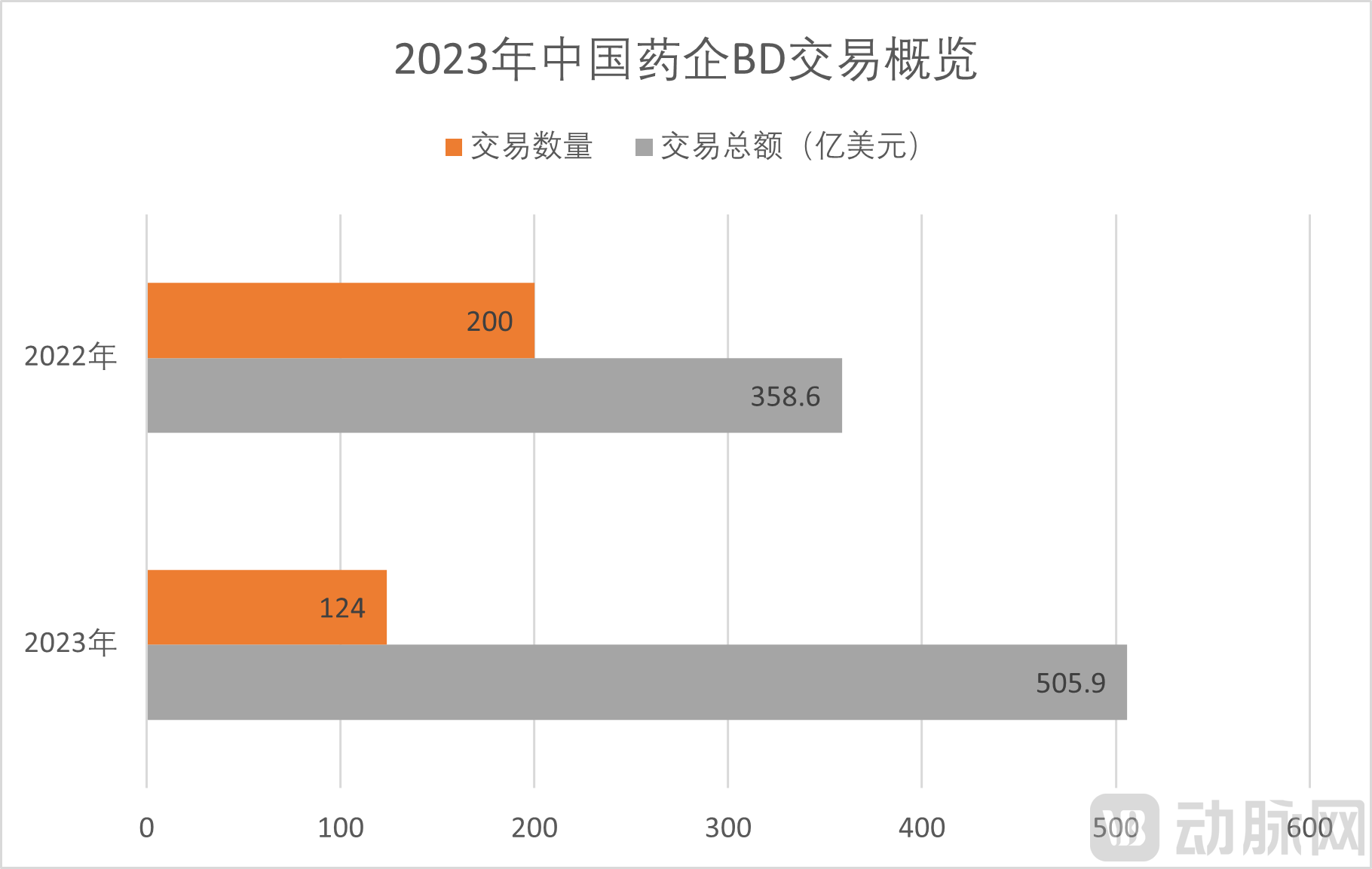
BD Status of Innovative Pharmaceutical Companies in China from 2022 to 2023 Data Source: VCBeat
Since 2023, the BD transactions of innovative pharmaceutical companies in China have been characterized by large total amounts and high frequency.According to the "2023 China Pharmaceutical Enterprises BD Transaction Report," in 2023, there were 18 large-scale BD licensing deals exceeding US$1 billion. According to VCBeat statistics, as of 2024, there have already been four major transactions exceeding US$1 billion. Since 2023, multiple innovative drug companies in China have consecutively completed several pipeline licenses. For instance, Duality Biologics disclosed four BD transactions, while companies like Yilian Biotech and Xennovate Bio disclosed three each, and RiboBio and Allorion Pharma successively disclosed two BD transactions.
In a sense, BD has become the new normal for the operation of innovative pharmaceutical companies in China.
In previous news, VCBeat had noticed that the investment institutions behind domestic innovative pharmaceutical companies active in the global BD transaction market showed a clear trend of concentration towards the top players. Institutions such as Apricot Capital, Lilly Asia Ventures, Hillhouse Capital, Legend Capital, Orbimed, and Huagai Capital have completed over half of the representative transactions through their invested projects. Most of these top-tier institutions provide accessible assistance in the early stages of project formation, either by investing in shares or directly participating in incubation.
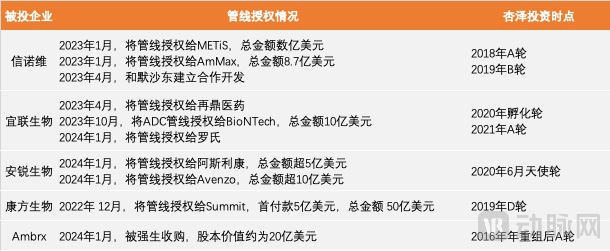
Recent BD Transactions of Apricot Capital's Portfolio Companies Data Source: VCBeat Database
Among them, since 2023, the innovative drug companies invested in and incubated by Apricot Capital have successively completed 10 pipeline BD licensing deals and 1 equity acquisition, with a cumulative transaction value exceeding 10 billion US dollars, making it the most active investment institution in terms of BD transactions among its portfolio companies. Qiang Jing pointed out that it is extremely rare for domestic innovative drug companies, especially those in niche fields that have only been established for a short time, to complete multiple transactions in the global BD market within a short period, and even achieve star deals in popular tracks. The core requirement behind this is that the company itself possesses world-leading technical strength. The winning formula at the negotiating table lies in the foresight of early movers who accurately grasp the direction and the unbeatable speed of a knowledgeable team.
The aforementioned companies, Yilian Biologics and Argo Biopharma, were both established after 2020. However, with world-class, even Best-in-Class (BIC) technology platforms, they have rapidly grown into leading enterprises in China’s ADC and siRNA fields, boasting a rich pipeline and excellent data, which has allowed them to stand out among numerous innovative pharmaceutical companies.
In the case of Argo Biopharma, the sequence design, modification, and safe and efficient delivery of small nucleic acid drugs are recognized technical challenges for this highly anticipated class of drugs. At this stage, the world's leading small nucleic acid drug companies have been able to continuously develop clinically valuable small nucleic acid drugs precisely because they have mastered powerful nucleic acid design and modification platforms as well as delivery platforms. The core team of Argo Biopharma has rich development experience and has mastered the key technical points in areas such as the GALNAC technology platform, nucleic acid sequence design, and modification, thereby advancing product development rapidly and efficiently. "In addition, small nucleic acids have relatively high drug-like properties and offer significant therapeutic advantages and market potential, which is their greatest strength," said Qiang Jing.
"Of course, cooperation is a process of mutual need. As long as the needs match, everything else can be resolved through negotiation." In Qiang Jing's view, for the biopharmaceutical industry, product data is undoubtedly the most important factor to consider. However, as a professional investment institution, it can act as a liaison to establish communication between innovative pharmaceutical companies and multinational pharmaceutical corporations. "Investment institutions can assist companies from a market perspective in determining the best timing for business development (BD), the optimal mode of cooperation, and, when necessary, help companies secure the best terms in agreements," Qiang Jing emphasized. "However, it should be particularly noted that capital should not overstep its bounds but instead provide support in the background."
The Survival of the Fittest Will Accelerate
VCBeat noticed that the deal between Argo Biopharma and Novartis marks the third nucleic acid drug BD transaction reached between China's innovative pharmaceutical companies and multinational pharmaceutical enterprises since the end of last year. It is reported that Novartis, the final buyer, was not the only multinational pharmaceutical enterprise interested in acquiring Argo Biopharma’s small nucleic acid assets. Following the global popularity of bispecific antibodies and ADC drugs, people have now turned their attention to small nucleic acid drugs.
"In 2024, ADCs will continue to be a hot topic in the global pipeline BD market. As more mature R&D and clinical data become available, transaction records are expected to reach new highs." When discussing trends in innovative drug pipeline BD, Qiang Jing appears quite optimistic. "Additionally, we have noticed that blockbuster deals worth billions of dollars are starting to emerge in the siRNA and PROTAC drug fields. This indicates that a peak period for siRNA and PROTAC BD transactions lasting about three years, from 2024 to 2026, is on the horizon."
More importantly, the rising tide of pipeline BD fever has brought significant changes to new drug development in China.
On the one hand, the funding sources for China's innovative drug industry will undergo structural changes."BD is changing the competitive landscape and intensifying the survival of the fittest," Qiang Jing pointed out.
In the future, the funding sources for innovative pharmaceutical companies in China will shift from the past decade's 80% from venture capital institutions and 20% from government investment promotion, to 40% from BD transactions with multinational pharmaceutical companies, 40% from venture capital institutions, and 20% from government investment promotion. This structural change in funding sources will also alter the survival path of innovative pharmaceutical companies. In the past, due to the differing preferences, philosophies, and levels of expertise of venture capital institutions, judgments could vary, leading to a relatively dispersed distribution of invested funds, allowing various types of innovative pharmaceutical companies to potentially secure funding.
However, the BD needs of multinational pharmaceutical companies are relatively concentrated. "In my opinion, less than 3% of innovative drug companies have the ability to obtain 40% of the funds from multinational pharmaceutical companies' BD," Qiang Jing pointed out. Therefore, the structural change in the funding sources of the innovative drug industry may further intensify the survival of the fittest in the industry.
Of course, as for specific companies and pipelines, how to carry out BD still needs to be determined based on each company’s situation. Take the timing of BD as an example—there is no standard answer to this question. If a company has a strong technology platform, manageable scientific risks related to the target, sufficient funding to support development into later stages, a huge market space for the product, and an excellent competitive landscape, it can choose to develop the product to a relatively mature stage, such as Phase 2 or even Phase 3 clinical trials, before considering BD. However, if the scientific risks of the product are relatively high, funding is limited, or the cost of late-stage clinical trials is enormous, opting for BD at an earlier stage may be more advantageous to help manage risks.
On the other hand, the cooperation model of innovative drug companies will become more diversified.In the past, running an innovative drug company was a relatively one-dimensional endeavor, with going public and building late-stage commercialization capabilities often being the primary goals. Qiang Jing believes that this situation will change in the future. Pipeline business development (BD) will continue to transform the survival logic of innovative drug companies, and improving efficiency through collaboration is gradually becoming a consensus. At the same time, the methods of collaboration will not be limited to pipeline BD.
For instance, co-development is gradually gaining popularity. Legend Biotech and Baili Tianheng have pioneered the way in co-development. As the R&D capabilities of biotech companies in China improve, more enterprises hope to enhance their R&D abilities through co-development, explore overseas markets, and achieve greater returns. However, co-development also implies a greater risk-sharing mechanism. Biotech companies should reasonably decide whether to engage in business development (BD) or co-development based on their own capabilities and the risk-reward profile of the product.
In addition, selling the entire company may also become an option for innovative drug companies. At the end of 2023, Gracell Biotechnologies took the first step in the complete equity transaction of a China-produced innovative drug company by selling the entire company. Of course, this is also a sign of the phased maturity of China's innovative drug ecosystem. As China’s industrial and commercial, as well as tax systems continue to improve, more companies will optimize resource allocation through industry mergers and acquisitions.
BD Changes "Beliefs"
With over a decade of experience in pharmaceutical investment, Qiang Jing and Xingze Capital have invested in many star projects. He has always adhered to three principles. First, investments are made strictly based on the development cycle of the industry, not the capital market cycle. Second, those chasing market trends will always be one step behind the market. Third, value creation is what drives market capitalization; no arbitrage transactions are pursued. "Xingze insists on contrarian thinking. We believe that 2024-2026 will also be an excellent time for investment," Qiang Jing told VCBeat. "Similarly, the current explosion in BD is merely a result, not guidance for investment. It’s hard for a VC to invest based on an outcome that has already occurred."
At this stage, the portfolio companies of Xingze Capital have achieved remarkable results in the global pipeline BD market, which once again validates Qiang Jing's investment logic and has led more and more people to start pondering the essence of new drug investment. "BD changes 'beliefs'," Qiang Jing joked.
In fact, the investment logic of Apricot Capital is very simple: through systematic research, discover valuable sectors and find capable companies within them. Qiang Jing has always known what he wants. According to Qiang Jing, Apricot Capital first conducted systematic research on several fields such as small nucleic acids and ADCs, and firmly believed that these areas present significant opportunities. "Internally, we have deeply studied the stage of technological development, the bottlenecks at each stage, future breakthrough points, targets, and early data," Qiang Jing told VCBeat. "Therefore, when Apricot Capital encounters excellent entrepreneurial teams, we can quickly assess the value and rarity of the projects and make difficult but correct decisions."
In making the investment decision for Argo, Xingze Capital was as decisive as ever. "Dr. Xu Bo Shu and the team’s experience, capabilities, and entrepreneurial spirit, combined with our deep understanding of the small nucleic acid field, made Xingze commit to investing in Argo at an early stage," Jing Qiang pointed out. He added that Xingze Capital's approach is consistent not only with Argo but also across ADC, PROTAC, gene therapy, and gene editing sectors.
"We also have a principle, which is 'helping without causing trouble'." Qiang Jing said that Apricot Zeal Capital focuses on early-stage investment, and its partners or senior employees all have experience serving as C-level executives in companies. During the process of a company’s development, they can provide necessary assistance in areas such as funding, management, talent acquisition, internal controls, and financing.
In fact, the belief in new drug research and development and investment has never changed. The goal is to create good drugs that can transform human life experiences. Both challenges and highlights serve to bring people closer to the essence.