Roche Inks $1.05B Deal with Yilien Biopharma for Global Development of c-MET ADC Candidate YL211

MediLink
Antibody-Drug Conjugates Developer

Roche
Oncology Drug Research, Development, and Manufacturing
▎Traceability
Suzhou, China, January 2, 2024 - MediLink Therapeutics Co., Ltd. ("MediLink"), today announced that it has reached a global collaboration and licensing agreement with Roche. The two parties will collaborate to develop YL211 ("c-MET ADC"), a next-generation antibody-drug conjugate candidate targeting mesenchymal-epithelial transition factor (c-MET), for the treatment of solid tumors.
According to the terms of the agreement, Roche will obtain exclusive global rights for the development, manufacturing, and commercialization of MediLink's YL211 project. MediLink will collaborate with Roche China Innovation Center (CICoR) to advance the YL211 project into Phase I clinical trials, after which Roche will take over further global development and commercialization. Roche will pay MediLink an upfront payment and near-term milestone payments totaling $50 million, along with potential development, regulatory, and commercial milestone payments of up to nearly $1 billion, as well as tiered royalties based on future global annual net sales.
On November 29, 2023, AbbVie announced the primary results of the single-arm Phase 2 LUMINOSITY trial, which evaluated the efficacy of its investigational therapy telisotuzumab-vedotin (Teliso-V) in treating patients with c-Met protein overexpression, epidermal growth factor receptor (EGFR) wild-type, advanced/metastatic non-squamous non-small cell lung cancer (NSCLC).
According to the trial results analyzed by Independent Central Review (ICR), the overall response rates for patients with high and medium c-Met expression were 35% and 23%, respectively. Additionally, other endpoints demonstrated meaningful clinical outcomes, including median durations of response of 9 months and 7.2 months, and median overall survival of 14.6 months and 14.2 months for patients with high and medium c-Met expression, respectively. The safety profile of Teliso-V was consistent with previous findings, with no new safety concerns identified. Adverse events associated with Teliso-V monotherapy were generally manageable and well-tolerated. AbbVie will continue patient enrollment in the TeliMET NSCLC-01 Phase 3 clinical trial and engage in discussions with global regulatory authorities regarding the potential for accelerated approval of the drug.
Approximately 85% of lung cancers are classified as NSCLC, and despite advancements in treatment, lung cancer remains the leading cause of cancer-related deaths worldwide in both men and women. C-Met protein overexpression is found in about 25% of patients with advanced EGFR wild-type NSCLC and is associated with a poor prognosis in these patients.
Telisotuzumab-vedotin (Teliso-V) is designed as VC-MMAE.
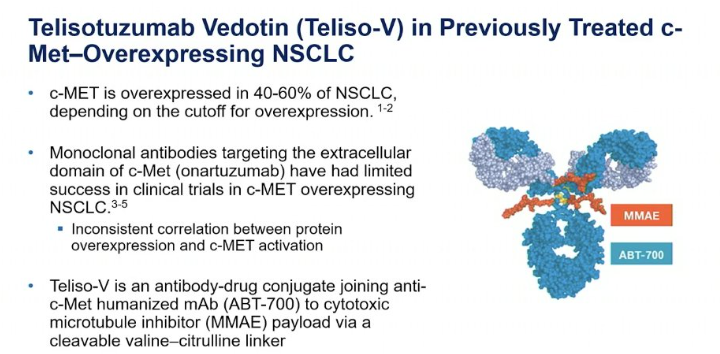
As for similar designs like EGFR MMAE, we haven’t observed better outcomes in lung cancer, even though some in vitro cell assays indicate higher EGFR expression compared to c-MET. However, mRNA data reveals that c-MET does exhibit an advantage over EGFR at the genetic level.
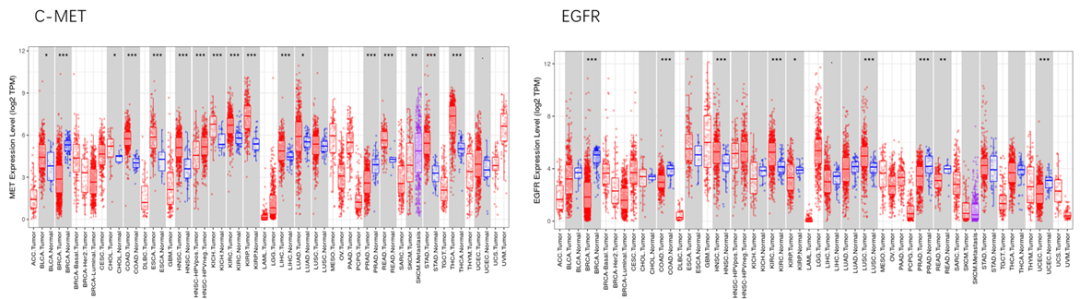
It is foreseeable that in the future, if c-MET is conjugated with toxins like camptothecin, it is likely to yield good results. AbbVie has already made strategic moves in this area.
The tweet is used to convey knowledge. If you have any questions about copyright, etc., please contact PharmaExpress within 30 days of the publication of this article.
Original content is prohibited from being reproduced on other platforms without authorization.
Questions can be sent.Email to yong_wang@pku.edu.cn for more information.
©2021 MediLink All rights reserved