

Astellas Receives Complete Response Letter from FDA for Zolbetuximab BLA Due to Manufacturing Deficiencies

Astellas
Pharmaceutical R&D Manufacturer
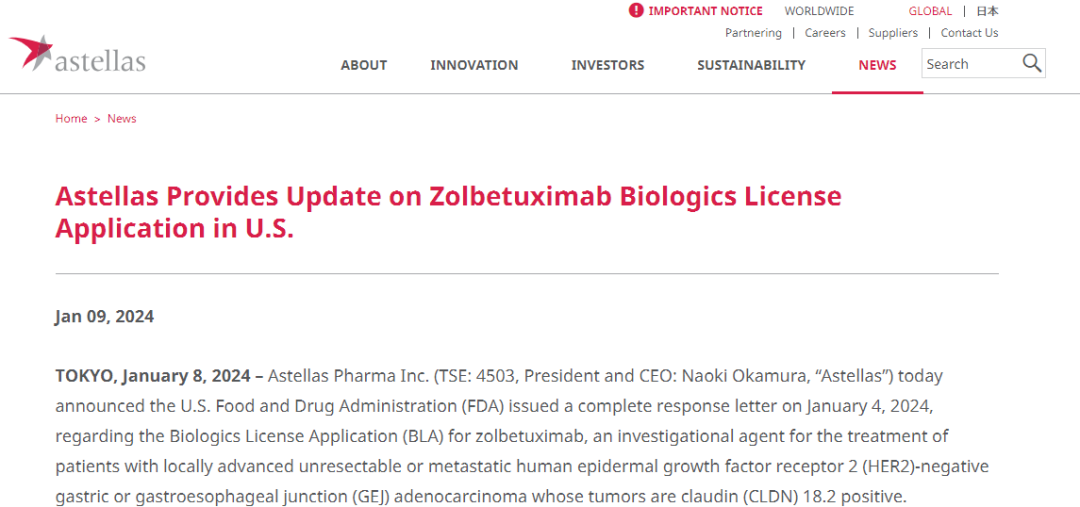
On January 9, Astellas announced,Received the Complete Response Letter from the FDA regarding the CLDN18.2 monoclonal antibody zolbetuximab's marketing application., Indications areFirst-line treatment for CLDN18.2-positive, HER2-negative locally advanced unresectable or metastatic gastric or gastroesophageal junction (G/GEJ) adenocarcinoma.
The FDA stated that due to unresolved defects at the third-party manufacturing plant,Cannot be approved before the PDUFA date of January 12, 2024Zolbetuximab Launched.The FDA has not yet approved zolbetuximab.No concerns were raised regarding the clinical data (including efficacy or safety), and no additional clinical studies were requested.
Zolbetuximab Marketing Application Journey
June 9, 2023Astellas Submits Marketing Application for CLDN18.2 Antibody Zolbetuximab in Japan for First-Line Treatment of Locally Advanced Unresectable or Metastatic HER2-Negative, CLDN18.2-Positive Gastric or Gastroesophageal Junction (GEJ) Adenocarcinoma.
July 6, 2023Astellas Pharma, Inc. announced on its official website that the Biologics License Application (BLA) for Zolbetuximab, its investigational IgG1 monoclonal antibody targeting CLDN18.2, has been accepted by the U.S. FDA and granted Priority Review. The indication is for first-line treatment of CLDN18.2-positive, HER2-negative locally advanced unresectable or metastatic gastric or gastroesophageal junction (G/GEJ) adenocarcinoma.
July 14, 2023, AstellasOfficial WebsiteAnnounced that the European Medicines Agency (EMA) has accepted the company's Marketing Authorization Application (MAA) for Zolbetuximab for regulatory review.
August 1, 2023Astellas Pharma, Inc. announced that the Center for Drug Evaluation (CDE) of the National Medical Products Administration (NMPA) in China has accepted the Biologics License Application (BLA) for Zolbetuximab, intended for the treatment of patients with gastric cancer or gastroesophageal junction (GEJ) adenocarcinoma.
About Zolbetuximab
Zolbetuximab is an IgG1 monoclonal antibody targeting the CLDN18.2, which can specifically bind to CLDN18.2 on the surface of tumor cells, thereby inducing antibody-dependent cellular cytotoxicity (ADCC), complement-dependent cytotoxicity (CDC), apoptosis, and inhibiting cell proliferation.
CLDN18.2 is a pan-cancer target that is highly expressed only in gastric epithelial cells in normal tissues but shows high expression in gastric cancer, pancreatic cancer, gallbladder and biliary tract cancer, esophageal cancer, and lung cancer. This characteristic has made CLDN18.2 another popular target following PD-1.
The new drug's marketing application is primarily based on the results of two Phase III clinical trials: the SPOTLIGHT study and the GLOW study.
The SPOTLIGHT trial evaluated the efficacy of Zolbetuximab combined with mFOLFOX6 (a combination chemotherapy regimen including oxaliplatin, leucovorin, and modified 5-fluorouracil) versus placebo combined with mFOLFOX6.
Results showed that, compared with the placebo combined with mFOLFOX6 group, the combination of zolbetuximab and mFOLFOX6 achieved statistically significant improvements in progression-free survival (PFS) and overall survival (OS). Specifically, compared with the placebo group, the combination of zolbetuximab and mFOLFOX6 reduced the risk of disease progression or death by 24.9%, reaching the primary endpoint of the study. The median PFS was 10.61 months in the treatment group and 8.67 months in the placebo group.
The study also showed that the combination of zolbetuximab and mFOLFOX6 significantly prolonged OS, reducing the risk of death by 25.0%. The median OS for the treatment group and the placebo group was 18.23 months and 15.54 months, respectively.
The GLOW trial evaluated the efficacy of Zolbetuximab combined with CAPOX (a combination chemotherapy regimen including capecitabine and oxaliplatin) compared to placebo combined with CAPOX.
The results showed that the Zolbetuximab group extended PFS by 1.4 months and OS by 2.2 months. Additionally, the objective response rates (ORR) for the two groups were 53.8% and 48.8%, respectively; the mDOR for the two groups were 6.28 months and 6.18 months, showing no significant difference.
In terms of treatment-emergent adverse events (TEAEs) during the treatment period, the incidence rates were similar between the two groups, with 47.2% in the zolbetuximab group vs. 49.8% in the placebo group, consistent with previous studies. The most common TEAEs during the GLOW study were nausea (68.5% vs. 50.2%), vomiting (66.1% vs. 30.9%), and decreased appetite (41.3% vs. 33.7%) in the zolbetuximab group compared to the placebo group.


Shiyao Group Biopharmaceutical Technology Platform and Pipeline Review
Overview of the Competitive Landscape for Popular ADC Targets in China