

Johnson & Johnson Agrees to $700 Million Settlement Over Talcum Powder Cancer Probe, Still Faces Over 50,000 Lawsuits

Johnson & Johnson
Healthcare Product Manufacturers, Health Service Providers
U.S. Eastern Time on January 8, Bloomberg News cited insider sources saying that Johnson & Johnson (NYSE: JNJ) has preliminarily agreed to pay approximately $700 million (equivalent to about 5 billion RMB) to resolve investigations by more than 40 U.S. states regarding the company’s baby powder. Johnson & Johnson is accused of misleading marketing for not warning consumers of potential health risks associated with the product's ingredients during the sale of its baby powder.
Informed sources stated that the settlement agreement would allow Johnson & Johnson to avoid potential lawsuits, which accuse the company of concealing the risk that asbestos in its talcum powder could lead to various cancers. Currently, representatives of Johnson & Johnson and the attorneys general of various U.S. states are still finalizing the specific terms of the agreement, but they have already reached a consensus on the approximate total compensation amount.
Investigations are still ongoing in multiple states.
Johnson & Johnson's spokesperson Clare Boyle did not immediately comment on the latest $700 million settlement reached on Monday (January 8) Eastern Time. However, according to the spokesperson for Florida Attorney General Ashley Moody, investigations into whether Johnson & Johnson's baby powder causes cancer are still ongoing across multiple U.S. states, and these investigations "have not yet reached a settlement agreement." Moody has been in charge of the investigation and settlement negotiations regarding Johnson & Johnson.
Bloomberg reported that the settlement is part of Johnson & Johnson's strategy to curb the growing number of lawsuits regarding its baby powder products, which focus on the company's concealment of the product’s health risks.
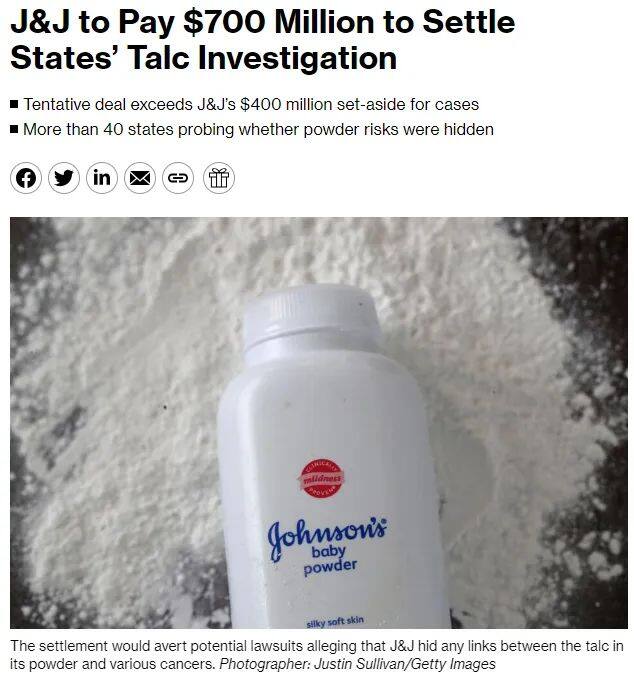
Screenshot from Bloomberg report
According to a filing submitted by Johnson & Johnson to the U.S. Securities and Exchange Commission (SEC) in October last year, 42 states in the United States and the District of Columbia have launched a "joint investigation into the marketing of the company's baby powder products." Several states, including Arizona and North Carolina, have requested further disclosure from Johnson & Johnson.
As of now, the U.S. states of Mississippi and New Mexico have filed lawsuits against Johnson & Johnson over the marketing practices of its baby powder.
But informed sources cited by Bloomberg said that the agreement Johnson & Johnson reached on Monday does not include lawsuits from Mississippi and New Mexico, as litigation in these two states against Johnson & Johnson is still ongoing, and consumers hope to negotiate for higher compensation. According to court documents, Mississippi wants Johnson & Johnson to be penalized for more than 6 million bottles of baby powder sold in the state from 1974 to the present that did not adequately warn of cancer risks. If the judge imposes a fine of $1,000 per bottle of baby powder under the state's law, this could result in Johnson & Johnson facing losses of up to approximately $6 billion.
Currently facing more than 50,000 lawsuits
Johnson & Johnson is the world's largest manufacturer of health care products, and its baby powder is one of its best-selling products. However, since 2014, the company has been embroiled in a prolonged legal battle due to allegations that its baby powder may cause cancer.
Bloomberg reported that Johnson & Johnson is currently facing up to 50,000 lawsuits. The majority of the plaintiffs are women suffering from ovarian cancer, while some are afflicted with mesothelioma (a cancer associated with asbestos exposure).
Consumers of Johnson & Johnson's baby powder previously claimed that executives at the company were aware as early as the 1970s that the product contained trace amounts of asbestos. Data compiled by Bloomberg showed that since 2014, at least a dozen juries have ruled on cancer lawsuits related to Johnson & Johnson’s talcum powder, involving compensation of more than $6.5 billion that the company was ordered to pay. However, some of the compensation was later reduced or overturned on appeal.
In 2018, a court in Missouri, United States, ruled that Johnson & Johnson must pay nearly $4.7 billion in compensation to 22 women who claimed that asbestos in the company's talcum powder was linked to their ovarian cancer. The judge involved in the case stated that Johnson & Johnson had "misrepresented the safety of these (talcum powder) products for decades." Afterward, Johnson & Johnson appealed the decision, but it was rejected by the Supreme Court.
Johnson & Johnson has long maintained that its talc products are not carcinogenic and that its baby powder has been sold for more than a century. The company has also won several related lawsuits in court, while some cases were dismissed before going to trial.
Under massive litigation pressure, Johnson & Johnson twice attempted to force previous talcum powder consumers into settlements by invoking bankruptcy law, but both efforts ended in failure.
The reporter of "Every Day Economic News" also noticed that Johnson & Johnson previously proposed to settle all current and future baby powder-related lawsuits in its subsidiary's bankruptcy filing for $9 billion, and the latest $700 million settlement agreement is part of that proposal.
Moreover, in 2020, Johnson & Johnson withdrew its talcum powder from the U.S. and Canadian markets due to declining sales. It replaced the baby powder with a cornstarch-based product and committed to ceasing the production of all talc-containing baby powders globally by the end of 2023.
The content on this website (including but not limited to text, images, and audio/video), except for reprints, is copyrighted by Time Online. Without written agreement authorization, reproduction, linking, reposting, or use in other ways is prohibited. Those who violate the above statement will be held legally responsible by this website. For reprinting by other media, websites, or individuals, please contact Mr. Ding of this website: news@time-weekly.com