

Fermion Secures IND Approval for FZ008-145, a Second-Generation Selective Nav1.8 Inhibitor for Non-Opioid Analgesia
Fermion
AI Drug Discovery Developer
January 8,National Medical Products Administration(NMPA) approved the IND application for FZ008-145, a pain pipeline product from AI Biotech Guangzhou Fermion Technology Co., Ltd. (Fermion, hereinafter referred to as "Fermion").
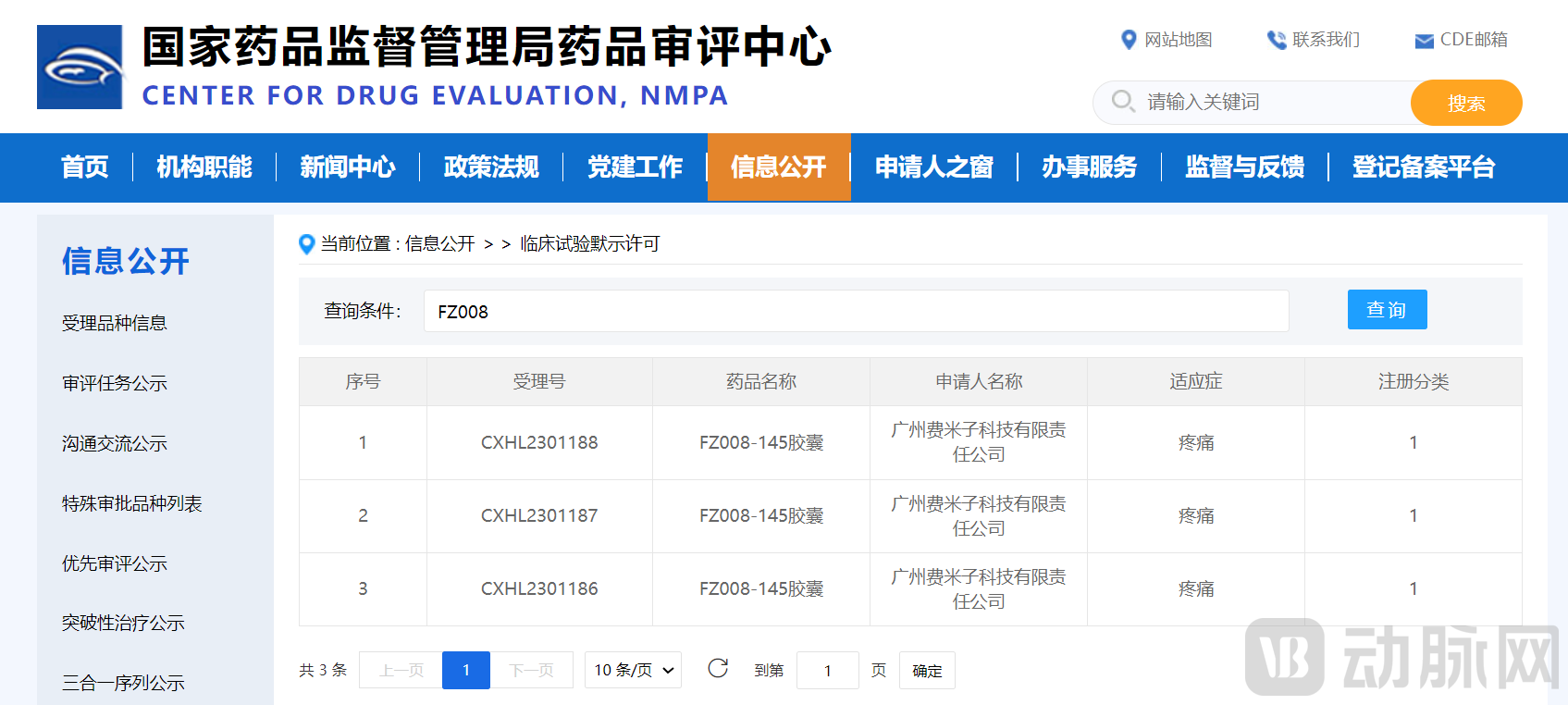
FZ008-145 is a highly selective second-generation Nav1.8 (voltage-gated sodium channel 1.8) inhibitor, offering the advantages of potent and non-addictive analgesia. Currently, the Nav1.8 target has been validated by five sets of clinical data for acute pain and one for chronic pain in proof-of-concept (POC) studies. In October 2023, Fermion signed an agreement with Joincare Pharmaceutical Group Industry Co., Ltd., granting the latter exclusive rights to FZ008-145, a self-developed novel analgesic drug, in Greater China, while retaining rights outside of Greater China.
In the field of non-addictive analgesics, Fermion currently has two candidate pipelines.Except for FZ008-145, the first-in-line pipeline FZ002-037 has completed Phase I clinical trials and is about to launch the Phase II Proof of Concept (POC) trial, being the second globally and the first in China targeting the same clinical drug.
Focusing on the non-addictive analgesic field, developing differentiated BIC/FIC products around early innovative targets
The "Report on the Development of Pain Medicine in China (2020)" pointed out that more than 300 million people in China are suffering from chronic pain, and this number is increasing at a rate of 10 to 20 million per year. Pain has become the third major health problem after cardiovascular and cerebrovascular diseases and cancer.
The pathogenesis of pain is relatively complex, leading to unsatisfactory outcomes for many treatment methods. Existing pain medications often have issues such as low tolerance, poor long-term safety, and potential drug abuse, with a dependency on opioid drugs observed in moderate to severe pain cases.
The core mechanism of opioid drugs is to reduce the transmission and perception of pain signals by binding to opioid receptors, providing pain relief in both the central and peripheral nervous systems. However, opioid receptors also exist in other parts of the central nervous system beyond the pain transmission pathways. Therefore, after using opioid drugs, these receptors in other areas are simultaneously stimulated, leading to various side effects, addiction, and subsequently, tolerance issues.
Since Fermion began operations in 2019, it has focused on laying out its new drug pipeline in the CNS (central nervous system) field.Relying on the self-developed Drug Studio AI drug discovery platform, with high target selectivity and tissue targeting as breakthroughs, reducing off-target effects and improving precise distribution in target tissues to enhance safety, and developing innovative BIC/FIC drugs with clear differentiation."Compared with other fields, the treatment options in the CNS field are limited. The existing drugs are mainly older ones that have been on the market for a long time, and there is an urgent need to improve their efficacy and safety, representing a huge unmet clinical demand," mentioned Dr. Deng Daiguo, founder of Fermion, during an interview.
"In addition, from a technical perspective, our research on the safety of CNS products at the underlying algorithms of the AI platform has undergone a long period of development and accumulation. We have unique algorithmic advantages, particularly in constructing target knowledge graphs, optimizing candidate compounds, and evaluating safety screenings. For ultra-high selectivity, we developed a molecular heterogeneous graph algorithm with higher prediction accuracy. For tissue targeting, we created a substructure heterogeneous graph algorithm based on stronger associations between structural information and physicochemical properties. These allow for the efficient screening of candidate molecules with outstanding target selectivity and tissue targeting, thereby enhancing..."Safety of Clinical Medication。Third, our R&D team members all have a background in CNS drug development, possessing a certain level of 'Know-how' and comprehensive capabilities in both preclinical and clinical development," added Dr. Deng Daiguo.
Currently,Fermion has laid out 4 CNS new drug pipelines, among which the fastest progressing ones, FZ002-037 and FZ008-145, are both focused on the non-addictive analgesic field.It is worth emphasizing that the two pipelines are respectively developed around the innovative analgesic targets SSTR4 and Nav1.8. Recently, there has also been exciting news regarding the development of innovative drugs based on the SSTR4 and Nav1.8 targets, bringing a glimmer of hope for new types of analgesics.
SSTR4 Agonist Clinical Progress Goes Smoothly, Expected to Bring New Therapy for Chronic Pain
FZ002-037, Fermion's leading non-addictive chronic pain pipeline, is a small molecule somatostatin receptor 4 (SSTR4) agonist. It is the second drug of its kind globally and the first in China to enter clinical trials, and is currently in negotiations for cooperation with multiple pharmaceutical companies at home and abroad. In March 2023, FZ002-037 completed the first dosing in Phase I clinical trials, and has now completed Phase I clinical trials.
SSTR4 is one of the five subtypes of SSTR (somatostatin receptor), highly expressed in the central nervous system and mediates potent analgesic and anti-inflammatory effects. As a novel pain target,SSTR4 Agonists Show Promise for Treating Chronic Neuropathic Pain, Inflammatory Pain, and Mixed Pain.
Compared with traditional opioid analgesics and non-steroidal anti-inflammatory drugs such as ibuprofen, FZ002-037 has three differentiated advantages: First, the novel non-addictive target SSTR4, for which POC validation clinical data has been obtained; Second, it mainly acts on peripheral nerve tissues, effectively enhancing drug safety; Third, it exhibits ultra-high subtype selectivity, reducing off-target side effects. Phase I clinical data shows that it has good pharmacokinetic properties and safety.
The SSTR4 agonist with the fastest clinical progress currently is Eli Lilly's LY3556050.In November 2023, Eli Lilly announced positive results from the proof-of-concept clinical trial (NCT04707157) of LY3556050 in diabetic peripheral neuropathic pain (DPNP) on Clinicaltrials.gov; simultaneously, Eli Lilly also announced the initiation of a Phase II dose-finding clinical trial of LY3556050 for the treatment of DPNP.
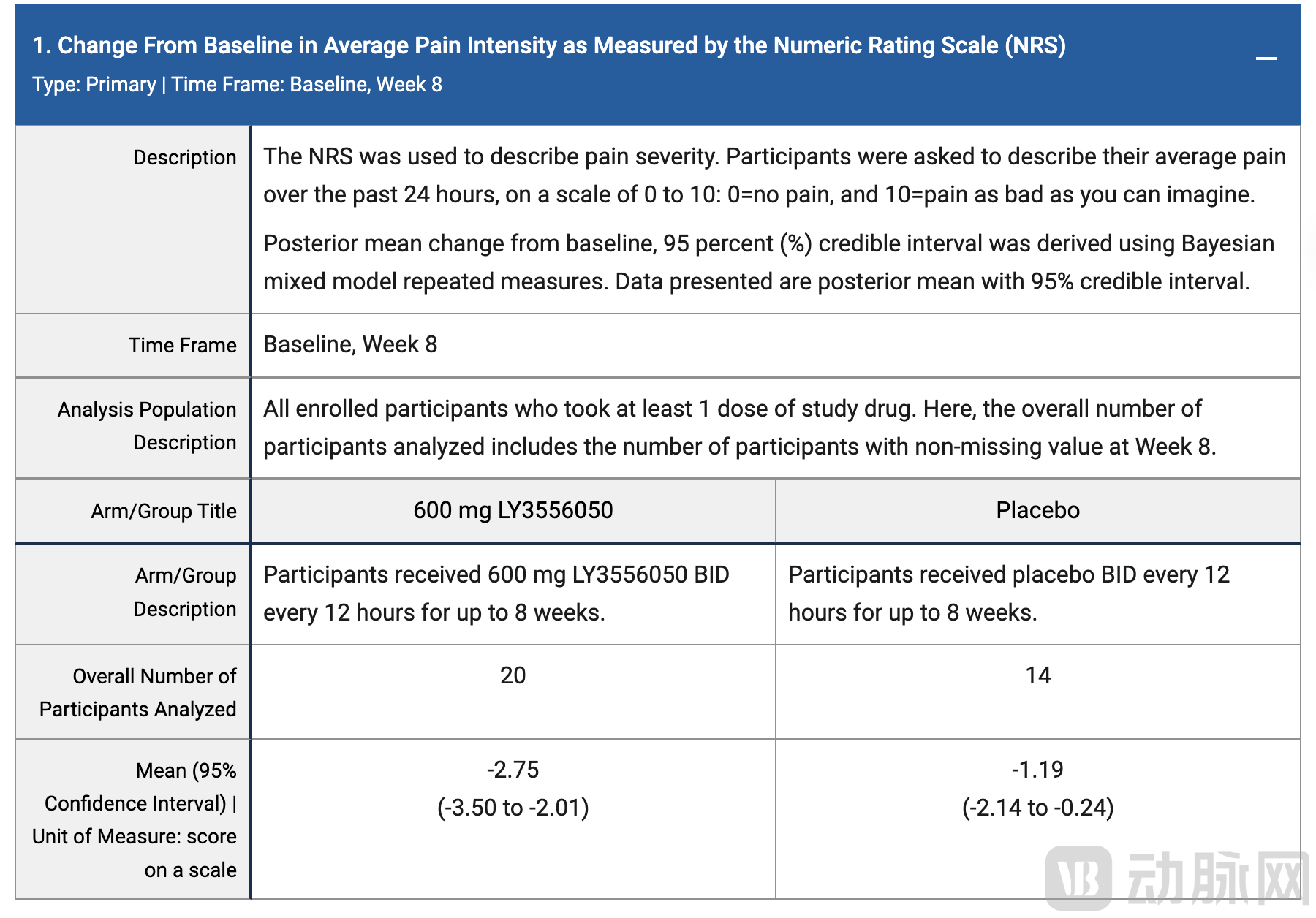
Data shows,The changes in NRS from baseline to Week 8 were -2.75 (-3.5 to -2.01) for the LY3556050 group and -1.19 (-2.14 to -0.24) for the placebo group, showing that the LY3556050 group had a statistically and clinically significant reduction in pain compared to the placebo group, offering a new therapeutic approach for neuropathic pain.
Nav1.8 Inhibitor Clinical Development Breakthrough, New Generation of Painkillers Research Sees Dawn
Fermion's FZ008-145, which has recently received IND approval, is the world's second and China's first highly selective second-generation Nav1.8 inhibitor. In addition to its safety and potent efficacy, it also exhibits excellent PK properties. Compared with the first-generation Nav1.8 inhibitors, it can provide better analgesic effects at a lower dose, avoiding side effects such as addiction.
Pain signal transmission relies on voltage-gated sodium channels (Nav) located on the cell membrane, and pain is treated by inhibiting abnormal sodium ion activity. The Nav family includes nine subtypes, with Nav1.8 and Nav1.9 being exclusively distributed in peripheral neurons and not involved in central nervous system-related activities, thus avoiding issues of addiction and potential side effects. Nav1.8 plays a crucial role in pain signal transmission within the peripheral nervous system, making it a primary selective target for pain treatment.
The second-generation Nav1.8 inhibitor with the most advanced progress currently is Vertex's VX-548. The phase 2 results of VX-548 for treating acute pain after abdominoplasty and bunionectomy were published in The New England Journal of Medicine. The data showed that the least-squares mean difference in SPID48 pain scores between the high-dose VX-548 group and the placebo group was 37.8 (95% CI: 9.2-66.4) in patients undergoing abdominoplasty and 36.8 (95% CI: 4.6-69.0) in patients undergoing bunionectomy, demonstrating excellent analgesic effects.
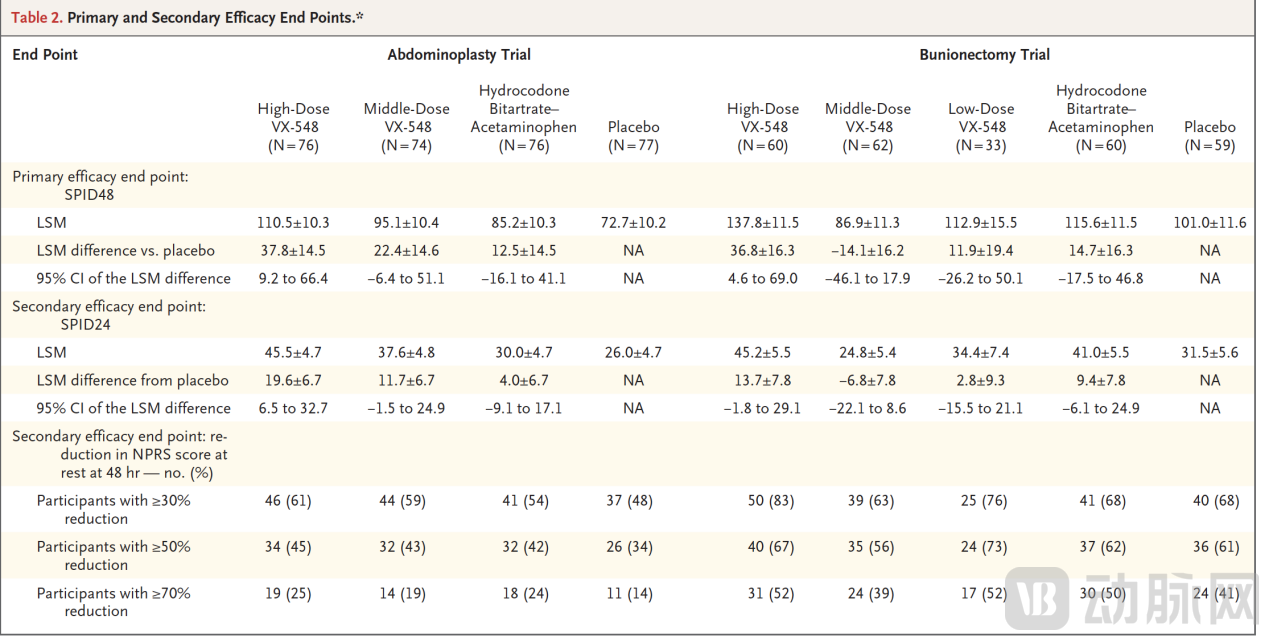 Source: N Engl J Med. 2023 Aug 3;389(5):393-405
In December 2023, Vertex announced positive results from the Phase II clinical study of VX-548 in treating diabetic peripheral neuropathy (DPN) and plans to initiate pivotal clinical trials in 2024. Meanwhile, the results of three pivotal Phase III clinical trials of VX-548 for acute pain are expected to be released in early 2024.
At present, the most effective acute analgesic is still opioid drugs, but their addictive side effects have led to strict clinical restrictions, resulting in a significant unmet clinical need. The breakthrough of Nav1.8 inhibitors is expected to fill this gap.
Overall, innovative drugs developed around SSTR4 and Nav1.8 have made significant progress. As research on novel analgesic targets continues to deepen, the drug development potential of SSTR4 and Nav1.8 is being increasingly validated.Fermion, which focuses on the development of non-addictive analgesic innovative drugs, has utilized its unique Drug Studio AI drug discovery platform to develop the SSTR4 agonist FZ002-037 and the second-generation Nav1.8 inhibitor FZ008-145. It has become one of the pioneers in China's innovative pain relief drug field, with an opportunity to claim a share of the billion-dollar pain medication market.