

Johnson & Johnson and Simcha Therapeutics Collaborate to Develop DL-18 Armored CAR-T Cell Therapies

Johnson & Johnson
Medical Device R&D and Manufacturer

January 10, 2023 / eMedClub News /--Recently,Simcha TherapeuticsAnnouncement of Cooperation with Johnson & Johnson (Johnson & Johnson) Company'sJanssen BiotechReach a licensing and option agreement.Johnson & Johnson willSimchaAnti-bait Interleukin-18(decoy resistant IL-18,DL-18) technology integrated into selectedCAR-TIn cell therapy candidate products.According to the terms of the agreement, Johnson & Johnson will be responsible for the development, manufacturing, and commercialization.DR-18Project of Enhanced Cell Therapy.SimchaWill receive an undisclosed upfront payment, potential option exercise fees, and milestone payments based on the development and commercialization process.

Cytokines are hormone-like proteins that control almost every aspect of immune function. Due to their profound biological effects,Cytokines not only "modulate" immune responses but can also activate potent anti-cancer programs in various immune cells.IL-18, as an immunoregulatory factor, can promote the transmission of inflammatory signals by interacting with the IL-18 receptor (IL-18Rα/IL-18Rβ), induce the secretion of IFN-γ, and significantly enhance Th1-type immune responses. Therefore,IL-18 Expression in CAR-T Cells Enhances Proliferation and Antitumor Activity, While Reducing the Required Dosage and Systemic Side Effects。IL-18 may also have broad activity against various types of tumors, including immunogenic "hot" tumors and "cold" tumors that are resistant to immunotherapy.
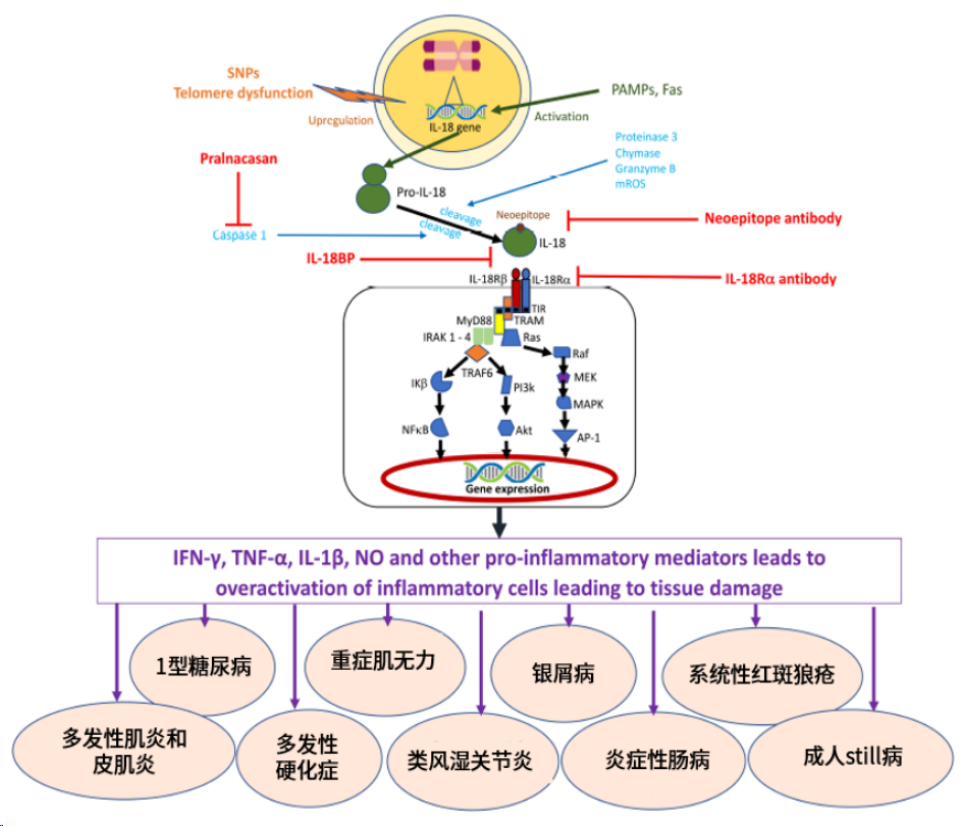
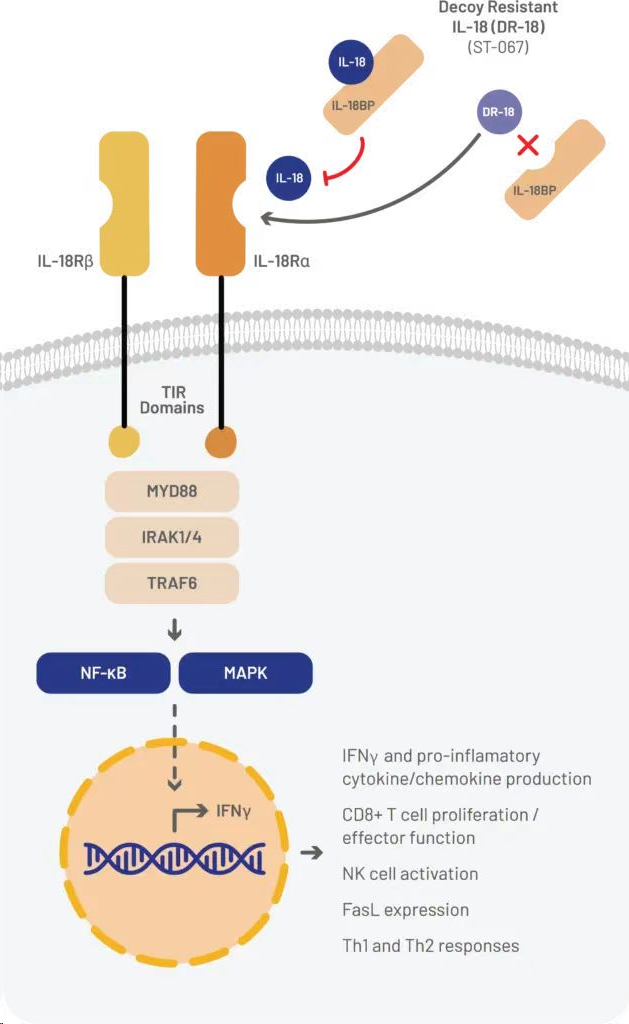
Despite the potential of cytokine therapy, its clinical implementation has been limited due to the inherent flaws of natural cytokines as drugs, and historically, the clinical efficacy of IL-18 has been unsatisfactory. Research led by Dr. Aaron Ring, founder of Simcha, has revealed the reasons behind the weak anti-cancer activity of natural IL-18.Tumors often produce large amounts of IL-18 interfering signals, a decoy receptor known as IL-18 binding protein (IL-18BP).
In order to overcome this problem,Simcha has developed the first anti-decoy IL-18 variant, ST-067, which is completely unaffected by IL-18BP and maintains strong immune-stimulating effects in the tumor microenvironment.In preclinical studies,Decoy-resistant IL-18 exhibits potent antitumor activity, either alone or in combination with immune checkpoint inhibitors such as anti-PD-1 antibodies.ST-067 is currently undergoing Phase 1/2 clinical trials, both as a monotherapy and in combination with pembrolizumab, for the treatment of patients with solid tumors, particularly those who are unresponsive to other immunotherapy drugs.
Cytokines Boost CAR-T Cell Potency
T cells Redirected for Universal Cytokine-Mediated Killing (TRUCKs) are a new generation of CAR-T cells, designed toExpress certain cytokines to enhance the anti-tumor efficacy of CAR-T cells, attract and activate innate immune cells, thereby eliminating antigen-negative cancer cells, improving their persistence, and altering the characteristics of the tumor microenvironment.TRUCKs can also be used in fields such as viral infections, metabolic diseases, autoimmune diseases, and hard-to-treat solid tumors, greatly expanding the application scope of CAR-T cells.

The 6th Symposium on Tumor Immunotherapy and Cell Therapy Technologies
Challenges and Clinical Experience in CAR-T Frontline Treatment Development
Clinical Development Progress of CD19 Dual-Target CAR-T
Innovative Space in Hematologic Tumor Cell Therapy
Construction of a Process Platform for Rapid Preparation of CAR-T
Strategies for the Armed Upgrade of CAR-T in Solid Tumors
How TCR-T Overcomes Tumor Antigen Escape
Frontier Breakthroughs in Universal Cell Therapy
Innovative Development of Targets for Solid Tumors
mRNA Technology Empowers Cell Drug Development
Non-viral Vector CAR-T
Logic Gate Design in Cell-Based Drugs
Innovative Design of CAR Molecules
Opportunities for China-produced CAR-T to Enter Overseas Markets

999 SheetsFree single-session ticket,
Limited Time Offer!
Collaboration, Speeches, Synchronously Recruiting
DLL3 CAR-T Cells Secreting IL-18
Promising Treatment for Small Cell Lung Cancer
eMedClub
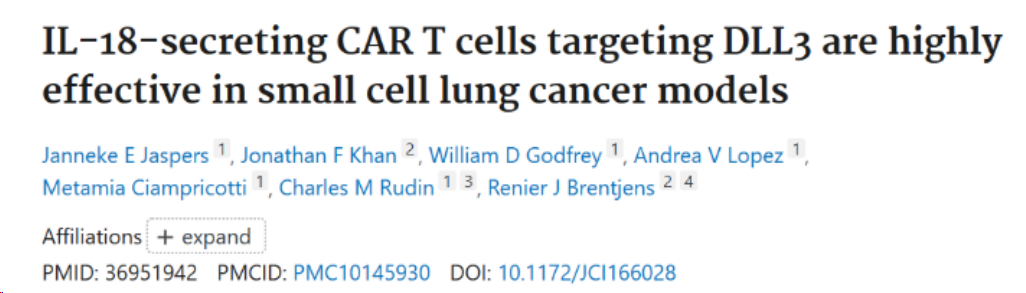
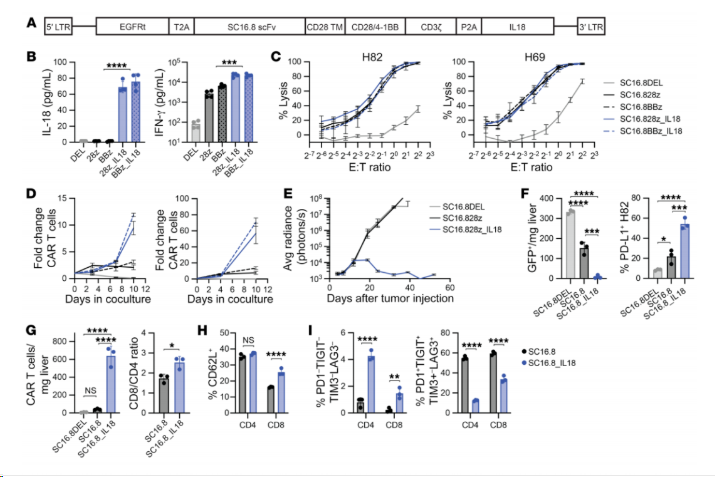
In a new preclinical study published last year, researchers from the Roswell Park Comprehensive Cancer Center and Weill Cornell Medicine in the United States foundDLL3 CAR-T Therapy Secreting IL-18 Shows Great Promise for Small Cell Lung Cancer (SCLC). The relevant research results were recently published in the Journal of Clinical Investigation, with the paper titled "IL-18-secreting CAR T cells targeting DLL3 are highly effective in small cell lung cancer models".
Renier Brentjens, MD, from the Roswell Park Comprehensive Cancer Center, believes that the tumor microenvironment (TME), which consists of blood vessels, normal cells, and other elements surrounding tumor cells, suppresses the immune system, causing T cells to become functionally exhausted and unable to combat cancer cells, thereby affecting the efficacy of CAR-T therapy against solid tumors.
To overcome this issue, the researchers devised a two-pronged attack strategy. First,The CAR-T cells they developed can target delta-like ligand 3 (DLL3), an antigen found on the surface of SCLC tumor cells.. They were then designed as"Armored CAR-T cells" capable of expressing another molecule—interleukin-18 (IL-18)—where IL-18 is a protein encoded by the IL-18 gene that modulates the immune system's response to disease.
In SCLC xenograft and mouse models, theseCAR-T Cells Secreting IL-18 Target DLL3, Significantly Enhancing Antitumor Activity, with the Resulting Antitumor Response Outperforming IL-12 and IL-16(Two other interleukin molecules evaluated during the study period)Stronger。IL-18 also reduced T-cell exhaustion, enabling CAR-T cells targeting DLL3 (DLL3 CAR-T cells) to proliferate more robustly and persist longer, generating more T cells capable of "remembering" the DLL3 antigen for continued targeted destruction in the future.. Meanwhile,IL-18 activates more tumor-infiltrating lymphocytes (TILs), which can enter the tumor to perform killing.
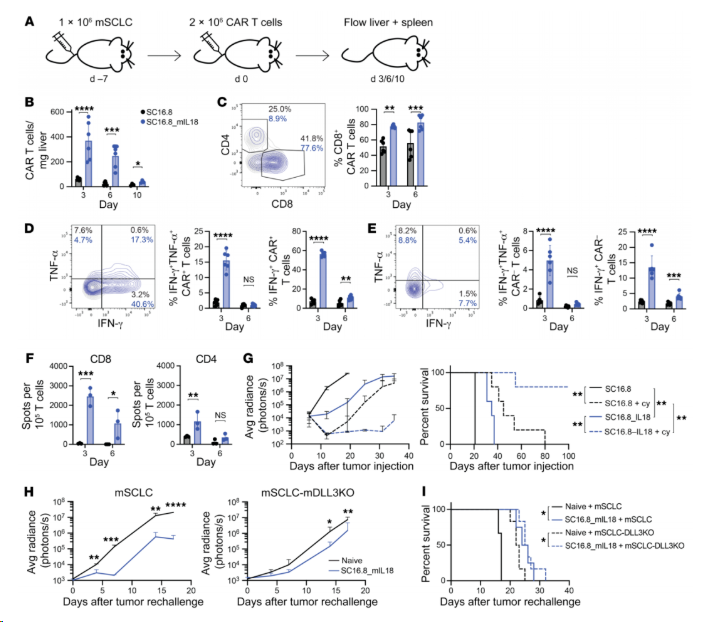
Dr. Brentjens believes: Introducing the IL-18 gene into DLL3 CAR-T cells can lead to better eradication of tumors. In fact, in xenograft animal models of small cell lung cancer (SCLC), this strategy resulted in the complete destruction of H82 tumors that mimic recurrent SCLC. Notably,When DLL3 CAR-T cells secreting IL-18 were combined with an immunotherapy known as immune checkpoint inhibitors, survival rates improved significantly.
DLL3 is expressed in many neuroendocrine cancers, including high-grade cancers of the lung, prostate, breast, pancreas, and intestine, as well as low-grade gliomas and neuroblastomas. Therefore, DLL3 CAR-T cells may offer new therapeutic options for these diseases.

HuCART19-IL18 for the Treatment of Lymphoma,
ORR is82%!
eMedClub
On July 3, 2023, the medical online journal "OncLive" announcedFirst-in-Human Trial (NCT04684563) of the Fourth-Generation 4-1BB CAR-T Product HuCART19-IL18 for the Treatment of Relapsed/Refractory Lymphoma: Study Data.
As of March 3, 2023, 16 patients have been enrolled in the trial. Of these, 11 patients are evaluable for efficacy, and 12 patients are evaluable for safety.
Among the 13 patients who received HuCART19-IL18 injections, the median age was 65 years. 92% had previously undergone anti-CD19 CAR-T therapy. Among the 11 patients evaluable for efficacy, HThe objective response rate (ORR) of uCART19-IL18 was 82%, with a complete response rate (CR) of 55% and a partial response rate (PR) of 27%. 18% of patients experienced disease progression (PD).The median duration of response (DOR) has not yet been reached. Additionally, the 12-month progression-free survival rate (PFS) is 54%. With a median follow-up time of 12 months, the 12-month overall survival rate (OS) is 100%.
Regarding safety, the most common adverse events (AEs) were considered potentially related to treatment, with any-grade CRS occurring in 58% of patients and any-grade neurotoxicity syndrome (ICANS) occurring in 17% of patients.
The study showed that huCART19-IL18 has better safety and efficacy.Even at low cell dose levels, high peak huCART19-IL18 expansion was observed, which may suggest that the expansion does not have a clear correlation with cell dose.In addition, the researchers also noted that patients using CD28 products (such as brexu-cel) had better expansion compared to those previously using 4-1BB products. The study had a small sample size, and further analysis with an expanded sample is needed.
Conclusion


Dian Dian "Share”、“Like" and "In Progress",Give me a little charge~"