

Peking University Researchers Shen Lin and Peng Zhi Collaborate to Uncover Critical Role of Gut Microbiome in Gastrointestinal Cancer Immunotherapy Resistance

Xbiome
AI Drug Developer for Gut Microbiota

Peking University
The First National Comprehensive University in Modern China
On January 8, Shen Lin from Peking University, Peng Zhi, and researchers from Xbiome Co. Ltd. jointly published an article titled “Multi-omics of the gut microbial ecosystem in patients with microsatellite-instability-high gastrointestinal cancer resistant to immunotherapy” in the journal Cell Reports Medicine.The study demonstrated the important role of the gut microbiome in drug resistance, which will help to use it as a preventive diagnostic tool and therapeutic target in the future. The findings will help guide the clinical practice of cancer immunotherapy and further explore the feasibility and efficacy of FMT in reversing immunotherapy resistance in gastrointestinal cancer patients.
https://www.cell.com/cell-reports-medicine/fulltext/S2666-3791(23)00572-4
Research Background
01
The deficient mismatch repair (dMMR) subtype accounts for 15%–22% of gastrointestinal cancer patients and approximately 5% of metastatic/recurrent gastrointestinal cancers. Patients with the dMMR subtype are unable to recognize and repair certain spontaneous mutations, leading to a high tumor mutation burden and microsatellite instability-high (MSI-H) status, making them more likely to benefit from anti-PD-1/PD-L1 (antibodies targeting programmed cell death protein-1 [PD-1] or its ligand PD-L1) immunotherapy.According to existing evidence, MSI status is one of the most effective biomarkers in cancer immunotherapy.
However, the response of MSI-H/dMMR gastrointestinal cancer patients to immunotherapy is highly heterogeneous, with approximately 30% of MSI-H patients exhibiting primary resistance. About 17% of MSI-H patients develop acquired resistance after two years of treatment, and this proportion tends to increase with prolonged treatment duration. Considering the relatively consistent molecular patterns within the MSI-H/dMMR subtype,Understanding other factors affecting the heterogeneity of therapeutic efficacy is crucial for improving the immunotherapy response in dMMR/MSI-H patients.
Research Progress
02
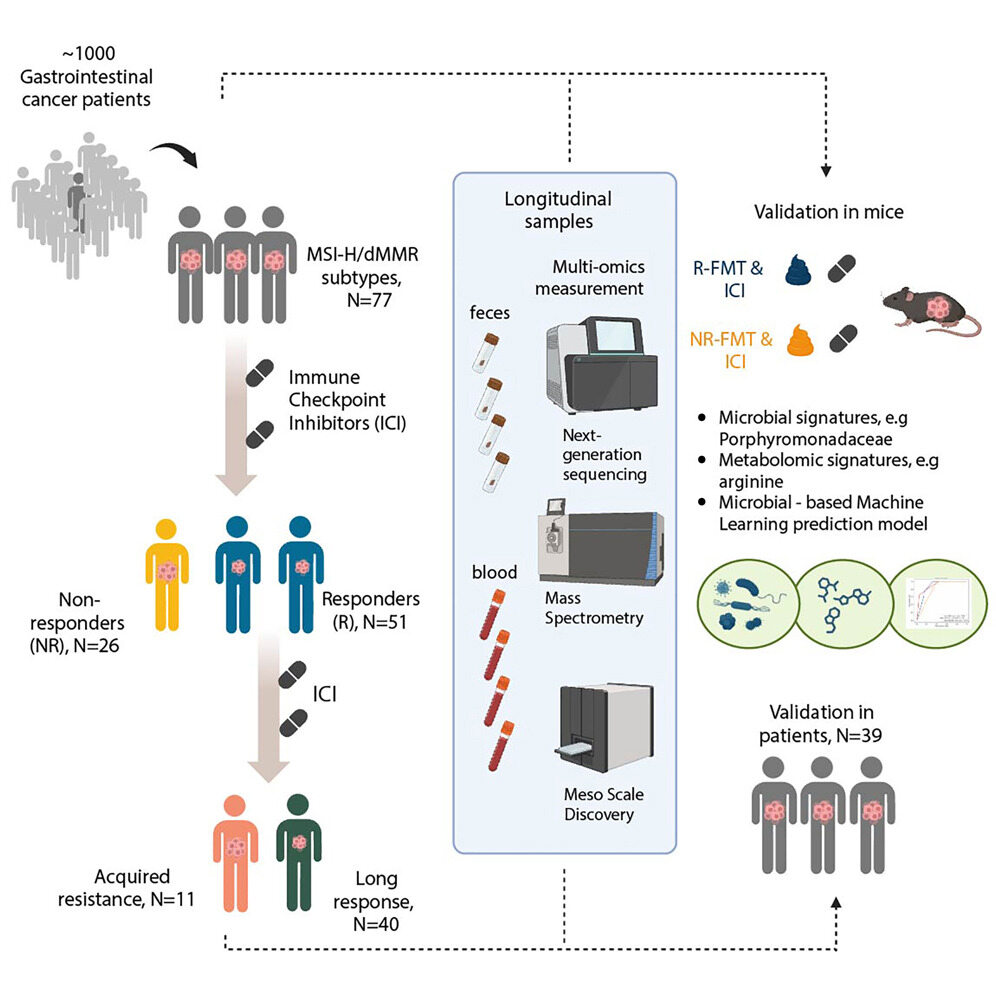
Through comprehensive multi-omics analysis of a rare cohort of gastrointestinal cancer patients with high microsatellite instability/deficient mismatch repair (MSI-H/dMMR), researchers identified biomarkers significantly associated with primary or acquired resistance to immunotherapy drugs. In particular, microbes, metabolic pathways, and/or metabolites involved in arginine metabolism and short-chain fatty acid metabolism suggest that certain common molecular mechanisms are involved in the response of gut microbiota and host to immunotherapy. Researchers have also developed robust machine learning models to predict patient responses to immunotherapy, which can greatly improve the accuracy of patient stratification to maximize treatment efficacy beyond the "gold standard" microsatellite status.
Research Results
03
In summary,The study demonstrated the important role of the gut microbiome in drug resistance, which will help to use it as a preventive diagnostic tool and therapeutic target in the future. The findings will help guide the clinical practice of cancer immunotherapy and further explore the feasibility and efficacy of FMT in reversing immunotherapy resistance in gastrointestinal cancer patients. (360zhyx.com Translational Medicine Network)
References:
https://www.cell.com/cell-reports-medicine/fulltext/S2666-3791(23)00572-4
Note: This article aims to introduce the progress of medical research and cannot be used as a reference for treatment plans. For health guidance, please visit a regular hospital.