

WIRAXON Secures Over 300 Million Yuan in Financing, "Three-in-One" Brain-Spine Interface Technology Accelerates Towards Clinical Application
wiraxon
Brain-Computer Interface Developer and Manufacturer

Cathay Capital
Cross-border Investment Institutions

sherpa
Venture Capital Institution

SSCILF
Pilot Industry Investment Institutions
Innovation & Entrepreneurship
Early-Stage and Growth-Stage Investment Firms
WIRAXON was founded in 2025 in Pudong, Shanghai. Relying on the technology transfer from Fudan University, it focuses on the R&D and commercialization of brain-spine interface technology. Recently, WIRAXON announced the completion of its series angel financing, led by Cathay Capital, co-led by SSCILF and Sherpa, with follow-up investments from HENGXU CAPITAL. The existing shareholder, Fudan Science Park Capital, continued to increase its investment. The funds raised will be mainly used for multi-center registration clinical trials across China for implantable brain-spine interface technology, the construction of the headquarters in Waigaoqiao, Pudong, and global strategic layout, accelerating the benefits for twenty million spinal cord injury patients worldwide.
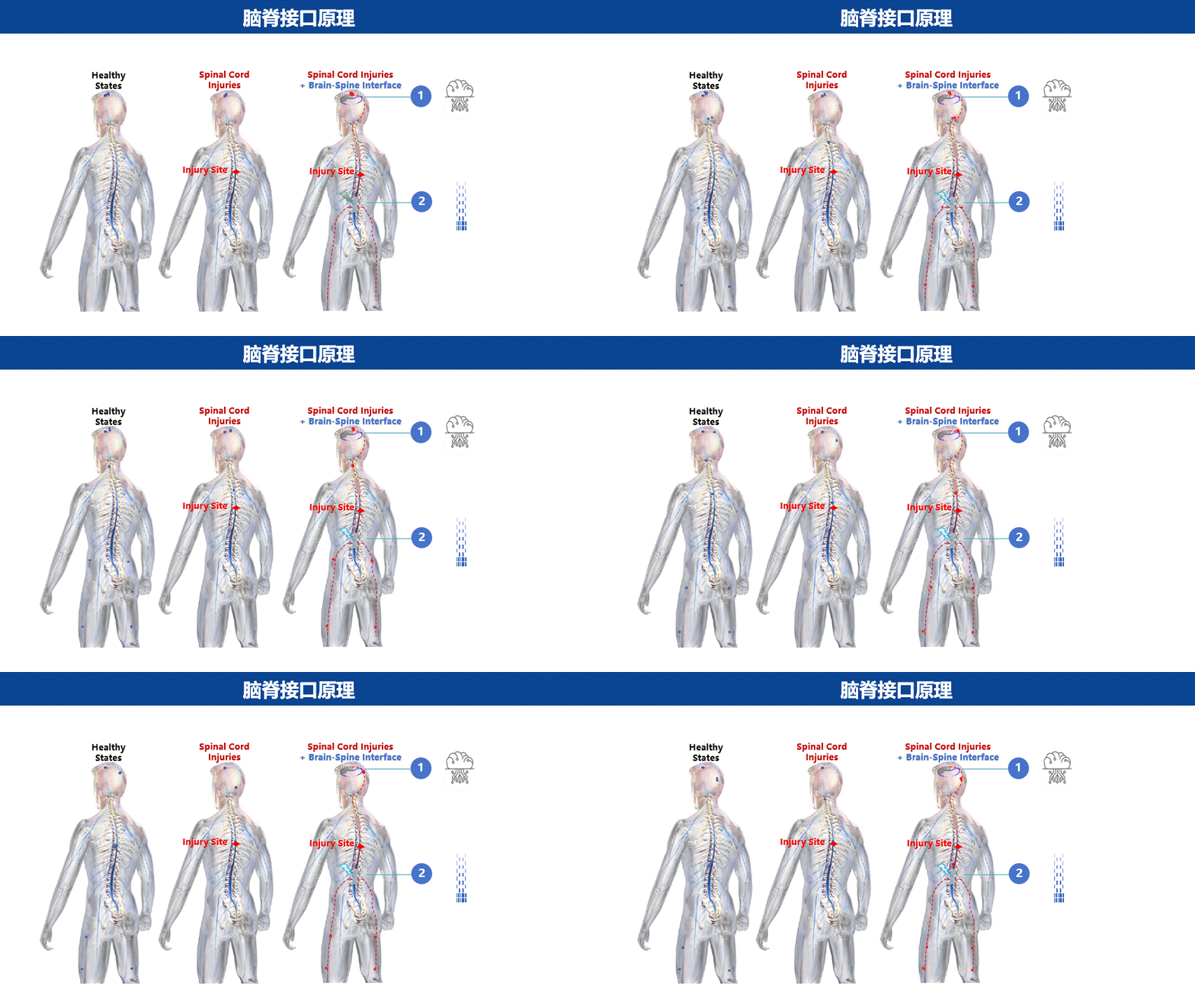
Recently, Elon Musk has set his sights on brain-spinal interface technology, referring to it as one of the two "Jesus-level technologies." Unlike the traditional brain-computer interface approach of "functional replacement," brain-spinal interface technology directly reconstructs the neural pathways between the brain and spinal cord to restore motor function. Following this path, the WIRAXON team pioneered the world’s first "three-in-one" implantable brain-spinal interface technology, creating a "neural bridge" that directly connects the brain and spinal cord for patients with spinal cord injuries, helping them regain their natural motor abilities.
Clinical validation achieved breakthrough results. In 2025, WIRAXON collaborated with expert teams from Zhongshan Hospital and Huashan Hospital, both affiliated with Fudan University, to conduct clinical proof-of-concept (POC) studies. They administered brain-spinal interface treatment for four patients with complete loss of motor function due to spinal cord injuries. Postoperative observations showed that all subjects regained voluntary control of leg movements within 24 hours, with the fastest achieving independent control of hip and knee joint movements within seven days. Additionally, the research team observed sweating in the lower limbs of the subjects, suggesting that neural pathway reconstruction may positively impact the recovery of autonomic nerve function. This breakthrough has also gained recognition from global authoritative regulatory bodies: the technology has received the "Breakthrough Device Designation" from the U.S. FDA, making it the first and only invasive brain-spinal interface technology interface technology in China to receive this designation.
Core Technology Builds Systematic Barriers. Behind the aforementioned clinical outcomes lies the pioneering "Triune" implantable brain-spine interface technology: electrode chips, each with a diameter of only about 1 millimeter, are implanted in the patient’s motor cortex and the epidural space of the spinal cord. When the brain generates movement intentions, signals are decoded in real-time by an independently developed AI algorithm, then converted into electrical signals that the spinal cord can interpret, effectively restoring the body's natural motor function. Helping patients regain voluntary control over their limb movements is the mission of every member of the WIRAXON team. The team firmly believes that every voluntary step taken by a patient marks a new beginning, and every such step embodies the profound meaning of "Every Step Counts."
Integrating the three independent modules of EEG acquisition, signal decoding, and spinal cord electrical stimulation into a miniature implantable device is not a simple engineering combination. Behind every single breakthrough lie the joint efforts of people from different disciplines. The team has formed a "trinity" full-chain capability encompassing basic research, translational engineering, and clinical validation. In terms of nerve root imaging, relying on the solid platform of Fudan University's Zhangjiang Imaging Center and the university’s interdisciplinary strengths, the team spent two years overcoming the challenge of micron-level nerve root imaging, making precise stimulation possible. In motion simulation computing, the team built an electrostimulation parameter-neural activation-musculoskeletal motion simulation computing platform to ensure accurate and effective parameters. In terms of decoding speed, the lightweight AI algorithm independently developed by the team boasts fast computing speed, high accuracy, and low computational power demand, reducing signal processing delay to within 100 milliseconds to meet the high latency requirements for lower limb walking. Beyond basic research, the team also overcame numerous engineering challenges, such as creating a highly integrated miniaturized device that combines three functions while meeting biocompatibility and long-term implant reliability requirements, ultimately applying the technology in clinical settings.
Innovation in China, serving the globe. WIRAXON will soon launch a multi-center registrational clinical trial across China, laying the groundwork for the subsequent registration and market entry of its brain-spine interface technology in China and globally. The company is accelerating its global expansion, committed to making China-developed brain-spinal interface technology accessible to patients worldwide. Brain-spinal interface technology involves the intersection of multiple disciplines and technologies, including artificial intelligence, microelectronics, electronic engineering, biomedicine, mechanical engineering, and materials science. WIRAXON welcomes partners with relevant professional expertise and shared missions to join the team and work together to promote the compliant implementation and clinical application of brain-spinal interface technology in more countries and regions, allowing innovative achievements from China to transcend borders and benefit patients globally.
Regarding this round of financing, investors from all parties expressed firm confidence and high expectations.
Cathay Capital Managing Partner Duan Lanchun pointed out: "Brain-computer interface has been included in the key layout of the future industry in China's '15th Five-Year Plan'. Wiraxon focuses on the brain-spinal interface track, forming a distinctive competitive advantage: =without relying on external devices, directly driving the restoration of voluntary neural motor function. WIRAXON has developed a new technology and has become the first enterprise in China to receive the U.S. FDA Breakthrough Device Designation in the brain-computer interface field, defining the track. We are optimistic about the company's certainty in moving from technical validation to large-scale implementation, and will fully support its rapid industrialization in China and globally."
SSCILF pointed out: "The growth of WIRAXON is a microcosm of how Shanghai’s science and technology innovation ecosystem empowers hard tech startups. It marks another significant move by SSCILF in the brain-computer interface field, as well as the firm’s first initiative to translate outstanding scientific research achievements from Fudan University into real-world applications. From the research soil of Fudan’s Institute of Brain Science, to the industrialization base in Pudong, to the support from China’s National Disruptive Technology Innovation Program and Shanghai Science and Technology Commission’s special projects, to the clinical support from Zhongshan Hospital and Huashan Hospital, we have witnessed a systematic push for original technology moving from the lab to the bedside. There are nearly 4 million patients in China and about 20 million spinal cord injury patients worldwide. Professor Fumin Jia's team has gone through years of arduous efforts in neural root imaging and achieved success in four clinical proof-of-concept procedures surgeries. This carries not only the breakthrough of cutting-edge technology but also the heavy public hopes for improved livelihoods. Although there is still a long way to go from clinical trials to commercialization, with Shanghai's full support for its three leading industries, we believe that the inflection point for this track—from technical validation to large-scale commercialization—is approaching."
Deng Xuan, Partner at Sherpa pointed out: "The team at WIRAXON has successively overcome multiple core technical barriers, such as nerve root imaging, decoding latency, and three-in-one integration. Each of these individual challenges was once considered an insurmountable obstacle. However, not only did they overcome these hurdles, but they also delivered clinical validation results showing "leg movement within 24 hours and walking within 7 days." This kind of groundbreaking innovation from zero to one, along with therapid pace of clinical translation, is extremely rare in the medical hard tech field. What moves us even more is the humanistic warmth behind the technology—they are enabling patients to regain control over their own bodies. We will accompany this team on their journey to greater heights 或 new milestones."
Lu Yongtao, Chairman of HENGXU CAPITAL, believes: "WIRAXON is not only developing a medical device but also opening a new window for the integration of brain-computer interfaces and embodied intelligence. Brain-computer interfaces provide high-dimensional command input, while embodied robots ensure precise execution. The synergy between the two can significantly boost operational efficiency and intelligence. Application scenarios span medical rehabilitation, industrial manufacturing, and special operations, addressing the pain points of traditional control methods that lack advanced planning capabilities."