Keytruda Secures 39th FDA Approval for Stage III-IVA Cervical Cancer in Combination with Chemoradiotherapy

MSD
Pharmaceutical R&D and Manufacturer

FDA
U.S. Food and Drug Administration
Recently, MSD's PD-1 inhibitor Keytruda received FDA approval for a new indication, in combination with chemoradiotherapy (CRT), for the treatment of patients with stage III-IVA cervical cancer.
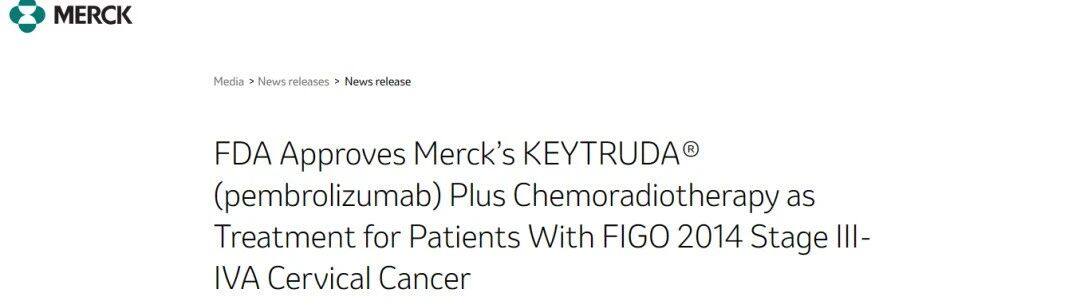
Image Source: MSD Official Website
K Drug Secures 39th Indication in the U.S.
According to the announcement on MSD's official website, based on Keytruda's established role in advanced cervical cancer, regardless of PD-L1 expression levels, Keytruda + chemoradiotherapy is currently the first anti-PD-1-based therapy approved in the United States for treating FIGO 2014 Stage III-IVA cervical cancer patients. This approval provides newly diagnosed patients with an anti-PD-1-based treatment option, which has the potential to reduce the risk of disease progression or death compared to chemoradiotherapy alone.
The FDA approved the therapy based on data from the Phase III KEYNOTE-A18 study, in which Keytruda in combination with concurrent chemoradiotherapy significantly improved progression-free survival (PFS) for patients; compared with placebo plus CRT, Keytruda combined with CRT reduced the risk of disease progression or death by 41% (HR=0.59, 95% CI: 0.43-0.82). The median progression-free survival was not reached in either group.
This approval marks the 39th indication for Keytruda in the United States, and it is also the third FDA-approved indication for Keytruda in the cervical cancer field. Previously, Keytruda was approved in combination with chemotherapy for the treatment of patients with persistent, recurrent, or metastatic cervical cancer whose tumors express PD-L1 (Combined Positive Score [CPS] ≥1) as determined by an FDA-approved test; and as a monotherapy for the treatment of patients with recurrent or metastatic cervical cancer whose tumors express PD-L1 (CPS ≥1) as determined by an FDA-approved test, with disease progression during or after chemotherapy.
Keytruda Continues to Expand Its Reach in China, Following Widespread Success in the United States.
On December 18, 2023, MSD announced that Keytruda has been approved by the National Medical Products Administration (NMPA) of China for first-line treatment in combination with fluorouracil- and platinum-based chemotherapy for patients with locally advanced unresectable or metastatic HER2-negative gastric or gastroesophageal junction adenocarcinoma.
This approval marks the third indication for Keytruda in the first-line treatment of gastrointestinal tumors in China, and also the twelfth indication for Keytruda in China.
The Newly Crowned "King of Drugs"
As MSD's core anticancer drug, Keytruda has been highly anticipated since its launch. This groundbreaking immunotherapy has demonstrated promising efficacy across more than forty global indications and has become the gold standard for several major conditions. It is not only the PD-1 monoclonal antibody with the most approved indications covering various types of cancer but also the immune checkpoint inhibitor with the most comprehensive layout for lung cancer indications.
In the first half of 2023, Keytruda generated $12 billion in sales, securing its position as the "top drug" for the period. According to the latest Q3 financial report, Keytruda contributed nearly $6.4 billion in sales to MSD. The total sales for the first three quarters are approaching the $20 billion mark. However, there is no doubt that breaking the $20 billion mark for the entire year of 2023 is a certainty.
But an undeniable fact is that, behind Keytruda truly becoming the "king of drugs," the fierce competition within the PD-1 space has become a global phenomenon. At the same time, it also faces relentless challenges from "dark horses" in the pharmaceutical world, such as semaglutide and tirzepatide, which belong to the GLP-1 class.
Therefore, the market unanimously believes that the competition for the top-selling drug in 2023 and 2024 will be between Keytruda and Semaglutide.
According to the financial report released by Novo Nordisk, its重磅 product for obesity and diabetes, semaglutide (Ozempic, Rybelsus, and Wegovy), achieved approximately $14.2 billion in sales in the first three quarters, approaching Keytruda's $18.4 billion.
According to Eli Lilly's financial report, the global sales of tirzepatide reached $2.958 billion in the first three quarters of 2023, with global sales of $1.409 billion in the third quarter.
Although Keytruda far outpaces tirzepatide in sales figures, it is important to note that tirzepatide was only launched in May 2022. By its sixth quarter on the market, it achieved single-quarter sales exceeding $1 billion and has already been approved for weight loss indications, showing great potential to become a blockbuster drug with over $10 billion in annual sales.
It can be seen that the impact of semaglutide and tirzepatide on Keytruda is not to be underestimated.
Summary
As MSD's most powerful ace, Keytruda continues to expand its range of indications and targets major cancer types. At the recently concluded 42nd J.P. Morgan Healthcare Conference, MSD stated that although Keytruda will face a patent cliff by 2028,
But its product portfolio covers multiple areas such as oncology, infectious diseases, cardiometabolic disorders, immunology, and neuroscience, which is sufficient to address the patent cliff challenge posed by Keytruda.
MSD also predicted at the conference that the sales of its oncology drug candidates in the pipeline may exceed $10 billion. CEO Rob Davis raised this figure to over $20 billion by the mid-2030s.
Source: MSD Official Website

Editorial Responsibility: Pea Shooter
Disclaimer: This article is an integrated content and does not represent the views of this platform. If it involves issues related to the content, copyright, or other problems, please leave a message on this platform, and we will handle it promptly.