Roche's PD-L1 Monoclonal Antibody Tecentriq SC Receives First-in-EU Approval for Subcutaneous Administration in Multiple Cancers
Roche
Oncology Drug Research, Development, and Manufacturing
Just (January 16), Roche announced that the European Commission has granted marketing authorization for the subcutaneous injection version of PD-L1 antibody Tecentriq (Atezolizumab). The approval of Tecentriq SC also applies to all indications previously approved for the intravenous formulation, covering lung cancer, bladder cancer, breast cancer, and liver cancer. This is the first PD-L1 cancer immunotherapy in the EU for subcutaneous injection.
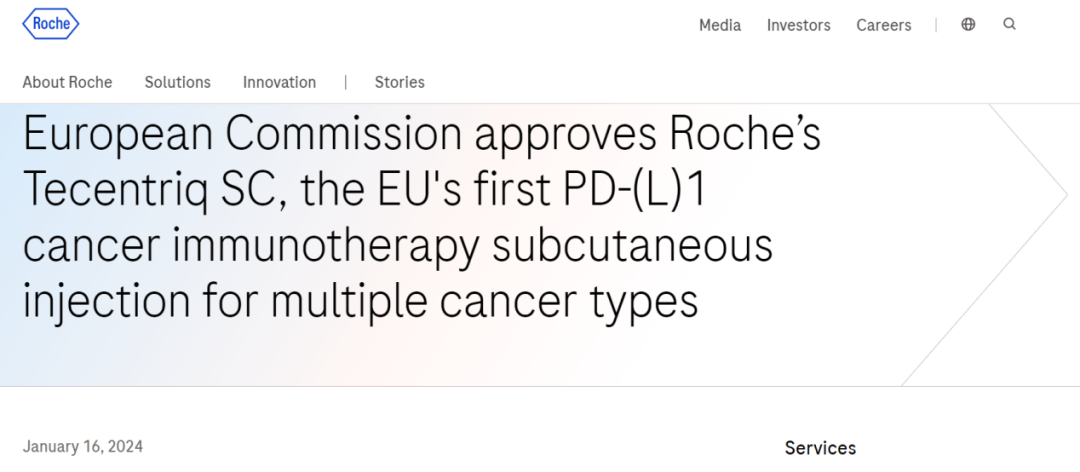
Image source: Roche
The therapeutic advantage of subcutaneous (SC) injectables lies in their administration convenience; the recently approved version takes only about 7 minutes to complete the injection, with most injections requiring 4-8 minutes, whereas the original intravenous (IV) infusion took 30-60 minutes.
This approval is based on key data from the Phase 1b/3 IMscin001 study, which aimed to compare the pharmacokinetics, safety, and efficacy of the subcutaneous formulation of Tecentriq with intravenous administration in patients with locally advanced or metastatic NSCLC who had failed prior platinum-based therapy.
The trial enrolled a total of 371 subjects. In August 2022, Roche announced that Part 2 of the study had met its primary endpoint. Based on predefined pharmacokinetic measurements, the levels of Tecentriq in the blood during the given dosing interval were comparable. The geometric mean ratio of the observed serum trough concentrations was 1.05 (drug concentration in the blood before the next dose; 90% CI: 0.88–1.24), and the model-predicted area under the curve (AUC), a measure of overall drug exposure, was 0.87 (90% CI: 0.83–0.92).
The ORR (11.8% vs 9.7%) and median PFS (2.8 vs 2.9 months) were comparable between the subcutaneous injection and intravenous infusion groups, and consistency was also observed in terms of safety.
Tecentriq SC combines Tecentriq with Halozyme's Enhanze drug delivery technology. The Enhanze drug delivery technology is based on proprietary recombinant human hyaluronidase PH20 (rHuPH20), an enzyme that temporarily degrades hyaluronic acid—a glycosaminoglycan or natural sugar chain in the body—locally within the subcutaneous space. This increases the permeability of subcutaneous tissue, creating space for Tecentriq to enter, allowing it to disperse quickly and be absorbed into the bloodstream.
Ninety percent of healthcare professionals surveyed said that subcutaneous formulations are easy to administer, and 75% said it could save the healthcare team a significant amount of time compared with intravenous formulations.
In addition to offering shorter treatment times, Tecentriq SC can be administered by healthcare professionals outside of hospitals, community care organizations, or in patients' homes, according to national regulations and health systems. Roche is in discussions with several providers in Europe to include Tecentriq SC in home cancer care programs where possible.
Tecentriq SC was first approved in the UK in August 2023. The approved indications for Tecentriq SC are the same as those for Tecentriq IV.
FDA Approval Process Not Smooth: In November 2022, Roche submitted the marketing application for Tecentriq SC to the U.S. FDA and the European Medicines Agency. However, in September of last year, its partner Halozyme stated in a securities filing that Roche needed to update the manufacturing process of this drug before the FDA makes an approval decision. Therefore, the U.S. launch will be delayed until 2024.
References:
Roche Announcement

Editor: Muyan
Disclaimer: This article is a reprint from PharmaSmart, with all images and text copyrights belonging to the original author. The purpose of the reprint is to convey more information and does not represent the views of this platform. If there are any issues regarding the content, copyright, or other aspects, please leave a message on this platform, and we will address it promptly.