AstraZeneca Ranked #1 in MNC China Competitiveness: Leadership in Revenue, Pipeline, and Business Development

AstraZeneca
Biopharmaceutical Manufacturer
AstraZeneca has long been regarded as the multinational corporation (MNC) that understands China the most, consistently ranking first in MNC revenue within China. Living up to expectations, Med+ Research Institute recently conducted a comprehensive evaluation of multinational corporations (MNCs) in the healthcare industry across five dimensions—revenue, pipeline, brand, talent, and business development—using 36 indicators. AstraZeneca once again topped the "2023 Healthcare MNC Competitiveness in China Ranking" at No. 1.
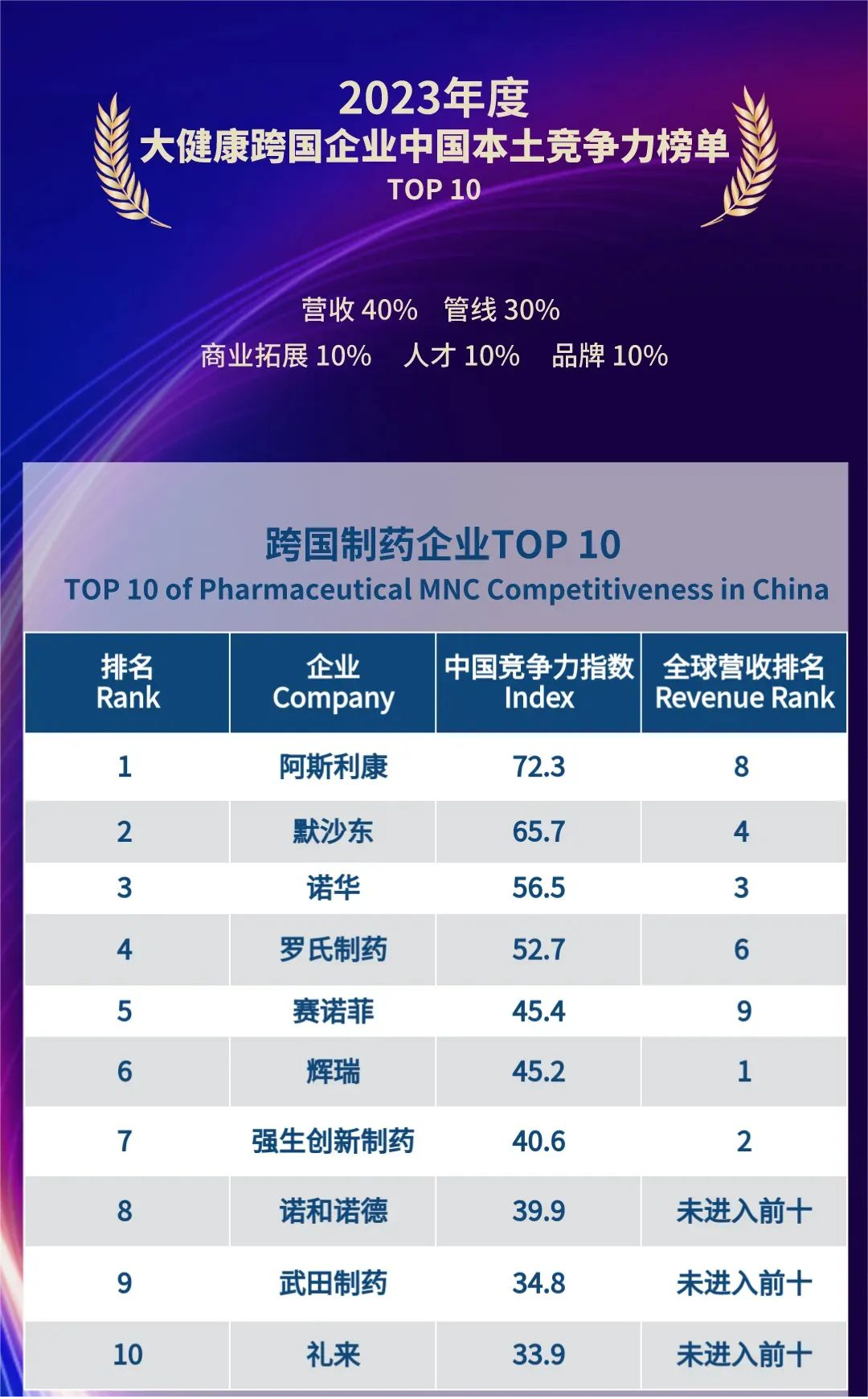
Source: Med+ Research Institute
2023H1 Revenue Surpassed, Frequent Adjustments to Respiratory Business Unit
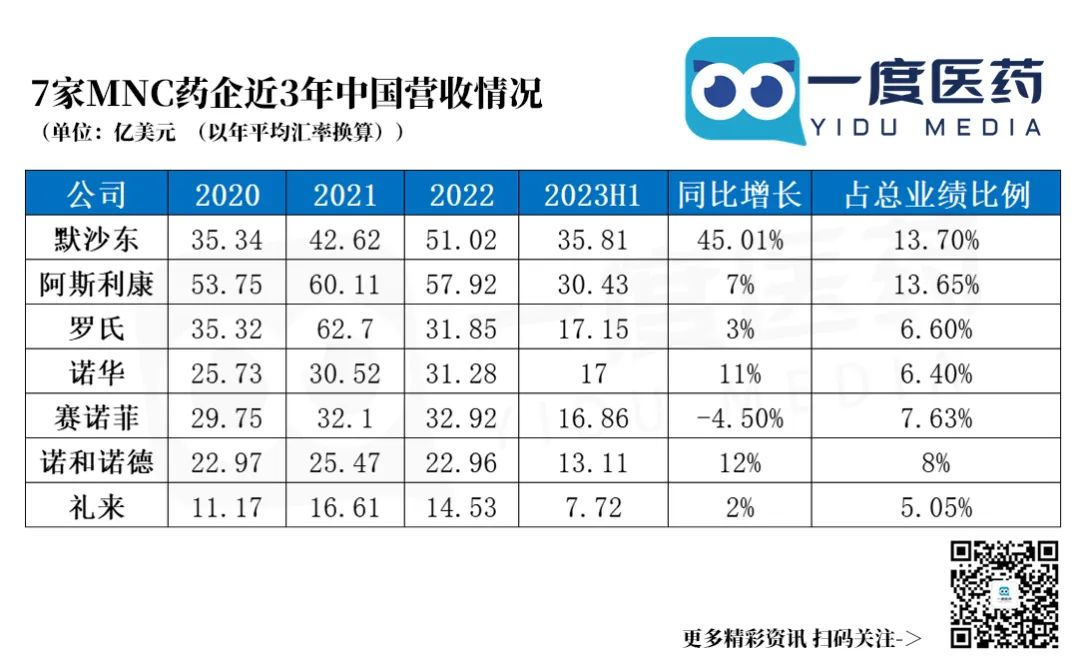
Yidu Pharma compiled the revenue of multinational pharmaceutical companies in China over the past three years. In 2021, Roche surpassed AstraZeneca with $6.27 billion (including pharmaceuticals + diagnostics). However, looking only at the pharmaceuticals business, AstraZeneca has consistently remained the leading multinational pharmaceutical company in the Chinese market for three years.
In 2022, amid the dual impact of recurring pandemic disruptions and a capital market downturn, Merck achieved a high double-digit growth rate of 20%, driven by Keytruda and the HPV vaccine. In contrast, AstraZeneca's performance declined for the first time (-4%). In the first half of 2023, AstraZeneca’s revenue growth in China was only 7%. The influence of its respiratory business segment cannot be overlooked, prompting AstraZeneca to take frequent actions in this area.
Merger: At the beginning of the New Year 2023, AstraZeneca China merged its Respiratory & Immunology (R&I) and Gastrointestinal & Respiratory Nebulization (GNR) divisions to establish the Respiratory, Gastrointestinal & Immunology (RGI) division.
Further Split: In August 2023, after more than half a year of operation, RGI was officially split into two major business units: the Respiratory Inhalation and Biologics Business Unit, and the Respiratory Nebulization, Gastroenterology, Vaccines and Immunotherapy, and Autoimmunity Business Unit.
Reintegration: In December 2023, the Gastrointestinal Oral Business Unit, which belongs to AstraZeneca China’s Omnichannel Division, was merged into the Respiratory Nebulization, Gastrointestinal, Vaccines and Immunotherapy, and Autoimmunity Business Unit.
42 Products in China, 5 Included in the Medical Insurance Catalog
Since 1993, AstraZeneca has been rooted in China for thirty-one years, introducing 42 innovative global drugs, with marketed products covering cardiovascular/renal/metabolic, oncology, respiratory/immunology, gastroenterology, and rare diseases. According to financial reports, AstraZeneca's revenue in China for the first three quarters of 2023 was $4.495 billion.
In the 2023 National Medical Insurance Negotiation, AstraZeneca had three products successfully included in the medical insurance:
The BTK inhibitor acalabrutinib capsule (Acalabrutinib, trade name: Kangkeqi, specification: 100mg) had a pre-negotiation median price of 635.70 yuan. The national medical insurance directory restricts its indications to adult patients with mantle cell lymphoma (MCL) who have previously received at least one prior treatment. This product was approved for marketing in China on March 22 last year, and its global sales in the first three quarters of 2023 reached 1.839 billion US dollars, increasing by 26% year-on-year, ranking eighth in sales;
Dapagliflozin Metformin Sustained-Release Tablets (I) (brand name: Andas) are used to improve blood sugar control in patients with type 2 diabetes. The product was imported and approved for marketing in China under Registration Category 5.1 on June 26 of last year. It is worth noting that XigduoXR (the brand name for Andas in the U.S.) is currently embroiled in legal disputes in several U.S. jurisdictions. Plaintiffs claim that treatment with XigduoXR has caused bodily harm, including Fournier's gangrene and necrotizing fasciitis. In September 2023, a settlement was reached in one case, while other cases are still ongoing.
Selumetinib Sulfate Hydrogen Capsules (brand name: Koselugo, specifications: 10/25mg), the median pre-negotiation prices were 341.67 RMB and 689.03 RMB respectively. The restricted indications in the medical insurance directory are for pediatric patients aged 3 years and above with symptomatic, inoperable plexiform neurofibromas (PN) associated with Neurofibromatosis Type 1 (NF1). This is an orphan drug jointly developed by AstraZeneca and Merck. It was approved for marketing by the U.S. FDA in April 2020. Global sales in the first three quarters of 2023 reached 246 million U.S. dollars, marking a year-on-year increase of 65%.
In addition, there are products that had already been included in the medical insurance catalog, such as Eculizumab Injection and Osimertinib Mesylate Tablets.
Eculizumab Injection (Eculizumab, trade name: Soliris) is the world's first approved C5 complement inhibitor, a rare disease product, and also its first rare disease therapy launched in China. It was approved for marketing in China in November 2022. In September 2021, AstraZeneca established a rare disease business unit in China. In the future, the company will introduce more innovative rare disease drugs to China. Although it is a rare disease drug, the product's global sales in the first three quarters of 2023 reached $2.429 billion (-15%), ranking fourth in the company's sales.
Indications restricted by the Eculizumab medical insurance directory include:
Patients with Paroxysmal Nocturnal Hemoglobinuria (PNH);
Patients with atypical hemolytic uremic syndrome (aHUS);
Adult patients with refractory generalized myasthenia gravis (gMG) who are positive for anti-acetylcholine receptor (AChR) antibodies;
Osimertinib Mesylate Tablets are an irreversible third-generation epidermal growth factor receptor tyrosine kinase inhibitor (EGFR-TKI), which were approved for marketing in China for the first time in March 2017. In the first three quarters of 2023, global sales reached $4.38 billion (10%), making it AstraZeneca's best-selling drug. For osimertinib, AstraZeneca hopes that it can reach every EGFRm patient, with key Phase III clinical trials ongoing for resectable Stage I-III, unresectable Stage III, and first-line metastatic disease states, along with extensive exploration into combination therapies.
Osimertinib's medical insurance catalog restricts indications to include:
►Patients with non-small cell lung cancer (NSCLC) at stages IB-IIIA who have epidermal growth factor receptor (EGFR) exon 19 deletions or exon 21 (L858R) substitution mutations, must have previously undergone surgical resection and may or may not receive adjuvant chemotherapy as determined by their physician;
►First-line treatment for adult patients with locally advanced or metastatic non-small cell lung cancer (NSCLC) harboring epidermal growth factor receptor (EGFR) exon 19 deletions or exon 21 (L858R) substitution mutations;
► Adult patients with locally advanced or metastatic NSCLC who have experienced disease progression during or after prior treatment with EGFR tyrosine kinase inhibitors (TKIs) and have been confirmed to have EGFRT790M mutation positivity through testing;
Over $2 billion investment in China, Top 1 in domestic new drug BD transactions
AstraZeneca has invested over 20 billion US dollars in China (excluding R&D investment) and established six regional headquarters in the country, located in Beijing, Guangzhou, Wuxi, Hangzhou, Chengdu, and Qingdao, each with different focuses. At the same time, AstraZeneca continues to expand its local innovation ecosystem by creating the Innovation Center for Smart Health in China, the International Life Science Innovation Park, and the AstraZeneca Zhongjin Healthcare Industry Fund Cluster, further strengthening its own ecosystem while transforming from a pharmaceutical company into an industry platform enterprise.
In addition, AstraZeneca has been making continuous efforts in introducing new drugs produced in China.
Chen Bing, Vice President of International Business Development and Strategic Investment at AstraZeneca and Managing Director of AstraZeneca-CICC Healthcare Industry Fund, said in a media roundtable interview in 2023 that AstraZeneca's business development (BD) activities were relatively more active in 2023, reflecting the market value.
From AstraZeneca's actions, these collaborations have not only expanded its existing pipeline, bringing new developments, but also contributed to the growth of its performance.
AstraZeneca China Executive Changes
According to the news on AstraZeneca's official website in China, the current leadership team in China consists of 19 senior executives:
In March last year, Chen Xi joined AstraZeneca China as the Vice President of the Respiratory Nebulization, Digestive, Vaccines and Immunotherapy, and Autoimmunity Business Unit, reporting to Mr. Lai Minglong, General Manager of AstraZeneca China. Chen Xi's previous position was General Manager of the Cardiovascular and Professional Solutions Business Unit at Johnson & Johnson China.
Last August, Lin Xiao was appointed as the General Manager of the newly established AstraZeneca China Biopharmaceuticals Business, Head of the Respiratory, Inhalation and Biologics Business Unit, and Head of the Hong Kong and Macao regions, and also took over as the South Region SMT Sponsor.
Xie Qiong, former SMT Sponsor of the Southern Region, will assume the role of SMT Sponsor in the Eastern Region.
In August last year, Wu Shan was appointed as the General Manager of AstraZeneca Hong Kong and Macao, China, continuing to be fully responsible for the daily operations of the Hong Kong and Macao regions as a member of the SMT, and reporting to Lin Xiao.
In January this year, General Manager Lai Minglong took over as the head of AstraZeneca China Oncology Business Unit. The former head, Chen Kangwei, returned to Singapore due to family reasons and was appointed as the commercial head of AstraZeneca Asia Pacific.


Source: AstraZeneca China Official Website
References:
1. AstraZeneca Official Website
2.AstraZeneca PLC Hits the Top Again! Pharmacokinetics, 2023-01-17.

Editor: Penicillin
This article is a reprint from the Pharmacist Network. All images and text are copyrighted by the original author. The purpose of the reprint is to convey more information, and does not represent the views of this platform. If there are any issues regarding content, copyright, or other problems, please leave a message on this platform, and we will address it promptly.