

AstraZeneca's First-Line Immuno-Oncology Combination Nearly Doubles PFS in Liver Cancer Patients in Phase 3 Trial

AstraZeneca
Biopharmaceutical Manufacturer
▎Edited by the WuXi AppTec content team
Today, AstraZeneca announced that the重磅PD-L1 inhibitorImfinzi (durvalumab) in combination with transarterial chemoembolization (TACE) and bevacizumab, in the Phase 3 clinical trial for the treatment of hepatocellular carcinoma (HCC) patients suitable for embolization therapy, demonstrated a statistically significant and clinically meaningful improvement in the primary endpoint of progression-free survival (PFS).The PFS in the combination therapy group was 15 months, while the PFS in the control group receiving TACE alone was 8.2 months, nearly doubling the PFS.The press release noted that this is the first time that systemic therapy combined with TACE has provided clinical benefits in a phase 3 clinical trial in this patient population.
In the phase 3 clinical trial named EMERALD-1,Imfinzi in combination with TACE and bevacizumab reduced the risk of disease progression or death by 23% compared to TACE alone (HR=0.77, 95% CI: 0.61-0.98, p=0.032).The median PFS in the Imfinzi combination therapy group was 15 months, compared to 8.2 months in the TACE group. Consistent PFS benefits were observed across all key pre-specified subgroups.
In terms of secondary endpoints,Time to Progression (TTP) further supports the clinical benefit of the Imfinzi combination therapy, with a TTP of 22 months in the Imfinzi group and 10 months in the TACE group (HR=0.63, 95% CI: 0.48-0.82).
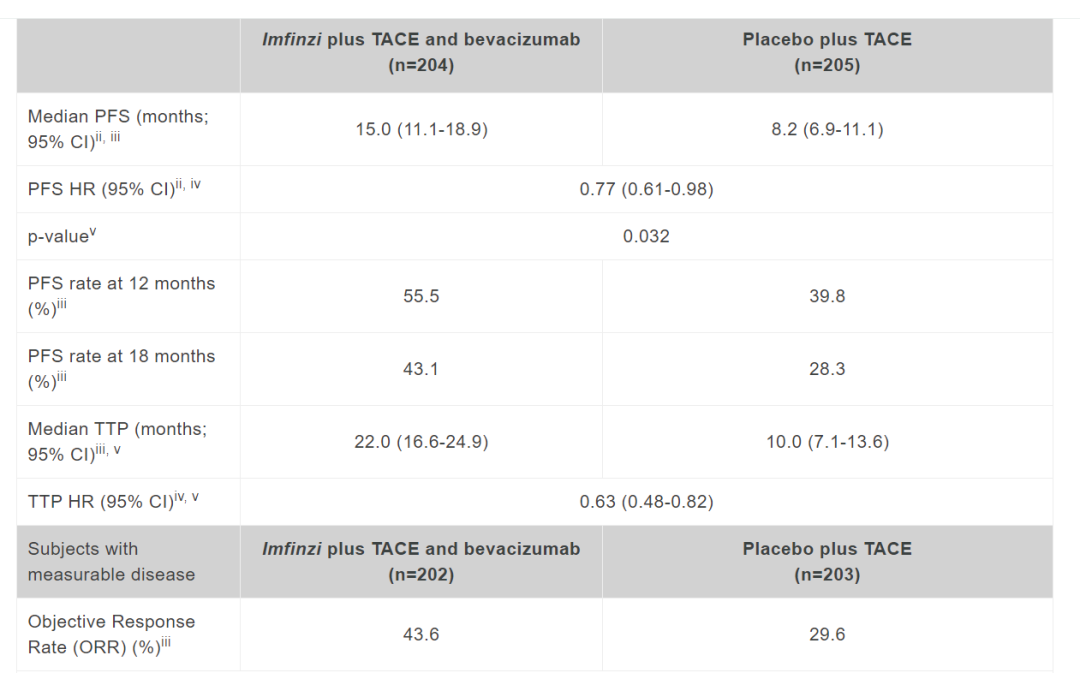
▲Main efficacy results of the Phase 3 clinical trial EMERALD-1 for Imfinzi combination therapy (Image Source:Reference [1])
The clinical trial will continue to evaluate data on the key secondary endpoint of overall survival (OS).
Imfinzi is a humanized monoclonal antibody. By binding to PD-L1, Imfinzi blocks the interaction between PD-L1 and PD-1 and CD80 proteins, thereby inhibiting the tumor's immune escape mechanism.It has already obtainedApproved by the U.S. FDA, in combination with the anti-CTLA-4 antibody Imjudo (tremelimumab), treats patients with unresectable hepatocellular carcinoma, offering them a novel immunotherapy combination consisting of dual immune checkpoint inhibitors.
Liver cancer is the third leading cause of cancer-related deaths globally, with a particularly high incidence in the Asian region. In recent years, significant progress has been made in immunotherapy for first-line treatment of liver cancer, with Roche's PD-L1 inhibitor Tecentriq (atezolizumab) combined with bevacizumab.Combination Therapy, as well as AstraZeneca's dual immune checkpoint inhibitor combination therapy, have been approved for first-line treatment of patients with unresectable or metastatic hepatocellular carcinoma. It is hoped that advancements in immunotherapy will benefit more liver cancer patients.

Everyone is watching






▲To learn more about the application of cutting-edge technologies in the biopharmaceutical industry, please long-press and scan the QR code above to access "WuXi AppTec Live Studio" and watch live discussions and exciting replays on related topics.
Copyright Statement: This article is from the content team of WuXi AppTec. Individuals are welcome to share it on their social media circles, but unauthorized reproduction by media or institutions in any form to other platforms is prohibited. For authorization to reproduce, please reply with "reprint" on the WeChat Official Account of "WuXi AppTec" to obtain the reprint guidelines.


Share,PointLike,In View, Focusing on Global Biomedical Health Innovation