AstraZeneca Bets on KRAS G12D Inhibitor UA022 with Global Licensing Deal from YouSen Health

Usynova
Innovative Drug Developer

AstraZeneca
Biopharmaceutical Manufacturer
Undruggable targets have seen increasing research interest in recent years, including tracks such as KRAS G12 inhibitors, Her3 monoclonal antibodies, and Her3 ADCs. Multiple products are currently under development, but uncertainties loom over the different tracks.
——Express——
KRAS G12D Inhibitor
On November 20, Shanghai Jiaochen Biomedical Co., Ltd. announced that it had entered into a global exclusive licensing agreement with AstraZeneca for the UA022 project, a preclinical small-molecule candidate drug targeting the KRAS G12D mutation. Under the terms of the agreement, AstraZeneca will obtain the global exclusive rights to research, develop, and commercialize UA022. Jiaochen Biomedical is eligible to receive an upfront payment of $24 million, as well as up to $395 million in potential development and commercialization milestone payments, plus tiered royalties on net sales.

UA022 is an effective, orally administered small molecule drug that selectively targets the KRAS G12D mutation.
The known members of the RAS gene family include KRAS, NRAS, and HRAS, among which KRAS mutations are the most common, accounting for approximately 85%. Data shows that KRAS mutations occur in about 25% of cancer cases, primarily observed in lung cancer, pancreatic cancer, and colorectal cancer, and are associated with extremely poor disease prognosis. Between 93-95% of pancreatic cancer patients have KRAS gene mutations. According to publicly reported data, younger pancreatic cancer patients (<50 years old) more frequently present with non-mutated KRAS genes.
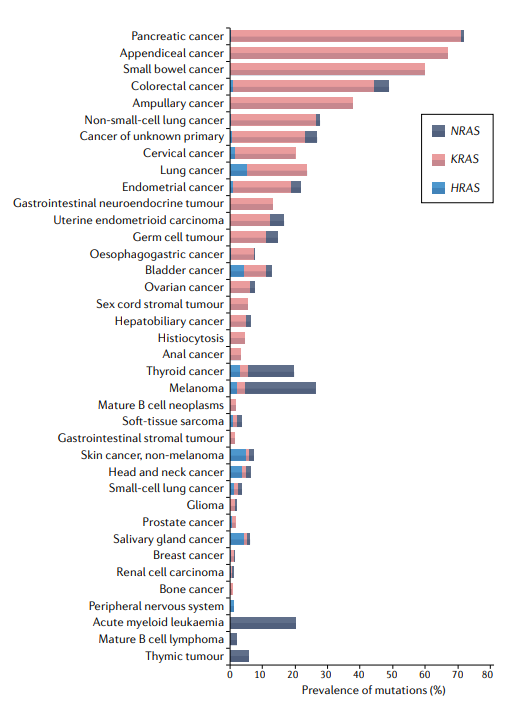
Mutation Rates of KRAS, NRAS, and HRAS in Tumor Patients
Despite KRAS being the most frequently altered oncogenic protein in solid tumors, it was historically considered "undruggable" due to the lack of pharmacologically targetable receptor pockets in its mutant subtypes. KRAS G12D is the most common KRAS mutation in human cancers, with the highest prevalence in pancreatic ductal adenocarcinoma (PDAC), colorectal cancer (CRC), and non-small cell lung cancer (NSCLC). KRAS is a GTPase that cycles between an inactive GDP-bound state and an active GTP-bound state, playing a crucial role in signal transduction for the regulation of cell proliferation and survival. KRAS mutations are commonly found in carcinomas and adenocarcinomas, with the most frequent activating mutations occurring as single nucleotide substitutions at four hotspot codons (12, 13, 61, and 146). Codon 12 has the highest mutation frequency among all four hotspot codons, with the G12D mutation being the most prevalent, followed by G12V, G12C, and others. Among these, the KRAS p.G12C mutation is one of the most common KRAS mutations, specifically referring to the substitution of glycine with cysteine at position 12 of KRAS. This mutation is present in 13% of lung adenocarcinomas, 3% of colorectal cancers, 2% of uterine cancers, and 1% of mesotheliomas, with low proportions also observed in pancreatic cancer, cervical cancer, bladder cancer, and gastric cancer (<1%).
KRAS G12C Inhibitor
On October 5, 2023, the FDA organized an expert committee to review the Phase III validation clinical trial of Amgen's KRAS G12C inhibitor Sotorasib. This has been a long-standing focus of mine, as any successful product targeting Kras, previously considered an undruggable target, is particularly precious.23WCLC丨PFS Benefit, OS Negative: Prospects for KRAS InhibitorsOne article reviewed past research and made predictions about possible future scenarios. Now, it is time to announce the results. At the end of the meeting, the expert panel voted 2 in favor and 10 against, concluding that the primary endpoint of CodeBreaK 200—Progression-Free Survival (PFS) assessed by Blinded Independent Central Review (BICR)—could not be reliably interpreted. This once again brought the study’s endpoint design and trial process design to the forefront. Sotorasib received FDA accelerated approval based on ORR data, but in the confirmatory CodeBreaK 200 trial, long-term survival benefits such as PFS and OS were inevitably required. In recent years, there have been numerous cases where PFS benefits were observed without corresponding OS benefits, casting a layer of uncertainty over new drug development and further highlighting the unpredictability of investment in innovative drug development.
——2023 ESMO——
The 2023 European Society for Medical Oncology (ESMO) Annual Congress was held from October 20 to 24 (Central European Summer Time, CEST) in Madrid, Spain. The ESMO conference covers basic research, translational research, and the latest clinical research advancements, providing a broad and excellent academic platform for clinical practice, multidisciplinary discussions, and more.

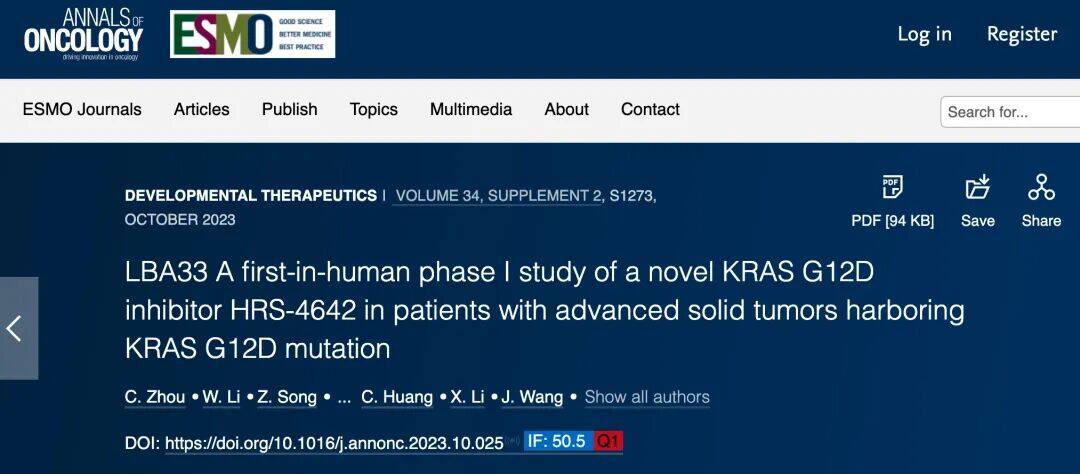
The Phase I study (NCT05533463) of HRS-4642, a KRAS G12D inhibitor led by Professor Cai-Cun Zhou for patients with advanced KRAS G12D-mutant solid tumors, was selected as an LBA oral presentation at ESMO. The results showed that HRS-4642 is the first KRAS G12D inhibitor with promising clinical efficacy and good tolerability.
Research Background:
KRAS G12D Mutation is One of the Most Common Subtypes in RAS-Mutant Cancers. However, there are currently no clinical trial result reports available regarding KRAS G12D inhibitors. HRS-4642 is a highly selective KRAS G12D inhibitor. Here, we report the preliminary results from the dose-escalation portion of the first-in-human phase I trial of HRS-4642 in patients with advanced KRAS G12D-mutant solid tumors.
Research Methods:
Patients with confirmed advanced solid tumors who had failed standard therapy and carried the KRAS G12D mutation were recruited. During a 21-day treatment cycle, patients received intravenous injections of different doses of HRS-4642 (15, 50, 100, 200, and 300mg QW).
The dose escalation part can accept patients with KRAS mutations. An accelerated titration and Bayesian Optimal Interval design will be used to guide dose escalation and determine the maximum tolerated dose (MTD). The primary endpoints include safety, MTD, and the recommended phase 2 dose (RP2D).
Research Results:
As of the data cutoff date on August 4, 2023, 18 patients were enrolled (lung adenocarcinoma n=10, colorectal adenocarcinoma n=5, appendiceal mucinous adenocarcinoma n=1, ovarian cancer n=1, and pancreatic cancer n=1).
Patients had previously received a median of 3 lines of treatment (range 2-7). No DLTs were observed, and the MTD has not been reached. Grade 3 or higher adverse events (AEs) were observed in 9 patients (50.0%). Treatment-related AEs (TRAEs) of grade 1 or higher occurred in 6 patients (33.3%), including hypercholesterolemia (16.7%), increased lipase (11.1%), and anemia (11.1%). No dose-related trend in the incidence of AEs was observed. Serious TRAEs (grade 2 ALT increase and grade 1 AST increase) were observed in one patient. No patients discontinued treatment or died due to TRAEs.
Thirteen patients underwent at least one baseline assessment, with one NSCLC patient achieving a partial response at the 200mg dose. Eleven patients (61.1%) had stable disease, and six (33.3%) exhibited target lesion shrinkage, including those with lung cancer and colorectal cancer. The half-life of HRS-4642 was approximately 40 hours.
Research Conclusion:
HRS-4642 Demonstrates Tolerable Safety and Preliminary Antitumor Activity in Advanced Solid Tumors with KRAS G12D Mutation. Dose Escalation is Ongoing, with Dose Expansion Expected to Begin Soon.
KRAS-G12D Inhibitor RMC-9805
First Patient with KRAS-G12D Mutant Solid Tumors Dosed in Phase 1/1b Clinical Trial of Oral Covalent Mutant-Selective KRAS Inhibitor RMC-9805
This study adopts a multi-center, open-label, dose-escalation and dose-expansion design, with the primary objective of evaluating the safety and tolerability of the drug in 290 patients with solid tumors carrying the KRAS G12D gene mutation.
Mark A. Goldsmith, Ph.D., CEO and Chairman of Revolution Medicines, the pharmaceutical company developing RMC-9805, stated in a press release: "Dosing patients with RMC-9805 represents a significant milestone for Revolution Medicines, marking the entry of the company’s third oral RAS inhibitor into clinical evaluation. We are now advancing three highly innovative RAS inhibitors with complementary profiles — RMC-6236 addresses cancers driven by multiple RAS mutations, while the other two inhibitors target specific RAS variants: RMC-6291 targets KRAS G12C, and RMC-9805 targets KRAS G12D."
Disclaimer: The publication/reproduction of this article is solely for the purpose of information dissemination, and does not represent the views of this official account or confirm the authenticity of its content. Any judgment made based on this content will be at your own risk.If there is any infringement, please inform us and we will delete it immediately!
Long press to follow this official account