

Huaxia Yingtai's LILRB4-Targeted STAR-T Cell Therapy YTS104 Receives IND Approval from China’s NMPA for Phase I Clinical Trial

BriSTAR Immunotech
Cellular Immunotherapy Product Developer


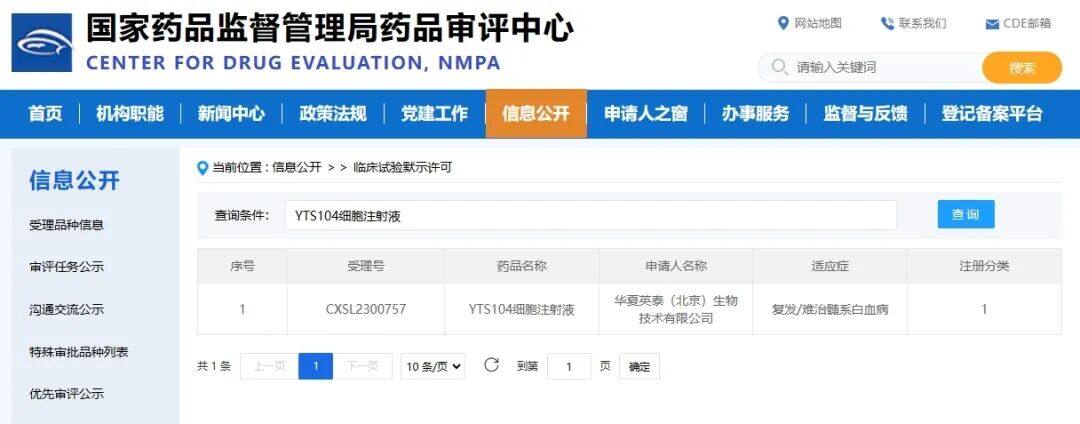
The website of the Center for Drug Evaluation of the National Medical Products Administration shows that YTS104 Cell Injection has received tacit approval for clinical trials.
YTS104 Cell Injection is an autologous cell therapy innovative drug developed by Huaxia Yingtai (Beijing) Biotechnology Co., Ltd. based on the STAR-T technology co-pioneered with Tsinghua University.The product advantage lies in the use of two independently screened LILRB4 nanobodies with different epitopes, which are connected to the α and β chains of the STAR structure, respectively. This is expected to provide better antigen recognition and killing effects. YTS104 cell injection showed positive data in early studies, effectively killing target-positive tumor cells, and was presented as a poster at the 2023 American Association for Cancer Research (AACR). Previously, YTS104 cell injection received "Orphan Drug" designation from the U.S. FDA in December 2022.
YTS104 targets the LILRB4 (also known as ILT3, CD85k), a myeloid immune inhibitory receptor., which is highly expressed on monocytic AML blasts (FAB M4 and M5 AML subtypes), making it an ideal therapeutic target for monocytic AML. At the same time, the LILRB4 target represents a differentiated exploration from the current CAR-T cell therapy research, which is more concentrated on targets such as CD19 and BCMA in hematologic malignancies.
The indications for YTS104 cell injection include relapsed/refractory acute myeloid leukemia (AML), chronic myelomonocytic leukemia (CMML), and other diseases.Among them, AML is one of the common malignant tumors of the hematopoietic system; AML has strong heterogeneity, with limited current clinical treatment options and poor prognosis. Primary drug resistance is common. Existing adoptive cellular immunotherapies, such as CAR-T therapy, have demonstrated significant anti-tumor activity in B-cell malignancies and multiple myeloma. However, due to the heterogeneity of AML cells, their similarity to normal hematopoietic cells, and the lack of leukemia cell-specific targets, the efficacy of CAR-T therapy for AML is very limited. CMML is a type of chronic myeloid leukemia that exhibits dual characteristics of myelodysplastic syndromes/myeloproliferative neoplasms (MDS/MPN); CMML is the most aggressive form of chronic leukemia, with a short median overall survival and a high risk of transformation into acute leukemia. Currently, there are no highly effective treatments available.
The IND approval of YTS104 cell injection not only marks a significant milestone for Huaxia Yingtai(Beijing)Biotechnology Co., Ltd., but also represents a differentiated exploration of new targets in cell therapy in China, offering a new treatment option for many patients with advanced AML and CMML in China and globally. As research progresses, Huaxia Yingtai will further promote the application of the STAR-T technology platform to treat more indications, addressing unmet clinical needs.
Huaxia Yingtai is an innovative pharmaceutical company with a global perspective, relying on strong research and development capabilities, focusing on the development of gene-edited T-cell immunotherapy products, and committed to addressing unmet clinical needs such as advanced cancer. Founded in 2018 by renowned global immunologist Professor Lin Xin, the company aims to develop next-generation cell therapy products through its proprietary STAR-T technology platform based on TCR-T technology, targeting solid tumors, hematologic malignancies, and autoimmune diseases, with the goal of becoming a world-leading biotechnology enterprise. Within two years, the company has obtained regulatory approval for two Phase I new drug clinical trials and is currently conducting several "First-in-Human" exploratory clinical trials. It is expected to submit one to two new drug applications for cell therapy products by 2026, benefiting patients in China and globally.
E.N.D
Previous article recommendations:
Illustrated Guide to NK Cell Therapy
Hengrui Medicine Subsidiary Files for First Gene Therapy Product
CDE Releases "Technical Guiding Principles for Non-Clinical Research of Human Stem Cell Products"
CDE Releases "Technical Guidelines for Clinical Trials of Gene Therapy Products for Rare Diseases"
CRISPR/Cas9 Gene Editing Therapy Receives FDA Approval for Treating β-Thalassemia
The Top Ten Advances in China's Medical and Biotechnology in 2023 Revealed
WuXi Biologics: Sherry Gu to Serve as Chief Technology Officer and Executive Vice President
Review of 40 Global Stem Cell Therapy Companies and Their Technology Pipelines
Further Optimization of Small Nucleic Acid Drugs Can Reduce Production Costs by 60%
Nuo En Gene Receives Tens of Millions of Yuan in Strategic Investment
$200 Million in Sales, the First DMD AAV Gene Therapy Drug Exceeds Expectations by a Wide Margin
The Real "Bottleneck" in China's Biopharmaceuticals Industry
$4.165 Billion! Bo Wang Pharmaceuticals Licenses Multiple RNAi Therapies to Novartis
The First Exosome Anti-Aging Stock Goes Public, Market Value Exceeds 490 Million Yuan
Disclaimer: This article is intended for knowledge sharing. All content is for reference only and does not constitute any advice.