Medtronic Completes First U.S. Implants of Percept™ RC, the First and Only Sensing, Directional, and Fully Programmable Deep Brain Stimulation System

Medtronic
Chronic Disease Medical Device and Therapy Developer
Medical Device Media Reporting Pioneer
Share Professional Medical Device Knowledge
On January 19, 2024, Medtronic announcedMedtronic's Percept RC Neurostimulator Completes First Implants in the U.S. in the Field of Deep Brain Stimulation (DBS),This is another major milestone for the product following its recent FDA approval.
According to reports,Percept RC is the first and only DBS system with perception, directionality, and comprehensive and advanced programming, which Medtronic calls a "game-changing" device.The product received EU CE certification in December of last year and was approved by the FDP for sale in the U.S. on January 8th this year.
Recently, Dr. Casey Halpern and his team from the University of Pennsylvania School of Medicine completed the first Percept RC implant surgery in the United States. In addition, other neurosurgical teams have also completed implant surgeries, including Dr. Alexander Papanastassiou and Dr. Eleni Okeanis Vaou from the University of Texas Health Science Center at San Antonio, Dr. Amir Faraji from Houston Medical Center, and Dr. Ronnie Alterman from Beth Israel Medical Center.
Dual-Channel Neurostimulator
Percept RC, as the latest innovative product in the Medtronic Percept series, isThe smallest and thinnest dual-channel neurostimulator currently available in the DBS field.It is equipped with BrainSense technology, which canCapture patients' brain signals to provide clinicians with objective data directly from the brains of DBS (Deep Brain Stimulation) patients.To understand the impact of treatment decisions (such as changes in medication or stimulation).
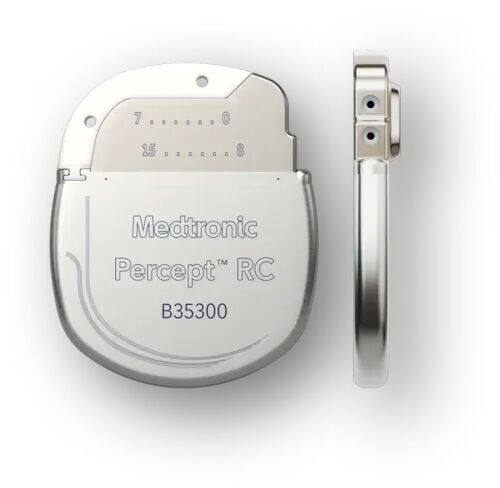
Medtronic Percept RC
BrainSense™ technology uses implanted DBS leads to capture brain signals (local field potentials or LFPs),Improved insulation of the Percept™ RC Neurostimulator enhances LFP detection, allowing its LFP to be one million times smaller than the DBS stimulation pulse.These signals can be recorded simultaneously while providing therapeutic stimulation both inside and outside the clinic. Healthcare providersThe collected data can be used to map each patient's brain response to stimulation or medication, as well as the manifestation of symptoms and side effects in brain activity, thereby helping to develop more effective and personalized treatment plans.
Unlike other rechargeable devices,The Percept™ RC battery provides a service life of at least 15 years.Features consistent and rapid charging performance. Medtronic's patented battery technology experiences less degradation compared to other rechargeable devices, making the battery more reliable and longer-lasting.Patients can charge the battery from 10% to 90% in less than an hour.
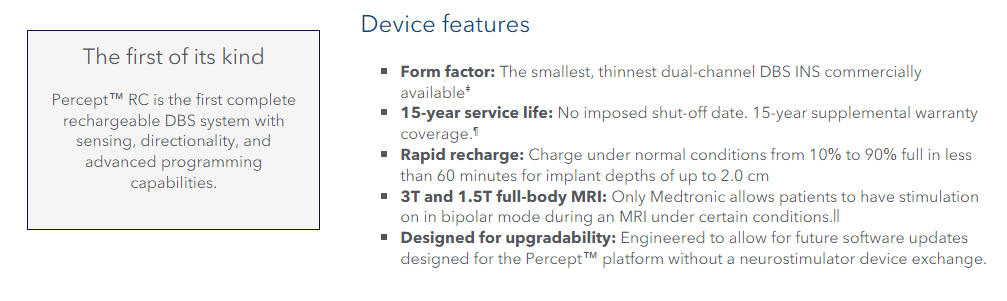
Moreover, nearly 70% of patients suitable for DBS require MRI examinations as part of their basic care.Medtronic is the first company in the United States to provide patients with a full-body MR Conditional DBS system, allowing patients to undergo 3T and 1.5T MRI scans without turning off DBS therapy under specific conditions.It will not cause damage to the deep brain stimulation system. In addition, the Percept neurostimulator is designed to allow software updates for the future Percept platform without the need to replace the DBS device.
The sensing DBS enabled by Percept allows doctors to personalize treatment for patients with movement disorders. These conditions include Parkinson’s disease, essential tremor, dystonia, and epilepsy.Associate Professor of Neurology, Dr. Eleni Okeanis Vaou, once stated: "This new rechargeable neurostimulator technology allows me to understand my patients' symptoms and capture data even when they are away from the clinic. Now, I have a rechargeable DBS treatment option with sensing technology that can track patients' responses to DBS and medication. I use this data to guide how to personalize and optimize patients' treatments."
The application space will be unlimited.
Deep Brain Stimulation (DBS), commonly known as the "brain pacemaker,"It is a therapeutic technique used to treat neurological disorders such as Parkinson's disease, epilepsy, dystonia, and essential tremor.At the same time, it has broad prospects in the treatment exploration of refractory obsessive-compulsive disorder, treatment-resistant depression, addiction, and anorexia nervosa.
DBS therapy uses stereotactic technology to implant electrodes into certain deep brain regions, which are controlled by an implantable pulse generator (IPG) placed subcutaneously below the clavicle.Electrodes emit electrical pulses to stimulate targets and modulate neural function, ultimately achieving the goal of treating neurological and psychiatric disorders.
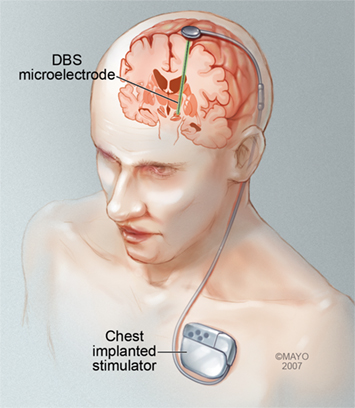
DBS Diagram
IPG contains a battery and electronic components that deliver electrical stimulation. It can be controlled by both patients and clinicians, who can regularly adjust stimulation parameters such as frequency, pulse width, and voltage to maximize the neuromodulatory effects of DBS.
In 1997, the U.S. FDA approved Medtronic's application to use DBS for treating essential tremor and Parkinson's disease.
Currently, more than 180,000 patients worldwide have received Medtronic DBS implants. Follow-up studies on implanted cases show that DBS is highly effective in controlling motor symptoms of Parkinson's disease and reducing medication intake.
In addition, recent research results show that,DBS is expected to be applied to a variety of diseases, including chronic pain, obsessive-compulsive disorder (OCD), and depression, among others. Meanwhile, scientists are also experimentally exploring the efficacy and safety of DBS therapy for drug addiction, anorexia, obesity, and Alzheimer's disease.As research on DBS continues to advance, the future application of DBS therapy will be limitless.
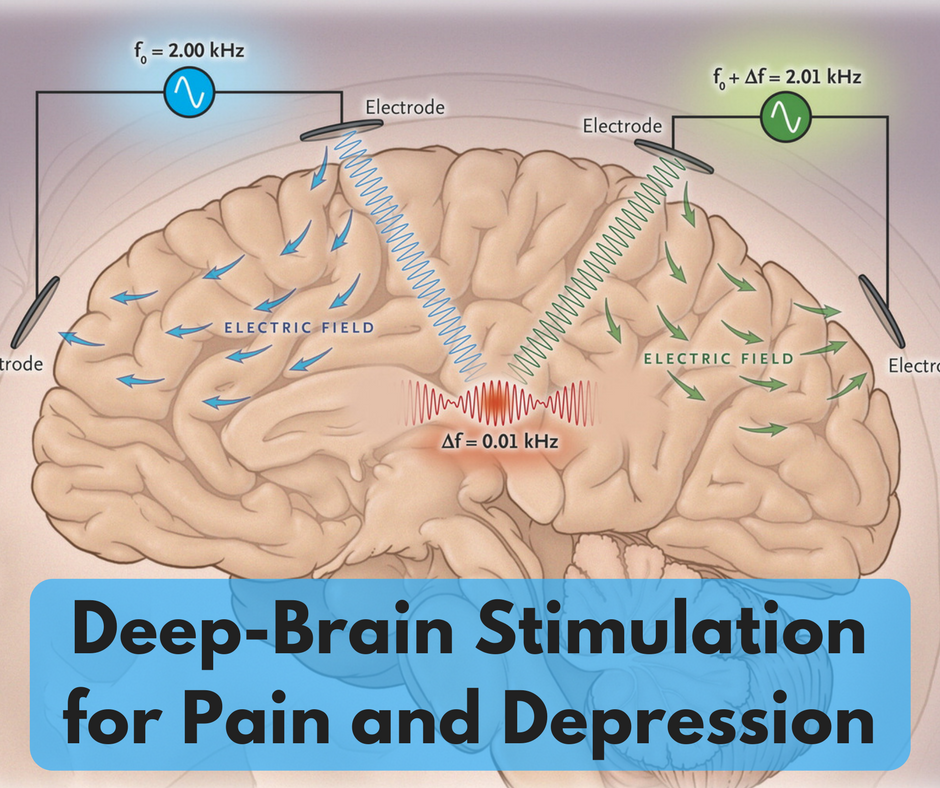
Numerous Participants in the Neurostimulation Market
Data shows,The United States is currently the largest production and consumption market for implantable neurostimulators globally, accounting for approximately 40% of the global market share.Among them, the top three细分 markets are spinal cord stimulation (SCS), deep brain stimulation (DBS), and vagus nerve stimulation (VNS), accounting for 54.67%, 16.52%, and 14.19%, respectively.
Facing a huge potential market, many companies have joined the competition in neuromodulation.Currently, the global neuromodulation market isNeuro modulation products from seven major players — Medtronic, Abbott, Boston Scientific, LivaNova, Nevro, Nuvectra, and NeuroPace — account for the vast majority of the global market share.
However, in recent years, in response to the tremendous demand for chronic diseases, related enterprises both in China and abroad have also entered this field, continuously developing new technologies and launching new products to expand their indications. Currently,A number of domestically produced enterprises have emerged in the field of neuromodulation devices, such as SceneRay Medical, Pinnacle Medical, etc., with broad space for domestic substitution.
So,With another major milestone completed for Percept™ RC, when will this product launch in the U.S. and the Chinese market? As a leading company in the field of neuromodulation, what surprises will Medtronic bring to the market in the future?Medical Device FrontlineWill continue to follow up.
More exciting content
Welcome to follow WeChat Video Channel


€1.5 Billion, Philips Makes a Move
Top 100 Influential Companies in China: 52 Medical Enterprises Honored
$21 Billion, 1,000 Employees: Giant Goes Head-to-Head with Abbott
Puzzle: A Medical Device Company Passed the Review One and a Half Years Ago, But Has Not Gone Public
7.3 Billion, WEGO's International Layout
Focus on Surgical Navigation, Major Moves by Orthopedic Giants
Another Medical Device Company Makes Progress in Pursuing STAR Market Listing
Involve 3 CEOs, Major Changes in Fosun Pharma's Senior Management
The Powerhouse Duo: A Game-Changer in Endoscopic Ultrasound
Breaking: Philips' This Business Has Been Acquired
BusinessBusiness cooperation email: qxzj@landianyiliao.com