

FDA Imposes Black Box Warnings on Six CAR-T Therapies Over T-Cell Malignancy Risk: Could Allogeneic CAR-T Emerge as the New Leader?

Kite Pharma
CAR-T Cell Immunotherapy R&D Provider

Gilead Sciences
Antiviral Drug Developer

Novartis
Drug Development and Manufacturing
Bristol-Myers Squibb
Biopharmaceutical and Nutritional Product R&D and Sales

Johnson & Johnson
Healthcare Product Manufacturers, Health Service Providers

Legend Biotech
Clinical-stage biopharmaceutical R&D and manufacturing

Preface
FDA announced on Monday that it will add a black box warning about the risk of T-cell malignancies to six cell therapies.
This action was initiated as early as the end of 2023. The FDA stated that since the approval of each CAR-T product, reports have emerged in post-marketing and clinical trial data regarding the occurrence of mature T-cell cancers (including CAR-positive tumors) following the use of CAR-T therapies targeting BCMA and CD19, with severe cases even resulting in death.
Referencing JAK inhibitors, after the first-generation JAK inhibitors received the FDA black box warning, it was not until the emergence of highly selective TYK2 allosteric inhibitors that the past safety constraints of JAK inhibitors could be bypassed mechanistically, thereby lifting the black box warning and significantly reducing commercialization barriers.
Therefore, as soon as the news was released, it caused the stock prices of several autologous CAR-T therapy developers to plummet. The decline was particularly significant for companies with CAR-T products that have not yet been marketed. Meanwhile, the stocks of Allogene and Cellectis, companies developing allogeneic CAR-T products, rose by approximately 2% and 9%, respectively.
As of the issuance of the letter on January 19, the following companies have 30 days to submit supplementary materials and make modifications to the approved labels of their respective products.
01
Kite Pharma
Yescarta and Tecartus, developed by Kite Pharma, both target CD19. Yescarta is the first CAR-T cell therapy to be launched in China and is currently the best-selling one.
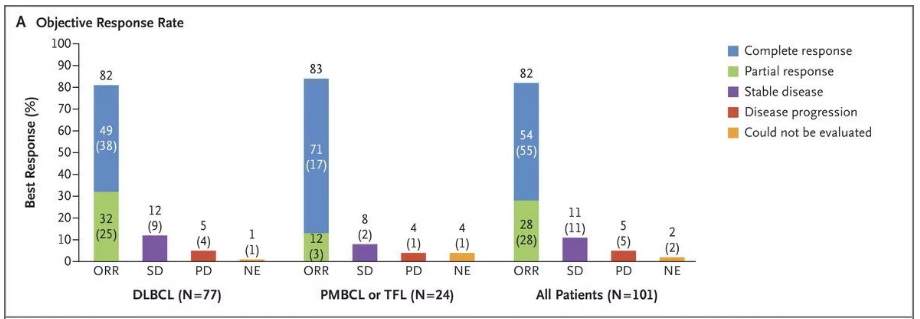
Data from the pivotal ZUMA-1 clinical study of Yescarta showed that, for adult patients with specific types of large B-cell lymphoma who had received at least two prior treatments but did not achieve remission or experienced disease recurrence, the ORR was 82%, the CR was 54%, the median follow-up was 15.4 months, 42% of patients maintained response, 40% of patients maintained complete response, and the 18-month overall survival rate was 52%.
On the other hand, the successful launch of Tecartus also made Kite the first company to have multiple approved CAR-T therapies. Data from the single-arm, open-label ZUMA-2 pivotal clinical trial showed an ORR of 87% and a CR of 67% following a single infusion treatment.
Regarding the FDA's black box warning investigation, Gilead stated that the company has full confidence in the overall safety of Tecartus and Yescarta. To date, there is no evidence indicating a causal relationship between them and the development of new malignancies.
02
Novartis

As the world's first approved CAR-T therapy, Novartis' Kymriah also targets CD19. However, its revenue from Q1 to Q3 in 2023 was $388 million, falling short of Yescarta. The main reasons are the increasing competition in the CAR-T field, along with Yescarta’s differentiated positioning, rapidly expanding indications, and cost advantages, which have allowed it to gradually surpass Kymriah and become the best-selling CAR-T therapy globally.
Despite Novartis expressing confidence in Kymriah's benefit-risk profile, no causal relationship has been found between the treatment and secondary malignancies among the more than 10,000 patients treated with Kymriah. However, with intensifying competition and the impact of a black box warning, could this be adding insult to injury for Kymriah, whose sales have already begun to decline?
03
BMS

Like Kite Pharma, BMS currently has two CAR-T cell therapies: Breyanzi and Abecma. Abecma is a BCMA-targeted CAR-T cell therapy co-developed by BMS and Legend Biotech.
Currently, the only CAR-T therapies targeting BCMA on the market are Legend Biotech's Carvykti and Bristol-Myers Squibb's Abecma. However, the sales performance of Abecma have been the weakest among the six CAR-T therapies, even being surpassed by the later entrant, Carvykti. From Q1 to Q3 of 2023, Abecma’s revenue reached $372 million, marking a 14% decline year-over-year. The fundamental reason lies in Carvykti’s superior efficacy.
But BMS has not been idle, hoping to further increase the sales of Abecma by expanding production capacity. However, with the needs of the multiple myeloma patient population largely met at present, expanding production capacity may lead to an oversupply situation, potentially exacerbating losses.
Therefore, how to achieve differentiated positioning and expand the range of indications is the key to whether Abecma can break through the current situation.
04
Legend Biotech/Johnson & Johnson
The first CAR-T therapy targeting BCMA, Carvykti, comes from the collaboration between Legend Biotech and Johnson & Johnson. Previously, Biospace also wrote an article titled "China-produced CAR-T Expected to Generate $500 Million in Sales This Year," which clearly demonstrates the stable growth of Carvykti.
Given Carvykti's excellent efficacy and safety, as well as the strong demand for medication among patients with relapsed or refractory multiple myeloma (R/R MM), orders for Carvykti have never been an issue. The biggest factor limiting Carvykti's sales growth is production capacity, which even led to zero quarter-on-quarter growth in the fourth quarter of 2022.
Therefore, it remains to be seen whether Legend Biotech's CMO agreement with Novartis will further accelerate the scale-up and drive sales growth of Carvykti.
Summary
Regarding the impact of the black box warning, economists and doctors have conducted in-depth studies indicating that it generally leads to a decrease in drug prescription volume. As for whether this will be the straw that breaks the camel's back for several CAR-T therapies whose sales are already on the decline, it remains uncertain.
Currently, all six approved CAR-T therapies have been added with black box warnings, and the impact on their future sales remains uncertain; as for other CAR-T therapies that have not yet been marketed, will their commercialization journey become more challenging? (Friends with thoughts are welcome to discuss in the comments below.)
Note: The information is reproduced from the official websites of various companies and public information sources.
Statement
The content of the article is for reference only and does not constitute investment advice. Investors who take action based on this information bear their own risks. The article maintains a neutral stance on the statements and viewpoints expressed, and provides no explicit or implicit guarantees regarding the accuracy, reliability, or completeness of the content.
The articles published in this official account are intended for sharing. If there is any infringement, please contact us and we will handle it.

Paid Recommendation
●Recommended 15 Classic Books for Systematic Learning of Biopharmaceutical CMC (Free Download)
●How are the CDMOs in China performing during this cold winter?
●The Bioprocessing Industry "Gathers Momentum," Breakthroughs in Critical Process Points!
●An Analysis: Requirements of the U.S. FDA for Pharmaceutical Process Development
●In-Depth Review of Nucleic Acid Drugs
● A Comprehensive Review of 42 ADC Drug Companies in China
● A Glimpse of Global Layout Bispecific ADC Enterprises
●The Four Classic Site-Specific Conjugation Technologies of ADC
● Stem Cell Drug Development: Quality by Design (QbD)
●A Brief Discussion on the CMC Research Focus at Each Stage of Innovative Drug Development
✦
Boutique Conference
✦



✦
High-Quality Community
✦


Scan the QR code to follow us
Reply "Target Audience", let's chat with the buddies in the biopharmaceutical industry~"

Forward, like, check, and arrange?