Source: Siyu MedTech; Editor: Liu XinyiReprint Requirements: Please indicate the source of the article at the beginning of the text, and it can be reprinted directly.
On January 24, 2024, Abbott (NYSE: ABT) announced its 2023 fiscal year fourth-quarter financial report and full-year results, which were generally in line with Wall Street expectations.# Highlights of Financial Report- Annual revenue of $40.11 billion, down 8.1% year-on-year;Revenue in the fourth quarter was $10.24 billion, a year-on-year increase of 1.5%;
- Net profit for the year was US$5.72 billion, a year-on-year decrease of 17.5%.;Net profit in the fourth quarter was US$1.59 billion, increasing by 54.2% year-on-year.
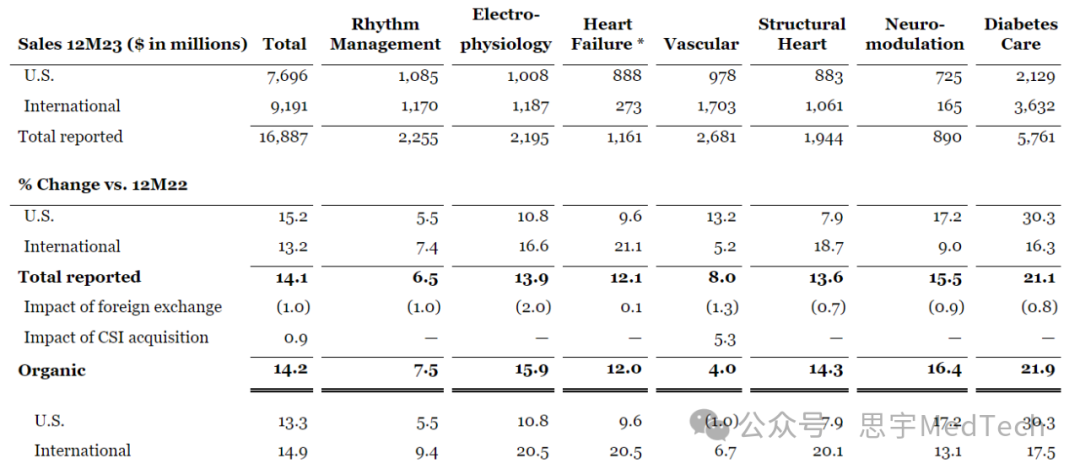
- Abbott's businesses are divided into four categories: pharmaceuticals, nutritional products, diagnostics, and medical devices.The Medical Device Business Shows the Most Significant Growth, with annual sales of $16.89 billion,An increase of approximately 14% year-over-yearAmong them, diabetes care grew the fastest (22.1%), followed by neuromodulation (15.5%), and then electrophysiology (13.9%);
- Full-year organic sales growth (excluding COVID-19 testing-related sales) for fiscal year 2024 is expected to be in the range of 8.0% to 10.0%.
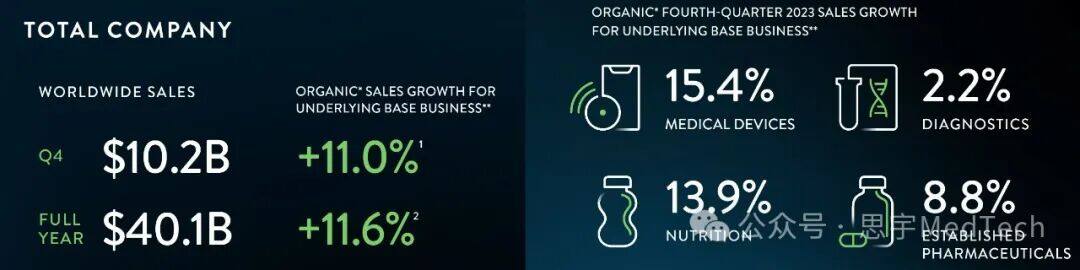
The growth percentages of the departments in the figure are based on Q4 data.
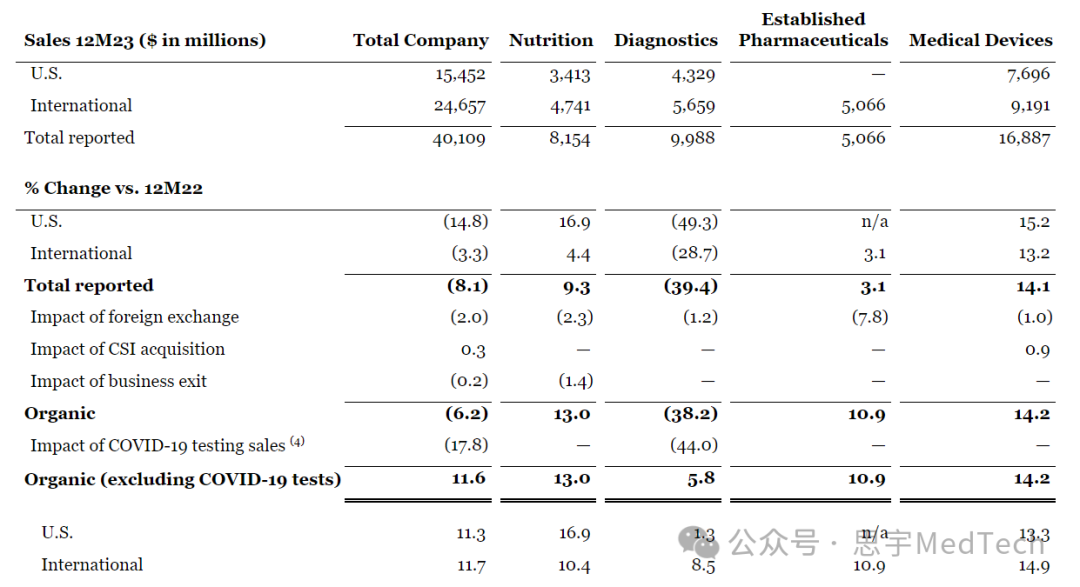
In 2023 fiscal year, Abbott's performance for the whole yearRevenue of $40.11 billion, a year-on-year decrease of 8.1%Except for a sharp year-on-year drop of 39.4% in diagnostic business ($9.988 billion), nutrition ($8.154 billion, up 9.3%), pharmaceuticals ($50.66 billion, up 3.1%), and medical device business ($16.89 billion, up 14%) all achieved positive growth (nutrition and pharmaceuticals showed seasonal weakness).By region, full-year revenue in the U.S. was $7.696 billion, while revenue outside the U.S. reached $9.191 billion, indicating that Abbott places significant importance on markets outside the United States.By business division, Abbott MedicalAll instrument businesses achieve positive growth.。
Ranked by business growth rate as follows:Diabetes care grows fastest (22.1%), followed by neuromodulation (15.5%), then electrophysiology (13.9%) and structural heart (13.6%). Growth in other segments was: heart failure (12.1%), vascular (8.0%), rhythm management (6.5%), and vascular (8.0%).
The ranking by business revenue is as follows: the largest revenue-generating business is Diabetes Care ($5.761 billion), followed by Vascular ($2.681 billion), Heart Rhythm Management ($2.255 billion), Electrophysiology ($2.195 billion), and Structural Heart ($1.944 billion) in the second tier. In the third tier are Heart Failure ($1.161 billion) and Neuromodulation ($890 million, although the figure is smaller, Abbott is one of the three giants in neuromodulation).
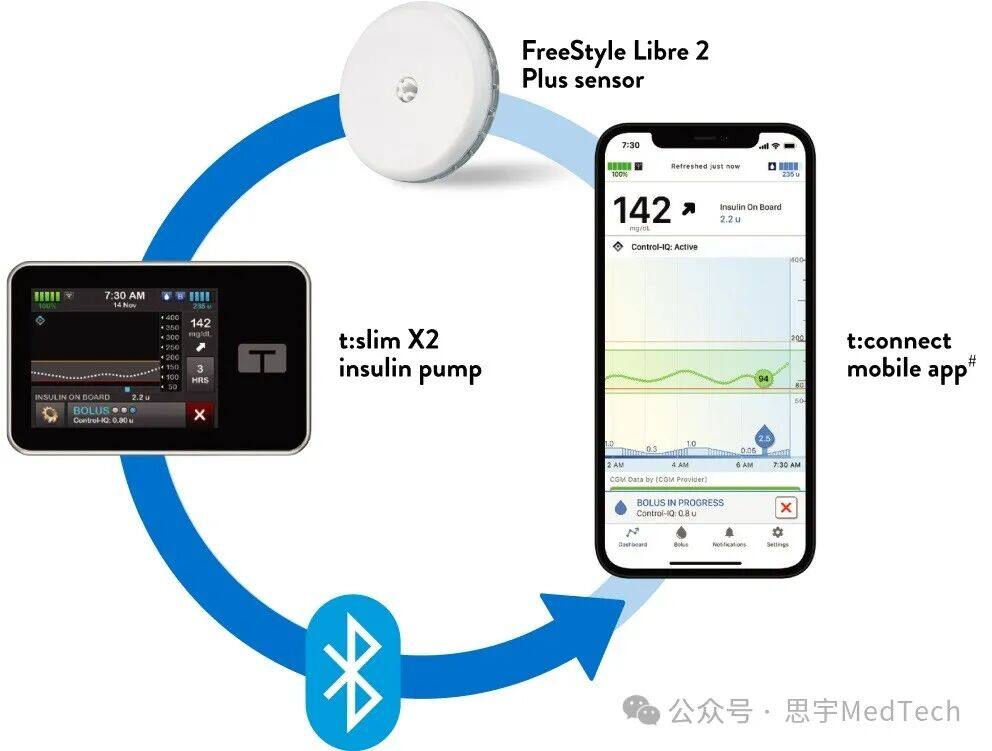
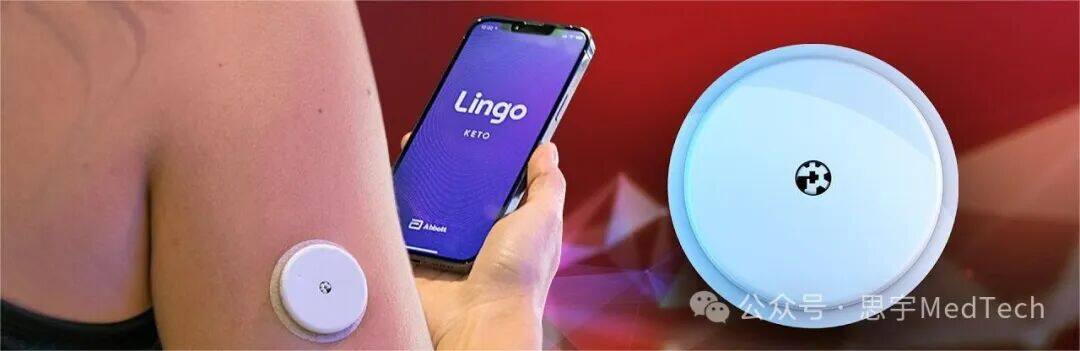
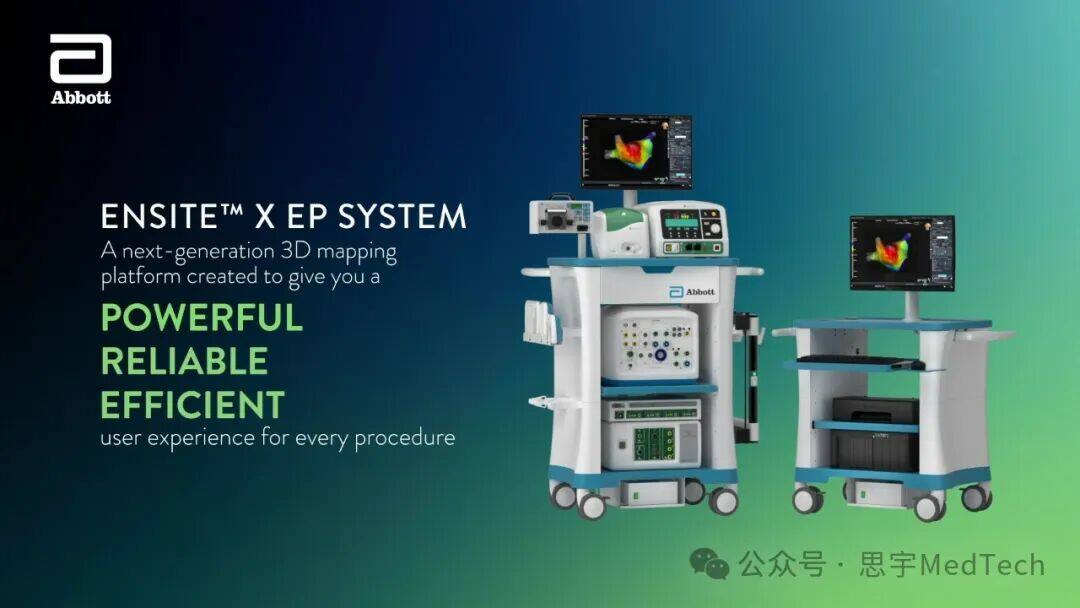
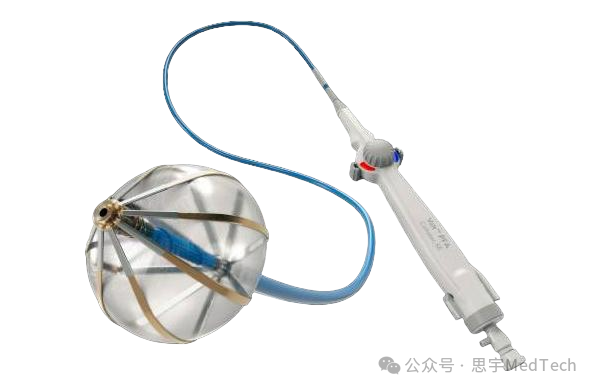
Abbott stated that the sharp decline in the diagnostics business was mainly due toDecline in COVID-19 Test SalesIn the fourth quarter of Abbott's fiscal year, global COVID-19 test sales shrank to $288 million. Although this figure is slightly higher than Wall Street's forecast of $205 million, it is still not optimistic.Moreover, this also marks a shift in the company's focus. The CEO of Abbott stated that the company’s plan isInvest in Core Business with Revenue from COVID-19 Testing, which has also proven to be a very correct strategy, as these areas are crucial fields in the healthcare industry.At present, Abbott's focus is onDiabetes CareAndElectrophysiologyUp.Diabetes Care:In terms of diabetes care, Abbott has a long history, and by the end of this fiscal year, the sales of Abbott's continuous glucose monitoring systems exceeded $5.3 billion. Its market-leading continuous glucose monitoring devicesFreeStyle LibreCan be said to have fundamentally changed the management of diabetes.Currently, there are over 5 million Libre users globally, and Libre's sales in the fourth quarter reached$1.4 billion, a year-on-year increase of 25.5%. The CEO of Abbott also praised Libre as Abbott's"The Most Successful Medical Device in History", In the past 16 quarters, the growth rate has exceeded the market growth rate in 13 quarters.Abbott's strategy isTargeting the Mass MarketThe market needs a painless, highly accurate, easy-to-use, and cost-effective system, and the arrival of Libre has met these demands. Currently, Libre's annual sales will not exceed $5 billion. However, Abbott has achieved initial success, with more than 500 million diabetes patients worldwide, and Abbott will embrace several new growth opportunities in the future.Moreover, healthcare payment providers around the world (especially in the United States, France, and Japan) are gradually recognizing the value of Libre for patients, healthcare providers, and healthcare systems, so regardingThe reimbursement scope of Libre is also expanding.. Recently, for example, the reimbursement scope is expanding to cover more patients with type 2 diabetes.Moreover, Abbott has reached collaborations with multiple insulin pump manufacturers, and Libre can now connect to automated insulin delivery pumps, such as Tandem's t:slim X2 pump.In addition to Libre, Abbott has also launched wearable blood glucose monitoring devices.Lingo。Lingo can track blood glucose levels while also providing personalized diet and exercise recommendations to users through an application. This device will soon enter the U.S. market using a direct-to-consumer model, without the need for a prescription or involvement from insurance companies or other payment entities—just cash payment. This product is expected to become Abbott's next major growth catalyst.Electrophysiology:Abbott said its electrophysiology businessHas achieved strong growth globally, not only in Europe, but also in the United States, and in China as well. Such results are the combined efforts of all electrophysiology products. However, the CEO still highlighted some equipment, such as the company'sAdvanced Mapping SystemAnd launched this yearTactiFlex Ablation Catheter System。Abbott's most advanced three-dimensional mapping system is the EnSite™ X EP. This mapping system received CE certification in November 2020 and FDA approval in January 2022. The system isThe First Mapping System with Two Cardiac Visualization Methods, combining single-pole measurement and bipolar measurement. Single-pole measurement has advantages in direction and speed, while bipolar measurement can provide local signal measurement to locate the target area.The TactiFlex ablation catheter, on the other hand, isThe World's First Flexible-Tip Contact Pressure Ablation Catheter, the distal end of the ablation catheter is etched like scales and features magnetic and electrical positioning as well as pressure monitoring. With an optical pressure design, it can bend upon contact with the heart wall to guide the flow of flushing fluid toward the target tissue. This catheter is also compatible with the EnSite™ X EP System.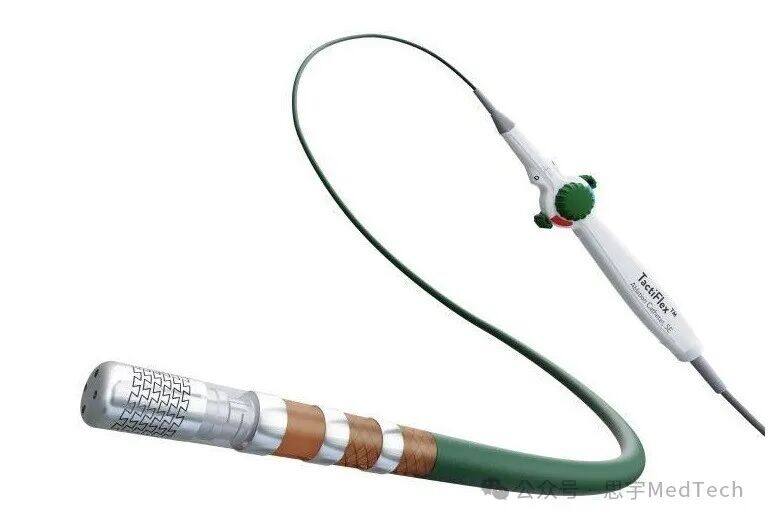 Moreover, based on advanced mapping systems, Abbott has recently entered the highly competitive pulsed field ablation (PFA) arena, announcing the company'sVolt™ Pulsed Field Ablation (PFA) SystemApplied to the human body for the first time. Compared with Medtronic's PulseSelect and Boston Scientific's FARAPULSE, this ablation system has two major features. One is that it follows the same route as Johnson & Johnson,CombinationAdvanced Mapping SystemUse(Also using the EnSite™ X EP), but there is a design feature in the tip of the ablation catheter.Dilation Balloon。Previously, Abbott has always been focused on the PFA system.Maintaining aWait and seeThe attitude, but if we continue to wait and seeGo, Abbott is not only affected in the radiofrequency ablation sector, but also the sales of diagnostic catheters and mapping systems will be impacted. After all, the main products of the two leading players in the PFA market do not require a mapping system.As for its own PFA system, the CEO of Abbott said that technology is not a problem and the team has done a great job.The issue lies in the speed of product launches.。After all, even if things go smoothly, Abbott's PFA system will not enter the market until 2026, a few years later than Medtronic, Boston Scientific, and Johnson & Johnson.In addition, the CEO also mentionedAveir PacemakerStimulated double-digit growth in the heart rhythm management business,MitraClipPromoted the structural heart business,Chronic and Acute Circulatory Support DevicesPromoted the sales of heart failure devices, as well as the recently launchedEterna Rechargeable Neurostimulation DeviceTakes a leading position in the field of neuromodulation.
Robert B. Ford, Chairman and Chief Executive Officer of Abbott LaboratoriesFord stated: "The strength and diversity of Abbott's product portfolio have driven our success in 2023. We are entering 2024 with positive momentum. With our highly productive pipeline, we are well-prepared for growth in 2024 and beyond."