HomeDingxin Gene Announces Breakthrough Clinical Results of RRG-003, a Dual-AAV Gene Replacement Therapy for OTOF-Mediated Deafness, Published in The Lancet
Dingxin Gene Announces Breakthrough Clinical Results of RRG-003, a Dual-AAV Gene Replacement Therapy for OTOF-Mediated Deafness, Published in The Lancet
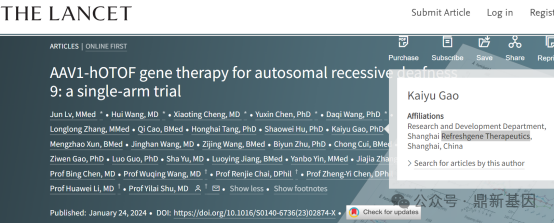
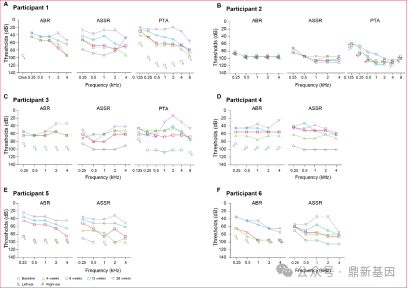
On January 25, 2024, RRGENER, in collaboration with the Eye, Ear, Nose, and Throat Hospital of Fudan University (Shanghai ENT Hospital), published a long article titled "AAV1-hOTOF Gene Therapy for Autosomal Recessive Deafness 9: a single-arm trial" in The Lancet, the world's top medical journal. RRG-003 (AAV1-hOTOF) is a dual-vector AAV (Adeno-associated virus, AAV) gene replacement therapy drug. Among the six children treated with RRG-003, five showed significant improvement in hearing and speech function. For this study,President of Shanghai Medical Association, Director Wu JingleiRRGENER collaborates with our basic scientific research and clinical doctors, enabling us to creatively develop such an AAV vector drug based on the problems identified in our foundational research, and swiftly proceed to clinical trials to explore results, laying a solid foundation for rapid future translation. Zhu Qigao, Deputy Director of Shanghai Science and Technology CommissionEvaluation: This study shows that we have taken a big step forward in dealing with genetic diseases and reducing deaf-mute disabilities. We will continue to support the construction of the gene and cell therapy center in the otolaryngology department. At the same time, we also hope that medical research teams and industry teams will collaborate more, so that more innovative achievements can benefit people all over the world. Professor Zhengyi Chen, Department of Otolaryngology-Head and Neck Surgery, Harvard Medical SchoolComment: The cochlear implant, invented more than 60 years ago, remains the only treatment for patients with severe hearing loss. However, in this work, children with otoferlin deficiency were treated through gene therapy, restoring their hearing and enabling them to communicate normally. This is indeed an extraordinary achievement. Continuing this work holds the promise of transforming it into a new gene therapy drug for otoferlin deficiency. This study also represents the first proof that treating hereditary deafness is feasible. Behind this hard-won clinical research achievement lies the close cooperation between the two parties and the support from the industry. At the end of 2020, when RRGENER was less than half a year old, it held discussions with Dr. Li Huawei and Dr. Shu Yilai's team from the Eye, Ear, Nose, and Throat Hospital of Fudan University on AAV gene therapy in the field of otology. After the discussion, they selected the OTOF gene from numerous otology targets and signed a strategic cooperation agreement. Both parties negotiated and divided the tasks: RRGENER designed the human OTOF vector, while the ENT Hospital designed the murine Otof vector, thus initiating the exploration journey of OTOF gene therapy. Behind the seemingly simple AAV gene delivery for rare diseases lies countless experiences and techniques. RRGENER has consistently integrated the concept that drug quality originates from design throughout the drug development process. RRG-003 is a dual-vector delivery drug, and the factors affecting drug delivery efficiency are highly complex, including AAV serotypes, promoters, recombination strategies and sequences, codon optimization, and more. In addition to the impact on delivery efficiency, the OTOF gene is extremely large. Even with a dual-vector system, it approaches the upper limit of AAV packaging capacity, which adds difficulty to AAV production. These challenges were fully considered during the initial design of the AAV vector. When it comes to experiments and specific analytical methods, the parameters for drug optimization multiply. Based on these realities, RRGENER quickly established and selected evaluation methods for related drugs and screened the designed drugs at the cellular level. During that period, the designed AAV was quantified, evaluated in vitro, and sent to the ENT hospital for animal efficacy testing every 1-2 weeks. After the drug restored hearing in mice, the production and quality control of the drug became another challenge. Although RRGENER's R&D team screened a series of components and vectors at the molecular and in vitro levels, the lower recombination efficiency of RRG-003 dual-vector delivery compared to single-vector delivery remains unavoidable. Therefore, increasing the drug concentration is one of the key factors for the success of the project. To this end, RRGENER explored various formulation recipes to reduce AAV aggregation at high concentrations and improve the production quality of AAV. At the initial stage of RRG-003 plasmid production, the yield was very low, which led to plasmid quality issues. After RRGENER’s optimization of the plasmid, the yield was increased 10-fold, significantly improving both the yield and quality of the plasmid. The drug must be safe. In the preclinical safety evaluation, RRGENER designed a targeted preclinical safety evaluation plan based on drug distribution data and the characteristics of local and pediatric medication. Also, because of RRGENER's persistence, after obtaining the ethical approval from the ENT hospital in June 2022, an additional safety evaluation test was conducted. The first clinical trial was ultimately carried out in December. RRGENER, combining its past experience in drug development, also participated in the writing and discussion of the clinical plan for the drug, and confirmed the dosing regimen and exploration process. Finally, on December 28, 2022, the first dosing of the RRG-003 drug was administered. The drug regimen selected by RRGENER showed actual therapeutic effects in patients that even exceeded our estimates based on animal data. The incidence of neonatal deafness is approximately 0.1-0.3%, of which genetic factors account for about 60%. According to WHO data, there are approximately 466 million people worldwide (5% of the global population) with disabling hearing loss (moderate or worse hearing impairment), including 34 million children. It is reported that there are about 70 million people in China with disabling hearing loss, and 30,000 new deaf children are added each year. If infants do not receive sound stimulation from an early age, their language function cannot develop, often leading to muteness due to deafness, placing a significant burden on families and society. DNFB9 is a type of congenital deafness caused by OTOF mutations, usually resulting in severe hearing loss. Currently, there are no drugs available in clinical practice to treat hereditary deafness. OTOF encodes otoferlin, an "otoferlin" associated with auditory vesicle release function, which is essential for neurotransmitter release at the synapses of inner ear hair cells. Defects in otoferlin caused by OTOF mutations can lead to significant hearing impairment. With a deeper understanding of the OTOF gene, researchers have found that patients with OTOF gene mutations and mouse models exhibit intact cochlear structures, while hearing loss often manifests as severe, profound, or complete deafness. Therefore, OTOF is the most promising and necessary gene for targeted deafness treatment to achieve clinical translation first. Since the length of OTOF is close to 6Kb, exceeding the common packaging limit of 4.7Kb for AAV, expressing OTOF through dual-vector AAV is an ideal approach. RRG-003 is divided into two vectors, carrying the N-terminal and C-terminal coding sequences of OTOF respectively. When both vectors enter the same cell, DNA recombination occurs, forming a complete OTOF sequence, thereby expressing the full-length OTOF protein and restoring hearing in DNFB9 patients. RRG003 Clinical Trial Received Ethical Approval from the Eye, Ear, Nose, and Throat Hospital of Fudan University in June 2022. This clinical trial involves single-ear administration for pediatric patients. Among the six subjects, four had previously undergone cochlear implantation, and the children’s ages range from 1 to 6 years. The first dosing was completed in December 2022, with the first patient being a 4-year-old girl who has now completed one year of follow-up. The child is currently able to engage in daily conversations. Except for the second case, which was ineffective, the other four cases showed varying degrees of hearing recovery, with continuous improvement in hearing over time after administration. RRGENER Founder Zhou Rui"We are very pleased that the clinical research of RRG-003 has been published in a top global medical journal."《The Lancet》Above. This project is an industry-academia-research cooperation and transformation project, covering everything from early molecular and animal experiments to late-stage drug production and clinical research, with both parties working closely together to fully leverage their respective strengths. Through collaboration with the Shu Yilai/Li Huaewi team from the Eye, Ear, Nose, and Throat Hospital affiliated with Fudan University, and by playing to each party's strengths under high standards, the project was pushed into clinical trials in a very short time. This has provided us with valuable experience in exploring the field of deafness, and we look forward to offering more treatment options for patients with hearing loss in the future. Meanwhile, we have also received FDA designations for Rare Pediatric Disease and Orphan Drug, and we hope our drug will bring good news to patients worldwide."