

Five Pivotal Clinical Trials in Neurodegenerative and Psychiatric Disorders to Watch in H1 2024

Denali Therapeutics
Biopharmaceutical Manufacturer

Intra-Cellular Therapies
Neurological Drug Developer

Sanofi
Pharmaceutical R&D Developer

ANNEXON BIOSCIENCES
Biological New Drug Developer

Wave Life Sciences
Genetic Drug Developer

Praxis Precision medicine
Central Nervous System (CNS) Therapy Developer
The field of neurodegenerative and psychiatric diseases has seen several breakthroughs in recent years. For instance, two amyloid-targeting antibodies for Alzheimer's disease have already received FDA approval, and a third anti-amyloid antibody is expected to be approved this year. The field of schizophrenia may also welcome the first new mechanism drug in decades. Today, an article published by the industry media BioSpace listed5 Clinical Trials Worth Watching in the Field of Neurodegenerative and Psychiatric Disorders: These Trial Results Are Expected to Bring Innovative Therapies for Diseases with Significant Unmet Needs Such as Huntington's Disease, ALS, and Depression.

Image Source: 123RF
R&D Company:Sanofi, Denali Therapeutics
Therapy Name:SAR443820/DNL788
Indications:Amyotrophic Lateral Sclerosis (ALS)
Type of Therapy:Small Molecule Drugs
In the treatment of ALS (also known as Lou Gehrig's disease), Sanofi and Denali Therapeutics are expected to announce the top-line results of the Phase 2 clinical trial for the investigational RIPK1 small molecule inhibitor SAR443820/DNL788.
RIPK1 is a key protein in the tumor necrosis factor receptor signaling pathway and a regulator of inflammation and cell death. Increased activity of RIPK1 in the brain drives neuroinflammation and necrosis. Inhibition of RIPK1 has shown beneficial effects in preclinical models of Alzheimer's disease, ALS, and other conditions.
SAR443820/DNL788 is a potent, selective, blood-brain barrier-penetrating small molecule RIPK1 inhibitor being developed for Alzheimer’s disease, amyotrophic lateral sclerosis, and multiple sclerosis (MS).It has been granted Fast Track designation by the U.S. FDA for the treatment of ALS.
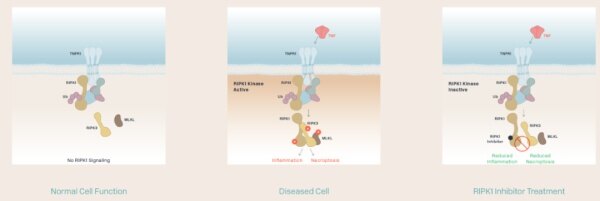
▲Mechanism of Action of SAR443820/DNL788 (Image Source:Denali Therapeutics Inc. Official Website)
Denali Therapeutics recently announced that patient enrollment has been completed in the HIMALAYA Phase 2 clinical trial, a randomized, double-blind, placebo-controlled study, with topline results expected to be released in the first half of 2024.
R&D Company:Intra-Cellular Therapies
Therapy Name:lumateperone
Indications:Major Depressive Disorder (MDD)
Type of Therapy:Small Molecule Drugs
Lumateperone is an oral, once-daily atypical antipsychotic. It has received FDA approval for the treatment of schizophrenia and as an adjunctive treatment for episodes of schizophrenia and depression associated with bipolar I or II disorder in adults.Although its mechanism of action has not been fully elucidated, its efficacy can be jointly mediated by the antagonistic activity on central serotonin 2A receptors (5-HT2A) and the postsynaptic antagonistic activity on central dopamine D2 receptors.
Previously,Lumateperone in Phase 3 Clinical Trials for the Treatment of Severe Depressive Episodes in Patients with MDD and Bipolar Disorder with Mixed FeaturesPositive Results, demonstrating its potential in treating a broad range of patients with depression.Currently, Intra-Cellular TherapiesThe company is evaluating the efficacy of lumateperone as an adjunctive therapy in treating MDD patients through multiple Phase 3 clinical trials. Among these, Study 501 and Study 502 are both randomized, double-blind, placebo-controlled Phase 3 clinical trials conducted in adult MDD patients who have shown an inadequate response to antidepressant monotherapy. Top-line results for Study 501 are expected in the first quarter of this year, while top-line results for Study 502 are anticipated in the second quarter.
R&D Company:Annexon Biosciences
Therapy Name:ANX005
Indications:Guillain-Barré Syndrome (GBS)
Type of Therapy:Monoclonal Antibody
Annexon Biosciences is expected to obtain pivotal Phase 3 clinical trial data for its lead candidate drug ANX005 in the first half of 2024, for the treatment of Guillain-Barré Syndrome. GBS is a potentially fatal and severe autoimmune neurological disorder caused by autoantibodies attacking peripheral nerves, which may lead to paralysis, neurodegeneration, and cognitive impairment. There are currently no approved therapies available.
ANX005 is designed to inhibit the complement protein C1q, which is upstream in the complement cascade, thereby not only blocking the activation of the entire classical signaling pathway but also maintaining the functional integrity of other complement pathways.It has been granted Orphan Drug Designation and Fast Track Designation by the FDA for the treatment of GBS.
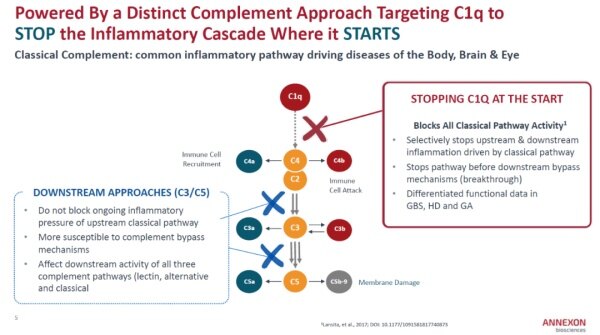
▲ANX005 Blocks by Inhibiting C1qThe classical signaling pathway of the complement system (Image source: Annexon Biosciences company website)
In a Phase 1b proof-of-concept clinical trial,ANX005 Rapidly and Consistently Improved Multiple Indicators of GBS DiseaseIncluding significantly reducing the activity of the classical complement signaling pathway, improving muscle strength, significantly reducing neurofilament light chain (NfL) levels (a biomarker indicating neuronal damage), and improving patients' disability scores.
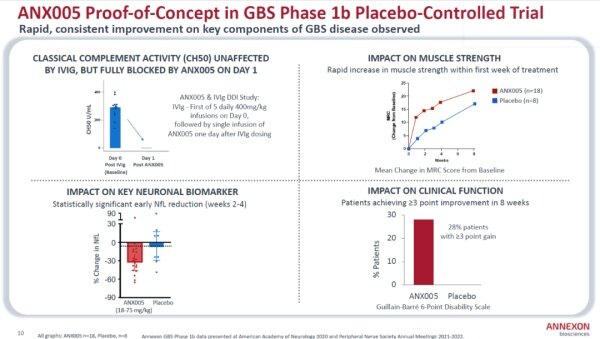
▲ANX005 Demonstrates Positive Efficacy in Proof-of-Concept Clinical Trials (Image Source: ANNEXON BIOSCIENCES Official Website)
A pivotal Phase 3 clinical trial, randomized, double-blind, and placebo-controlled, completed patient enrollment in the second half of 2023, with topline results expected in the first half of 2024.
R&D Company:Wave Life Sciences
Therapy Name:WVE-003
Indications:Huntington's Disease
Type of Therapy:RNAi Therapy
Huntington's disease is caused by the encoding of the huntingtin proteinHTTThe CAG expansion in genes leads to the production of a mutant huntingtin protein (mHTT), which exhibits neurotoxicity. The wild-type huntingtin protein also plays a crucial role in normal neuronal function; therefore,HTTGene mutations not only increase the production of mHTT but also reduce the levels of normal protein, leading to synaptic dysfunction, cell death, and neurodegenerative disorders.
WWE-003 is a potential “first-in-class” allele-specific RNAi therapy that selectively binds to the mRNA expressing mHTT, reducing the expression of the mutant protein while not affecting the expression of the wild-type protein.Previously published trial results show that a single dose of WWE-003 treatment compared to placebo,Can reduce the average level of mHTT in cerebrospinal fluid by 35%, while maintaining the level of wild-type protein. The company expects to report expanded follow-up results from the multi-dose (30 mg dose) patient cohort in the second quarter of this year.
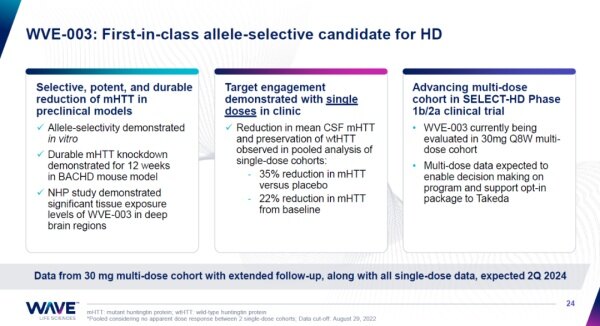
▲WWE-003 Introduction (Image Source:Wave Life Sciences Official Website)
R&D Company:Praxis Precision Medicines
Therapy Name:PRAX-628
Indications:Focal Epilepsy (Focal Epilepsy)
Type of Therapy:Small Molecule Therapy
Developed by Praxis Precision Medicines, Inc.PRAX-628 is a next-generation, functionally selective small molecule inhibitor of sodium channels, targeting sodium channels in the brain that are in a hyperexcitable state.The company's press release noted that preclinical studies have shown,PRAX-628 has the potential to become a "best-in-class" therapy for treating focal epilepsy.
Results from the Phase 1 clinical trial conducted in healthy volunteers showed that PRAX-628 demonstrated good tolerability, pharmacokinetic, and pharmacodynamic profiles at all tested doses.
The company is currently evaluating the efficacy of PRAX-628 (at doses of 15 mg and 45 mg) in a Phase 2a clinical trial. The preliminary analysis of the 15 mg patient cohort showed drug activity that exceeded expectations, according to the company’s press release. The full data from this trial is expected to be released in the first half of this year.