

Pfizer's Paxlovid Fades as RSV Vaccine Battle Heats Up
Pfizer
Pharmaceutical R&D Developer
In 2023, Pfizer is still recovering from the decline in demand for Drug P.
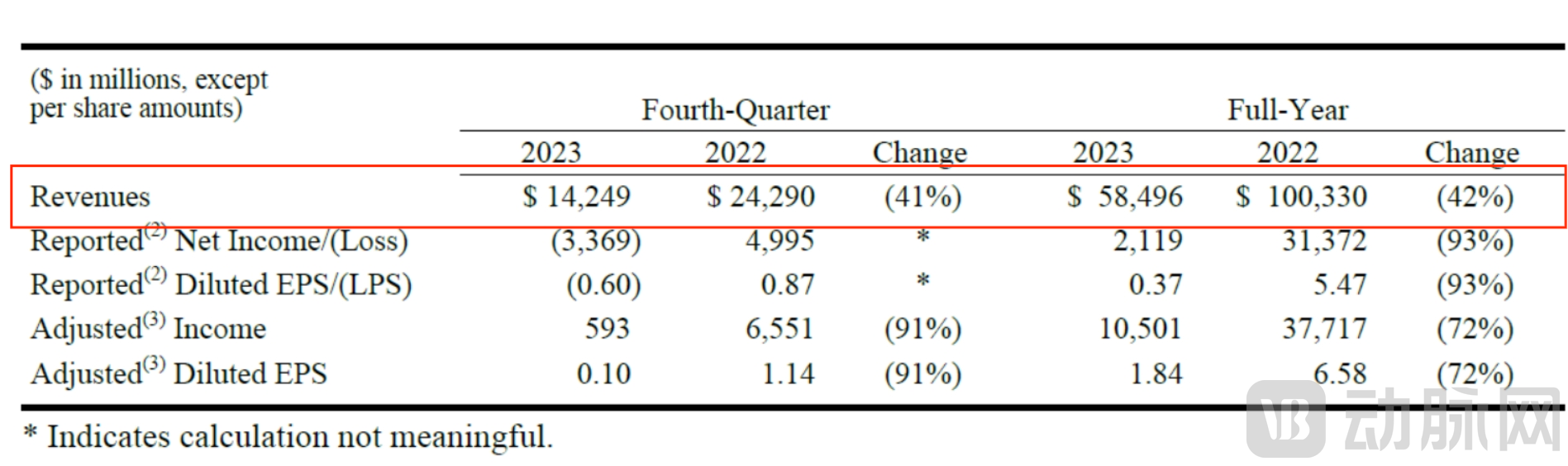
On January 30, Pfizer announced its financial report for the fourth quarter and full year of 2023. According to the financial data, Pfizer achieved a total revenue of $58.496 billion in 2023, a year-on-year decrease of 42%. Revenue in the fourth quarter was $14.249 billion, a year-on-year decrease of 41%.
In 2023, Pfizer achieved a net profit of $2.119 billion, a year-on-year decrease of 93%, including a net loss of $3.369 billion in the fourth quarter. In addition, Pfizer's total R&D investment for the year was $10.679 billion, a year-on-year decrease of 6%.
Pfizer has been working to improve its financial situation. In October 2023, Pfizer announced a $3.5 billion cost-cutting plan. By the end of 2023, Pfizer added another $500 million to its cost-cutting plan, expecting to save $4 billion by the end of 2024.
In addition, Pfizer has been carrying out layoffs and plant closures, including facilities in North Carolina and New Jersey. In October 2023, Pfizer shut down its plant in New Jersey, resulting in a workforce adjustment of 791 employees; the company also eliminated the Pharmaceutical Sciences Small Molecule (PSSM) department in Sandwich, Kent, UK, and reduced staff in Michigan and Ireland. Currently, Pfizer has initiated multiple rounds of layoffs, cumulatively exceeding 2,000 layoffs globally.
P药已成往事,未来辉瑞会将新的增长点放在哪里?
Top 20 Sales in 2023: COVID-19 Business Revenue Drops by $10 Billion, RSV Achievements Stand Out
Pfizer currently has four major business units: General Medicine, Specialty Medicine, Oncology, and Innovative Services. In 2023, the General Medicine unit generated $30.589 billion in revenue, a year-on-year decrease of 58%. The Specialty Medicine unit achieved $14.970 billion in revenue, an 8% increase year-on-year. The Oncology business reported revenue of $11.627 billion, a 4% decrease year-on-year. The newly established Innovative Services unit, launched at the beginning of the year, generated $1.31 billion in revenue, a 2% decrease year-on-year. Additionally, Pfizer is also engaged in CDMO and API supply businesses.
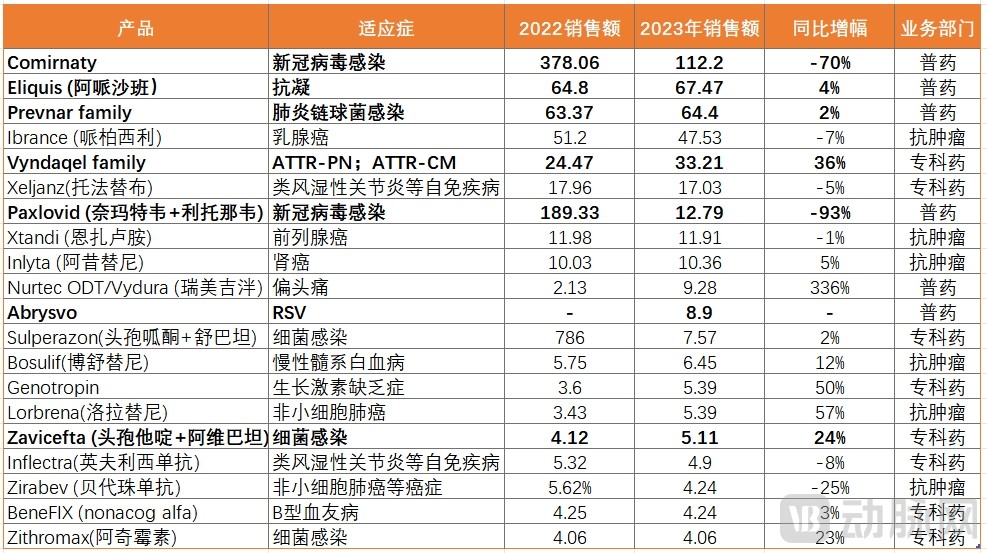
Pfizer's Top 20 Products by Sales in 2023
According to the explanation in Pfizer's annual report,The main factors affecting performance are the COVID-19 vaccine Comirnaty and the oral medication Paxlovid., Comirnaty and Paxlovid sales plummeted by 41%, ifExcluding these two major products, revenue increased by 7% year-over-year.At the same time, the decline in profits is also related to two COVID-19 drugs.
Looking back at last year, thanks to the sales contribution of the above two products, Pfizer became the first pharmaceutical giant to achieve revenue of over 100 billion US dollars in 2022. In 2022, the combined sales of Comirnaty and Paxlovid reached 56.739 billion US dollars, contributing approximately 56.57% to Pfizer's total revenue.
However, since the beginning of 2023, Pfizer's COVID-19 products have started to show signs of decline. At that time, Pfizer projected a significant drop in revenue for its COVID-19 products in 2023, with Comirnaty's revenue expected to be $13.5 billion and Paxlovid's revenue estimated at approximately $8 billion. This led to a substantial decrease in investor confidence, causing Pfizer's stock price to fall by 14% cumulatively in the first month of 2023, wiping out $43 billion in market value.
According to the 2023 annual report data, Comirnaty achieved revenue of $11.22 billion, a year-on-year decrease of 70%; Paxlovid achieved revenue of $1.279 billion, a year-on-year decrease of 92%. The combined sales of the two products amounted to $12.499 billion, which is $9.001 billion less than expected, and their contribution to Pfizer's total revenue also dropped to 21.37%.
It is worth noting that,Pfizer's revenue loss from its COVID-19 business was also lower than expected.Pfizer's adjusted diluted earnings per share for the fourth quarter were 10 cents, compared to a consensus estimate of a loss of 18 cents; fourth-quarter revenue was $14.25 billion, slightly below analysts' expectations of $14.42 billion.
Pfizer's Revenue Reversal: U.S. Government Returns Paxlovid, Saving $700 Million in Losses
In addition to the impact of its COVID-19 business, Pfizer also mentioned the revenue decline of Ibrance (palbociclib), a breast cancer treatment drug, in its 2023 financial report. Ibrance is the world's first CDK4/6 inhibitor to be marketed. In February 2015, Ibrance received accelerated approval from the FDA for use in combination with Femara (letrozole) as a first-line treatment for postmenopausal women with hormone receptor-positive (HR+), human epidermal growth factor receptor 2-negative (HER2-) advanced or metastatic breast cancer who have previously received systemic therapy to control advanced disease.
Beyond the downturn in its COVID-19 business, Pfizer has also achieved excellent results in other areas, includingThe most impressive product is Pfizer's new RSV vaccine, which generated $890 million in sales in its first year on the market, ranking 11th among Pfizer's best-selling products and outperforming over 90% of drugs.
The full-year revenue of Pfizer and BMS's next-generation oral anticoagulant Eliquis reached $6.747 billion, ranking second, with a 4% year-on-year increase, surpassing previous analysts' expectations.
In addition, the sales of Vyndaqel (which can delay nerve damage caused by hereditary heart disease) were also very strong, reaching $3.321 billion, achieving a significant increase of 36%; the sales of oral CGRP inhibitor Rimegepant were also impressive, reaching $928 million, more than quadrupling from $213 million in 2022.
It is worth mentioning that,Pfizer Attempts to Enter the Explosively Growing Obesity Market with its Oral GLP-1 Drug DanuglipronIn December 2023, the company abandoned the twice-daily version due to a high incidence of side effects. Results for its once-daily version are expected in the first half of 2024. This marks Pfizer's second setback in the obesity market, following the termination of another GLP-1 drug's development in June 2023 after elevated liver transaminase levels were detected in patients.
Ibrance's Oncology Business Unit Underperforms. In 2023, more than half of Pfizer's oncology drugs saw declining sales. Ibrance, the top revenue generator, continued its downward trend from the previous year with a 6% year-over-year sales decline to $4.753 billion, primarily impacted by competition from Eli Lilly's Verzenio. Sales of prostate cancer treatment Xtandi fell 1% to $1.191 billion. Another breast cancer drug, Trazimera, experienced a 53% sales drop, contributing to an overall 3% decline in Pfizer’s oncology business revenue.
The Dual Powerhouse Rivalry in the RSV Field: Who Will Take the Lead in 2024?
In Pfizer's annual report, the RSV vaccine Abrysvo showed outstanding sales performance. This RSV vaccine, approved for marketing in May 2023, generated $890 million in revenue in its first year on the market.
Pfizer expects approximately 80 million elderly people and 1.5 million pregnant women to be suitable for vaccination during this year's RSV high season. The RSV vaccine Abrysvo will continue to boost Pfizer's future performance.
据统计,每年全球约有6400万人被感染RSV呼吸道合胞病毒,每年导致约16万人死亡,包括10多万名不到5岁的儿童。老年人患RSV相关严重疾病的风险很高,RSV可加重慢性阻塞性肺病、哮喘和慢性心力衰竭等疾病。
Under the heavy burden of disease, the research and development of RSV preventive products has also been listed by the WHO as one of the highest priority products globally. However, it was not until 2023 that RSV vaccines officially embarked on their commercialization journey. First, GSK's RSV vaccine Arexvy was launched in May, followed by Pfizer's Abrysvo. Both multinational companies rushed to bring their products to market before the peak season arrived.
RSV vaccines are considered the "last blue ocean" in the field of human infectious diseases. Data from CIC Consultancy shows that the global market size for RSV drugs is expected to grow from $18 billion in 2020 to $128 billion by 2030, with a compound annual growth rate (CAGR) of 21.4%. Therefore, this field represents a competition among major companies both in terms of product variety and technological approaches.
Notably, during the same period last year,GSK's RSV Vaccine Arexvy Also Receives FDA Approval for Market Launch, a milestone breakthrough in the RSV field with the creation of the first preventive RSV vaccine. Arexvy's sales performance has been quite impressive, generating 1.238 billion pounds (approximately 1.545 billion US dollars) in revenue for GSK within just nine months of its launch, which is 74% higher than Pfizer's 890 million US dollars.
Currently, Pfizer's vaccine has a slight edge as it can be used for active immunization in pregnant women to prevent RSV-related lower respiratory tract disease in infants from birth to 6 months of age and has better safety; GSK uses the superior "recombinant protein + new adjuvant" technological approach, with a higher protection rate than Pfizer, and has been approved in the United States, Europe, Canada, and Japan.
Pfizer's RSV vaccine Abrysvo, while commendable, lags behind GSK's Arexvy, with its sales revenue at a disadvantage due to missing the first-mover advantage. This has left Pfizer less than satisfied with Abrysvo's performance. According to Pfizer, GSK's Arexvy dominates this field, capturing over 70% of the market share. "This is very hard for me to accept because GSK was able to secure contracts more effectively and execute better."Pfizer CEO Albert Bourla said"We are not very satisfied with the performance of certain product launches. Pfizer's commercial business 'used to be a well-oiled machine,' so we have taken some measures to correct this."
Pfizer needs to continue its efforts if it wants to sustain growth.
However, the market competition in the RSV field has not stopped, and the competition in this billion-dollar track remains highly noteworthy. In addition to GSK, Moderna, Pfizer's previous patent lawsuit opponent, is also making a push in the RSV race.
Moderna's RSV mRNA Vaccine mRNA-1345 Demonstrates Excellent Performance in Phase 3 Clinical Trials, with Notable Protective Efficacy in Elderly Patients. Moderna announced in July 2023 that it had submitted marketing authorization applications for the RSV vaccine mRNA-1345 to the European Medicines Agency, Swissmedic, and the Therapeutic Goods Administration of Australia. It also began a rolling submission of a Biologics License Application for mRNA-1345 to the U.S. FDA. Analysts predict its market potential will reach $700 million, following closely behind Arexvy.
In addition, the subunit vaccine ADV110 from Advaccine, the attenuated live vaccine SP0125 from Sanofi, and the VLP vaccine IVX-A12 from AstraZeneca are all in Phase II clinical trials.
The century-old RSV vaccine challenge, which has troubled the industry for over 60 years, has been officially solved. The hundred-billion-dollar RSV track has been initiated and will experience a major boom in 2024.
The Largest ADC Acquisition, FDA Approval of 9 Products: Is It a Good Medicine?
In addition to its sales operations, Pfizer made frequent acquisitions in 2023. Among the 20 M&A deals in the pharmaceutical industry valued at over US$1 billion in 2023, Pfizer's acquisition of Seagen, the leader in the ADC field, for a staggering US$43 billion topped the list.This is also the largest acquisition deal in the ADC drug field to date.
Among Seagen's four approved cancer therapies, three are ADC drugs, and the company's total sales in 2022 were close to $2 billion. Pfizer's oncology portfolio includes 24 approved cancer drugs. This deal will strengthen Pfizer's oncology pipeline. Pfizer expects that by 2030, Seagen’s sales could exceed $10 billion, with the potential for continued significant growth thereafter.
Interestingly, throughout 2023, the MNC's mergers and acquisitions transactions not only did not decrease in the capital winter, but significantly increased. The reason is that, based on their own products and strategic needs, MNCs are willing to spend heavily to strengthen their advantageous fields and address the patent cliff.
Analysts have calculated that among 19 large biopharmaceutical companies in the U.S. and Europe, BMS, Amgen, and Pfizer face the greatest threat from generic drugs. By 2030, the revenue that could be eroded by generics for BMS, Amgen, and Pfizer is projected to reach 47%, 29%, and 28% of each company's total income in 2025, respectively. By 2030, Pfizer will lose exclusive patent rights for 11 drugs, while nine of Amgen’s leading products are set to face patent expiration between 2021 and 2030.
Therefore,Pfizer Urgently Needs to Find Its Next Blockbuster Product; Pfizer’s RSV Vaccine Abrysvo Performs Well, But Not Well Enough.Pfizer also pointed out that the acquisition of Seagen will expand its influence in the RSV field to reverse last year's downturn.
At the same time, Pfizer has reaped continuous success in the approval of innovative drugs, with the FDA approving a record 9 new products in 2023, including two approvals for Abrysvo, although the company expressed some regret over the early performance of its RSV vaccine launch.
In 2023, despite a drop in stock price and shrinking performance, Pfizer still led the pack in all aspects of performance with the highest revenue.
In 2024, the Universe's Largest Pharmaceutical Company Returns to Fundamentals
At the JPM conference in early January, Pfizer CEO Albert Bourla discussed the challenges Pfizer faced over the past year and the changes made, stating that Pfizer has implemented significant cost-cutting measures necessary for restructuring its business.And will focus on the company's operations and profit growth in 2024."I recognize that last year was a very tough year for investors, but I also believe that 2024 will be a very good year for Pfizer and investors," Bourla said when discussing 2023.
Looking ahead to 2024, Pfizer expects its total revenue for the full year to be between $58.5 billion and $61.5 billion. Excluding the anticipated contributions of $11.1 billion from COVID-19 products and Seagen (with Comirnaty at $5 billion and Paxlovid at $3 billion), operational revenue is projected to grow by 8%-10%.
After experiencing many changes in 2023, Pfizer will face numerous challenges in 2024, and the adjustments it plans to make are highly anticipated. Whether at the JPM conference or in its earnings report, Pfizer mentioned three key issues that will help determine the company's development this year.
First, whether Pfizer can secure a place in the fierce competition within the obesity market.
In December last year, Pfizer announced its oral glucagon-like peptide-1 receptor agonist (GLP-1RA) candidate drug ——DanuglipronTop-line data from the Phase 2b clinical trial (NCT04707313) of PF-06882961 for the treatment of obesity and non-type 2 diabetes in adults.
The data is disappointing,Although the trial did achieve the primary endpoint of the interim weight loss study, the incidence of adverse events was high. Up to 73% of participants reported nausea, while the rates of vomiting and diarrhea reached 47% and 25%, respectively. The discontinuation rate for all dosage forms in the trial exceeded 50%, compared to a 40% discontinuation rate in the placebo group.
Therefore, Pfizer abandoned the clinical research on twice-daily oral Danuglipron and returned to the clinical research on once-daily oral Danuglipron.
Danuglipron is the world's first oral small-molecule GLP-1 receptor agonist, and this experimental drug has opened up an irresistible huge market for Pfizer in the weight loss field. Even though this area is currently dominated by Novo Nordisk and Eli Lilly, Pfizer has a precedent of turning Lipitor, the fifth lipid-lowering drug to reach the global market, into the best-selling drug. Therefore, if Danuglipron can stand out in the highly competitive weight loss arena, it will provide Pfizer with a new growth opportunity.
Clinical trials for once-daily oral Danuglipron will be conducted in the first half of 2024, and if successful, Pfizer will fully advance in the obesity field.
Danuglipron is not Pfizer's only obesity project, as a new asset named "6106" has just entered the clinical stage. Although the mechanism of action has not been disclosed, Bourla reiterated Pfizer's interest in the weight-loss field: "We do believe that obesity is a huge and growing market, and we believe Pfizer has the ability to make a difference and succeed in this area, which is where we will continue to invest."
Secondly, where is Pfizer's super blockbuster drug in 2024?
During the earnings call, Pfizer emphasized the potential of nearly 20 new drug launches, undoubtedly including a significant number of potential blockbuster drugs.
However,Other pharmaceutical giants have begun to increasingly showcase their super blockbuster drugs to investors, with annual sales potential far exceeding $1 billion.For example: Sanofi claims to have three drug projects with peak sales potentially exceeding 5 billion euros, while Johnson & Johnson has launched ten drugs with peak sales potentially surpassing 5 billion US dollars.
Despite Pfizer's 9 new drugs approved by the FDA in 2023, many of its commercial efforts have been disappointing.
Taking the RSV vaccine as an example, Pfizer's RSV vaccine significantly lags behind its competitor GSK's Arexvy, a trend that has yet to be successfully reversed. Umer Raffat, an analyst at Evercore ISI, also pointed out that the sales of several new products, such as the hair loss treatment drug Litfulo and the multiple myeloma drug Elrexfio, were not listed separately, indicating that their commercial scale is still insufficient to make a substantial impact.
Big pharmaceutical companies are often driven by single, large-scale franchises. For example, Sanofi and Dupixent, Merck and Keytruda, AbbVie and Humira. It remains to be seen whether Pfizer can find a mega-blockbuster to boost its revenue growth in 2024.
Third, most of Pfizer's mergers and acquisitions have been completed. Will these deals pay off for Pfizer?
Pfizer has made it clear that the company's series of large-scale acquisitions after the pandemic have come to an end.
Pfizer CFO David Denton mentioned: "At least from a business development perspective, the company's investment phase is over. We need investments to improve future performance, but we have already invested heavily."
Bourla also mentioned: "We do not expect to spend billions of dollars acquiring assets in Phase III clinical trials. Instead, we will consider cheaper pipelines at earlier clinical stages."
Bourla positioned Pfizer's 2024 as a year of strong execution, with the top priority being to protect dividends and reduce debt levels. They are implementing a significant cost-cutting plan, which slashed $2 billion in operations in 2023, and they aim to cut another $2 billion this year.
At the same time, Pfizer needs to integrate its acquisitions of Seagen, Arena, and Biohaven. The company has spent tens of billions of dollars entering rapidly evolving and highly competitive fields such as migraine, sickle cell disease, and ulcerative colitis. It remains to be seen whether and how quickly these drugs acquired through acquisitions can generate a return on investment.