

Implemented in multiple provinces, detection doubled! Known Future uses AI + portable DR to solve the challenge of grassroots tuberculosis screening
The "2024 Global Tuberculosis Report" released by the World Health Organization pointed out that in 2023, there were 10.8 million new tuberculosis patients globally, with an incidence rate of 134 per 100,000, reaching a new high since monitoring began in 1995. The global battle for tuberculosis prevention and control is far from over.
Against this backdrop, the deep integration of AI and healthcare has brought about a breakthrough opportunity. Hangzhou Suozhi Future Technology Co., Ltd. (hereinafter referred to as "Suozhi Future") has launched a full-process solution of "AI + portable DR + on-site testing," establishing an integrated intelligent platform for "perception-analysis-decision," truly delivering efficient and precise tuberculosis screening services to grassroots communities and people's doorsteps.
"In a certain city in China, the government once invested a large amount of funds to provide free tuberculosis screening for more than 200,000 elderly people, but due to reliance on fixed DR equipment, the final coverage rate was only 50%." This case is a microcosm of the current situation of tuberculosis prevention and control at the grassroots level in China.
As a key infectious disease under national prevention and control, tuberculosis (TB) prevention has been incorporated into the "Healthy China 2030" strategic goals, closely aligning with the United Nations' vision of "ending the TB epidemic by 2035." The country has also introduced multiple policies and allocated special budgets to improve the prevention and control system. However, significant shortcomings at the grassroots level still notably hinder the progress towards these goals.
On one hand, grassroots medical institutions lack radiologists and have insufficient DR equipment, making it difficult for residents in remote areas to access medical care and screening. On the other hand, traditional detection methods are updated slowly, and there is insufficient collaboration among imaging, immune, and molecular technologies, failing to form a united force. More crucially, grassroots screening has long been in a passive and inefficient state, and the disconnection between medical treatment and prevention makes it difficult for disease control departments to obtain diagnostic data in a timely manner, repeatedly missing early prevention and control windows.
Lin Xiaoquan, founder of Suozhi Future, has been deeply involved in the tuberculosis field for many years and clearly recognizes the bottlenecks of the traditional model. With the rapid development of AI medical technology in recent years, he keenly perceives the possibility of solving the aforementioned pain points — AI can not only compensate for the lack of grassroots manpower but also integrate multi-dimensional data. Through portable and efficient screening models, it can truly push public health services "to the last kilometer."
The team's industry accumulation spans many years. Its technical foundation began with an in-depth collaboration with Vision Medical Technology. Backed by the Chinese University of Hong Kong and the Hong Kong University of Science and Technology, its core R&D team has not only accumulated 25 years of expertise in AI and medical imaging but also won over 20 international imaging challenge championships, repeatedly outperforming top teams from MIT, Google, and others, demonstrating a solid technical foundation.
Against this backdrop, the initial DR AI algorithm of the future is directly built upon the world's top technical framework. This not only allows the team to bypass the lengthy "from-scratch development" cycle and quickly create efficient and accurate products, but also enables them to stay updated with global research trends, laying a foundation for international expansion.
But Lin Xiaoquan did not stop at technology introduction. Instead, he established a "medical-engineering-industry-academia integrated" R&D model: universities provide cutting-edge technologies and scientific research concepts, while the team offers practical application scenarios and data support for grassroots tuberculosis prevention and treatment; technical development is led by senior AI medical product experts, the business team is familiar with the tuberculosis prevention and treatment industry chain, and on the medical side, radiologists from tertiary hospitals participate in clinical validation. This combination of technology, experience, and resources allows Known Future to focus on real pain points from the outset, avoiding the pitfall of "AI for AI's sake" technological idling.
The core competitiveness of the known future lies in its self-developed DR AI-assisted diagnosis system, whose differentiated advantages precisely meet the needs of grassroots tuberculosis prevention and control.
At the technical level, the system development integrates the feature attention mechanism in the chest X-ray industry, and conducts a series of self-developed technical frameworks and modules based on the Transformer + Yolo benchmark model, including:
● Scale-aware Superpixel Technique: By synergizing dual pathways with multi-core modules, the capability for simultaneous identification and segmentation of small and large lesions is enhanced, significantly improving the detection rate of early tuberculosis and alleviating missed diagnoses caused by insufficient experience among grassroots doctors.
● Omni-supervised Learning Technology: Integrate strongly labeled, weakly labeled, and unlabeled data to overcome the bottleneck of limited medical image annotation resources, comprehensively enhancing the detection performance for multiple diseases in chest X-rays.
● Weakly Supervised Learning Technology with Generalization:Significantly reduce the model's reliance on labeled data, enabling the system to be quickly deployed and applied in grassroots environments where labeling resources are scarce, effectively lowering the implementation threshold.
Clinical practice has validated the reliability and practicality of the system. In a multi-product comparative evaluation conducted at Shenzhen Third People's Hospital (National Infectious Diseases Medical Center), test results based on 235 annotated samples showed that the system achieved a sensitivity of 0.91, with specificity, accuracy, and AUC values all exceeding 0.95, outperforming similar products across all metrics. This indicates that the system not only exhibits extremely low rates of missed and incorrect diagnoses but also demonstrates strong differentiation capabilities between tuberculosis and non-tuberculosis cases, making it highly suitable for large-scale screening scenarios at the grassroots level.
To precisely implement technological advantages, the company has also established a three-level strategy system:
First, demand grading, focusing on core scenarios.In response to the current situation where 70% of approximately 110 million annual chest X-ray examinations in the country are conducted at grassroots levels, it is understood that in the future, 80% of resources will be prioritized for township/community medical institutions to address the severe shortage of doctors there. For other scenarios, basic functions and interface compatibility will be maintained, aligning with the tiered diagnosis and treatment orientation.
Second, functional grading is tailored to the actual conditions at the grassroots level.The system launches an AI one-click film reading function, achieving second-level output, and introduces a four-color risk warning of "high-risk, medium-risk, low-risk, no significant abnormality" to assist grassroots personnel in making quick decisions. The system can also automatically enhance and denoise low-dose blurry images, ensuring detection accuracy with older equipment, truly realizing "smooth usage."
Third, the delivery is graded to break down access barriers.The system supports deployment from a single DR device to seamless integration with multi-level regional platforms at the provincial, municipal, and county levels, achieving full coverage of medical institutions. In terms of cooperation models, it offers various types of solutions such as leasing, sales, services, and customization. By optimizing R&D and operational costs, it ensures that grassroots institutions can "afford to buy, use effectively, and integrate smoothly."
With the collaborative support of technology and strategy, the system has currently achieved detection and classification of 19 types of DR chest key lesions, including tuberculosis, pneumonia, and nodules. It also integrates seven practical functions such as lesion heatmap annotation, structured report generation, and one-click data processing, fully adapting to grassroots operation habits and enhancing diagnostic efficiency and usability.
Moreover, the system also has strong scene adaptability. The self-developed technology provides a performance foundation that "enables precise screening and rapid deployment," while the three-level implementation strategy addresses the challenges of "where to use it, how to use it, and whether it is affordable." Ultimately, it breaks the limitations of single software and forms a full-process closed loop covering image acquisition, AI analysis, report generation, doctor review/no-review, on-site sampling, laboratory testing, and data management.
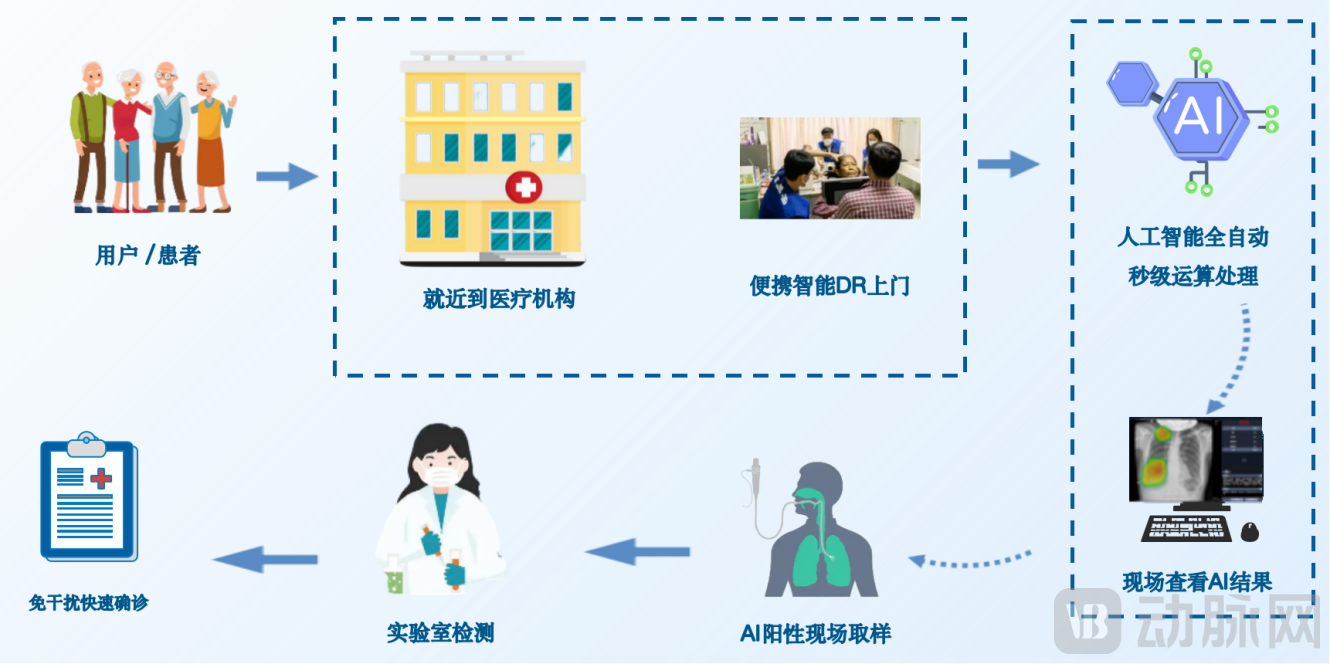
Overview of the Known Future Full-process Management Solution
As the team emphasized, the future offering is not just a software product, but an integrated one-stop solution combining devices, technology, services, and policies, truly bridging the "last mile" of TB prevention and control to enhance public health service efficiency.
The value of technology will ultimately bear fruit in the soil of grassroots.
Today, the DR AI-assisted diagnosis system developed by Suozhi Future has been deployed and put into practical use at primary healthcare institutions across multiple provinces including Zhejiang, Yunnan, Sichuan, and Guizhou. During the pilot phase, the system successfully identified multiple active tuberculosis cases on site, effectively contributing to early prevention and control. The company has now received procurement requests voluntarily submitted by numerous medical institutions.
In areas with inconvenient transportation and relatively weak medical resources, this solution has demonstrated significant advantages. In a low-epidemic island area, proactive on-site screening was achieved, allowing healthcare workers to obtain diagnostic results on the spot; in remote mountainous regions, portable devices were brought directly into villages and households, enabling simultaneous on-site sampling. This truly realized "preliminary screening + diagnosis" in one step, effectively improving screening efficiency.
Data speaks volumes about practical results. After implementing this solution in a certain area, the coverage rate of tuberculosis screening among the elderly population increased from 50% to over 90%. In pilot programs across multiple provinces, the system also reduced the time for taking images and diagnosis to within one minute through an AI pre-screening and expert review model, aligning the diagnostic accuracy at grassroots facilities with that of top-tier hospitals.
Behind this effective implementation lies the deep collaboration with the government. Known Future has always focused on the national tuberculosis prevention and control policies and public health service objectives, steadily advancing grassroots implementation under the guidance of governments at all levels. Its promotion strategy adopts a pilot-first approach followed by framework cooperation to ensure solid and effective technology promotion.
Particularly noteworthy is its "integration of medical treatment and prevention" practice. In a certain city in Zhejiang, the AI system interface, known to be implemented in the future, has been connected to all hospitals in the city. Without affecting the doctors' daily diagnosis, the system automatically synchronizes suspected tuberculosis case data to the Center for Disease Control. Clinical diagnosis and public health prevention are no longer disconnected, forming a closed-loop management of "screening-diagnosis-reporting-prevention," addressing the core demands of the current public health system.
In the current rapid development of AI healthcare, the known future has a clear "two-step" plan.
In the short term, the team will continue to focus on the field of tuberculosis,"To Fully Accomplish One Task"By optimizing the algorithm model, the system's specificity and sensitivity are further enhanced, reducing false negatives and false positives, allowing grassroots doctors to use it with greater confidence. At the same time, deepen scientific research cooperation with the National Center for Infectious Diseases (Zhang Wenhong's team) and provincial disease control centers to make the product more aligned with public health policy directions.
In the long term, the known future plans to extend horizontally and expand vertically from the tuberculosis field. Horizontally, the technology will be expanded to lung-related diseases such as pneumonia and pulmonary nodules, while vertically, it will rely on the "infectious disease attribute" of tuberculosis to explore AI prevention and control solutions for other infectious diseases. At the commercial level, the team adheres to top-level guidance and grassroots implementation, cooperating with channel partners who are familiar with tuberculosis prevention policies and grassroots needs to expand terminal coverage.
The overseas expansion layout has also been put on the agenda. It is known that the future plan will adopt the "borrowing a ship to go global + ecological co-construction" model, relying on the mature channels of domestic medical device manufacturers, to promote an integrated solution of "portable DR + AI + molecular rapid testing package" to high-burden regions such as Indonesia and the Middle East."Bring China's tuberculosis prevention and control technologies and models to the world"。
In the booming wave of AI healthcare, Suozhi Future's positioning is clear: not chasing trends, not blindly expanding, but starting with tuberculosis prevention and control to use technology to safeguard grassroots public health. As founder Lin Xiaoquan said, "The most important thing is to focus on R&D and product development" — this dedication is at the core of its competitiveness in rooting itself at the grassroots level and reaching out globally.