At the beginning of 2024, the global health market was "awakened" by a series of major mergers/acquisitions and licensing deals.In Less Than 15 Days, the Amount Has Exceeded 10 Billion US Dollars, more importantly, the targets are almost all the latest biotechnology frontiers, such as small nucleic acid drugs, CAR-T, and multi-specific drugs......., and AI pharmaceuticals account for one-third.- On January 8, Isomorphic Labs, a digital biotechnology company under Google, announced new drug research and development collaborations with Eli Lilly and Novartis, respectively, with a total value of up to$3 billion。
From2020The World's First AI Candidate Compound Enters Human Clinical Trials;2023Based on Generative AI (GenAI) technology "exploding" across global industries;In 2024, AI pharmaceuticals may fully enter the validation phase of capital and commercialization.Capital Verification: China's First AI Pharmaceutical StockChina's AI pharmaceuticals, after a long period of dormancy, are finally set to bear fruit in 2024.
June 2023,Insilico MedicineSubmitted to the Hong Kong Stock Exchange;Post-investment valuation of approximately US$895 million。
*** The current status is in the phase of material return and updating supplementation.
November 2023,XtalPiXtalPi Holdings Limited has submitted an IPO application to the Hong Kong Stock Exchange under the new Rule 18C for specialized technology companies, becoming the second company to file under Rule 18C.Post-investment valuation of approximately US$1.968 billion。
As representatives of two different business models, the outcome of their IPOs is not only a competition at the corporate level but also a test of which business logic loop gains more recognition from the capital market.
Although from the current post-investment valuation, XtalPi seems to be higher; butWho Will Become China's "First AI Pharmaceutical Stock" Still Remains a Mystery.
Comparison of Business Models: Pharmaceutical Companies vs CXO
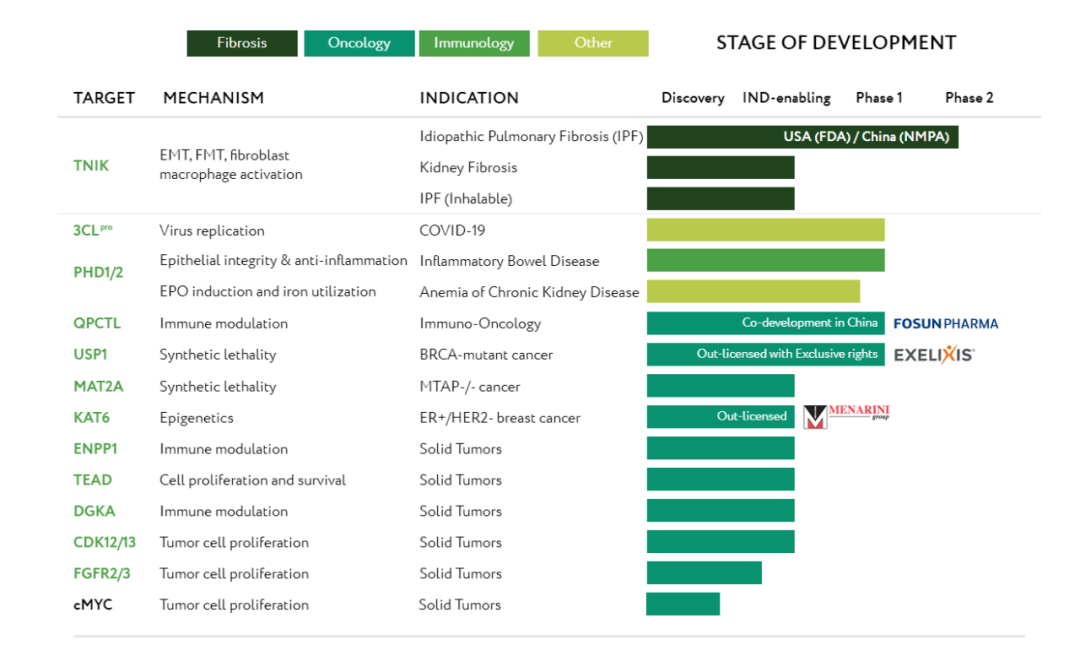
Insilico Medicine, founded in 2014, is an AI-driven innovative drug discovery company, or referred to asTechBio。*** Uses its self-developed high-efficiency artificial intelligence drug discovery platform, Pharma.AI, to enhance the efficiency of new drug development.TechBio Company,Essence remains an innovative pharmaceutical enterprise, usually using self-developed AI platforms to develop internal pipelines. Similar to Biotech, they mainly rely on external collaborations and License out during the clinical stage to maintain business operations.Innovative pharmaceutical companies still need to "focus on the pipeline."Powered by an AI platform, Insilico Medicine has established a diversified, fully internally generated pipeline comprising 31 projects, covering 29 drug targets across fields such as fibrosis, oncology, and immunology.
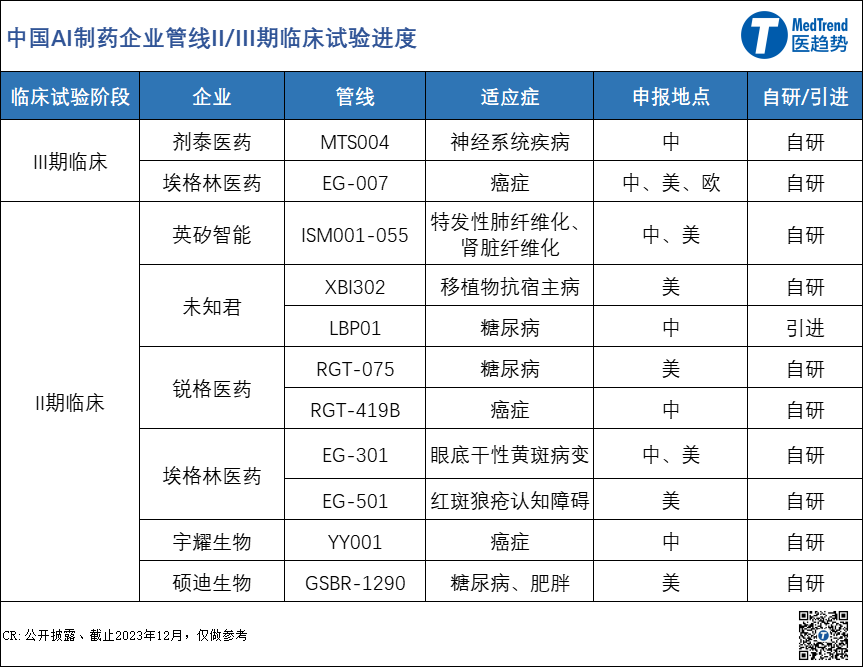
Currently, five projects have entered the clinical stage,Among them, the potential FIC (rare disease) idiopathic pulmonary fibrosis and renal fibrosis new drug ISM001-055 has entered clinical Phase II.The other four projects (COVID-19, kidney disease, two types of cancer) are all in Phase I clinical trials.China TechBio CompanyIs an indispensable force in the global AI pharmaceuticals field.As of the end of 2023,Globally, AI-developed drugs have successfully entered the clinical stage over 100 times.Among them, Phase II and Phase III clinical trials account for 45%, with approximately 1/5 coming from Chinese companies.The prospectus shows that Insilico Medicine's revenue in 2021 and 2022 (drug discovery services, software solutions) was $4.71 million and $30.15 million (approximately 200 million yuan) respectively (a year-on-year increase of 540%). The net loss for the year was $130 million and $222 million (approximately 1.5 billion yuan) respectively, mainly due to R&D expenses reaching $38 million and $78 million (approximately 560 million yuan).
Its revenue mainly comes from external cooperation. By the end of 2023, Insilico MedicineMore than 6 License out projects,Collaboration partners include Fosun Pharma,EQRx, Sanofi, Novo Nordisk, Exelixis, Menarini and other leading pharmaceutical companies in the industry. Continuously breaking the record for the highest transaction amount in AI-driven drug discovery collaborations.
XtalPi, founded in 2015 at MIT in Massachusetts, is a technology company., or referred to asAI-CXO。
CXO Led by AI Technology,Essentially more CXO-oriented, mainly providing outsourcing services for pharmaceutical companies and other CROs, accelerating the preclinical research and development process through AI.
CROs need to look at the "platform."FromXtalPiAccording to the official website, it mainly has four major AI pharmaceutical platforms:Small Molecule DrugsDiscovery System ID4Inno,Antibody DrugDiscovery Platform XupremAb, Laboratory Automation Solutions, Crystal Form Prediction Platform.
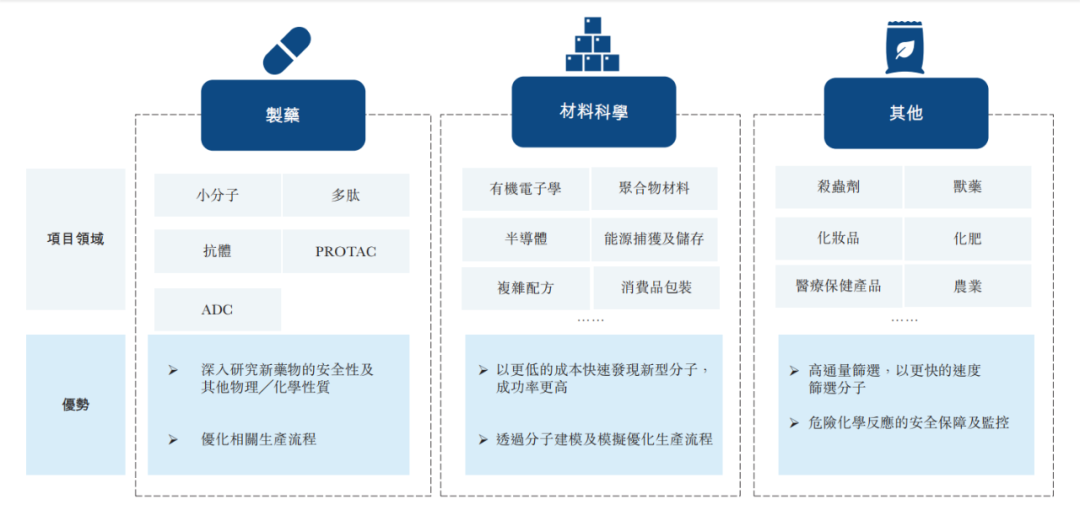
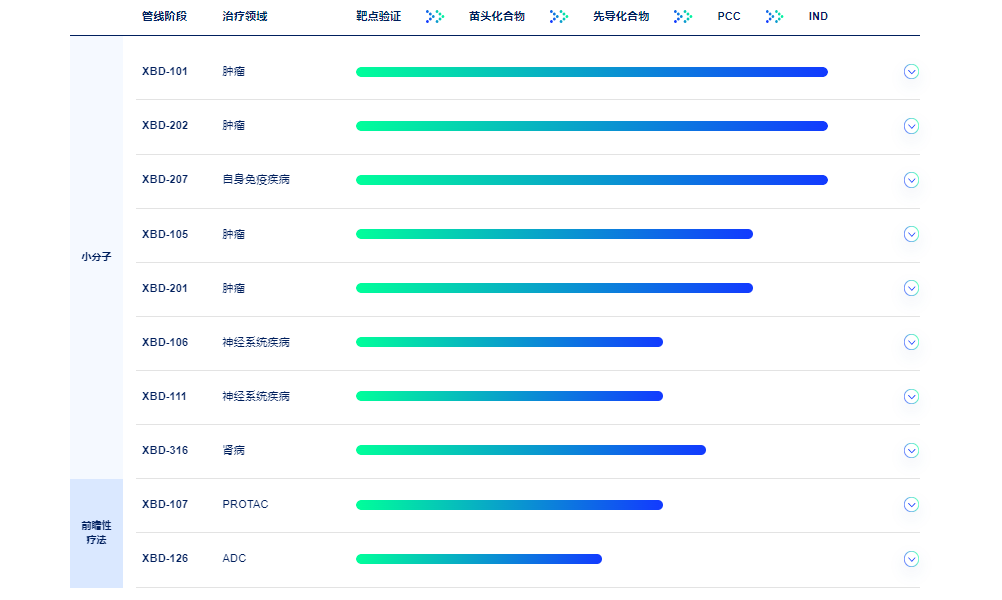
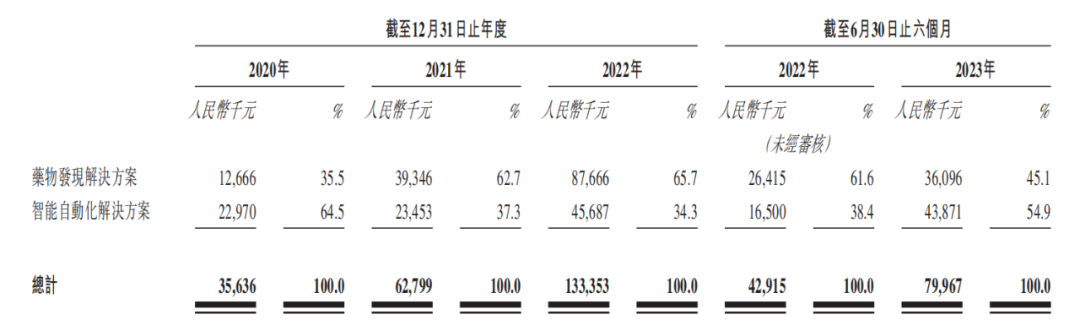
Although, from the perspective of project progress, all of its pipelines are currently in the preclinical stage, and except for one ADC, the rest are small molecule drugs in niche fields.However, the prospectus shows that its clients include multinational TOP pharmaceutical companies such as Pfizer, Bayer, Merck, Johnson & Johnson, Eli Lilly, Gilead, as well as major Chinese pharmaceutical companies like Hengrui, Hansoh, and Huadong Medicine.However,From 2020 to the first half of 2023, XtalPi's customer retention rates were approximately 53.8%, 67.5%, 51.4%, and 51.4%, respectively, indicating a customer churn rate of nearly 50%.。For CROs, customer stickiness is very important. Take the Wuxi AppTec group as an example, which has been promoting the "long-tail customer" strategy, with a customer retention rate close to 100%.In the context of poor customer retention, XtalPi's revenues for the years 2020 to 2022 were RMB 0.36 billion, RMB 0.63 billion, and RMB 1.33 billion, respectively, while the corresponding losses reached RMB 7.34 billion, RMB 21.37 billion, and RMB 14.39 billion.The loss was mainly due to the increased R&D activities, implementation of commercialization plans (especially in the United States and Europe), and anticipated costs and expenses related to share-based payment expenditures.- In 2020, 2021, and 2022, its R&D expenditures reached 0.8 billion yuan, 2.1 billion yuan, and 3.6 billion yuan, respectively, accounting for approximately 51.8%, 52.4%, and 53.5% of the total operating expenses in the respective years.
- Drug Discovery Solutions (Providing solutions across different modules throughout the entire drug discovery and research process)
- Intelligent Automation Solutions (Mainly Including Solid-State R&D Services and Automated Chemical Synthesis Services)
Overall, the two companiesRevenue, Loss AmountEquivalent.R&D Investment,Insilico Higher (Approx. 560 Million Yuan), XtalPi (approximately 360 million yuan).Comparison of Technical Platforms: Insilico Intelligence Builds Its Own "AI Lab"Insilico Medicine's higher R&D investment is not without reason.In addition to independently developing the Pharma.AI drug discovery platform, XtalPi addresses the pain points of the drug discovery process and enhances the efficiency of new drug development through three key components: the novel target discovery engine PandaOmics™, the compound design and generation platform Chemistry42™, and the clinical trial outcome prediction platform inClinico™.In November 2023, Insilico Medicine released"The World's First AI-Assisted Decision-Making Automated Laboratory". This "unmanned operation" laboratory (replacing approximately 50 biologists) can complete target discovery and validation within 14 days (a process that typically takes 2-3 years).These globally advanced technologies all require enormous investment, and have not yet "generated returns."After 2023, the application of quantum computing in generative AI drug research and development, and these two companies are also mainly promoting this concept.Quantum computing is expected to break through existing technological bottlenecks to achieve larger-scale data processing and more efficient innovative content generation.Previously, traditional AI required reviewing a large number of papers for the biological mechanism of each target, but now relevant results can be obtained directly by conversing with large models.Comparison of Funds: XtalPi is Good at Financing, While Insilico Has Stronger Cash FlowXtalPi seems to have always been favored by capital, with its financing capability ranked first among global AI pharmaceutical companies. Since its establishment, it has undergone eight rounds of financing, cumulatively obtaining approximately$732 million in funding。Therefore, as of the end of 2022, its cash and cash equivalents were approximatelyRMB 570 million(Approximately 1.04 billion yuan in the first half of 2023).Insilico MedicineTotal financing amount exceeds$400 million; butThe capital side includes star capitals in the healthcare sector such as Qiming Venture Partners, WuXi AppTec, Temasek, and Lilly Asia Ventures.Moreover, as of the end of 2022, Insilico Medicine had approximately US$210 million in cash and cash equivalents (1.5 billion yuan);Relying on (drug research and development services, software solutions) is one of the sources of its abundant cash flow.Currently, the valuation of XtalPi, which adopts the AI-CXO model, is more than double that of Insilico Medicine (approximately 14 billion yuan); we still look forward to the capital verification in 2024.
At the same time,For TOP multinational pharmaceutical companies, after more than a decade of "observation and cooperation," on this main stage that will lead the future of pharmaceuticals, some companies have taken different paths.When TOP pharmaceutical companies join the AI-CXO行列, will it produce a 1+1>2 effect?Commercial Validation:AstraZenecaWho Will Be the First to Enjoy the "AI Dividend"?The greatest contribution of AI to new drug R&D lies in the "basic research and development" stage, where it can shorten the R&D cycle by an average of 1/2 to 2/3, reduce R&D investment by 10%, and increase the success rate of new drug R&D.Therefore, the world's TOP pharmaceutical companies are all strategically deploying AI; for instance, Sanofi'sAiming to Become the First Large Pharmaceutical Enterprise Driven by AI at Scale。AndAstraZenecaHas established an AI-CRO company as an alternative approach, orThe First to Achieve Commercial Validation of AI Drug Discovery。
In November 2023, AstraZeneca announced the launch of a new global health technology company, Evinova, officially entering the CXO field.*** Evinova will provide three major categories of services for pharmaceutical companies and CROs, including experimental solutions, research design and planning, and pipeline asset management.As is known to all,AstraZeneca has increased its R&D success rate from 4% to 19% (higher than the average success rate of global TOP pharmaceutical companies) with its self-created "5R" framework.。*** 5R Principle: Refers to the Right Target, Right Tissue, Right Safety, Right Patient, and Right Commercial Potential.Therefore, the launch of Evinova aims to help improve the overall R&D efficiency of the industry; its biggest "selling point" might just be "AI empowerment."Unlike other CXOs, Evinova will mainly support new drug clinical development through the AI digital solution "Evinova drug development suite."In August 2023, AstraZeneca published an article in *Nature Medicine*, where the first author, Dr. Cristina Duran, proposedRight Digital SolutionAdd to the 5R framework to form a new "6R Framework".This Dr. Cristina Duran is the current Chief Digital Health Officer of Global R&D at AstraZeneca and also the first CEO of Evinova.AstraZeneca Has a先天 Advantage in "AI Pharmaceutical".As early as 2021, 50% of its small-molecule new drug pipeline was developed through AI.Between 2014 and 2019, 65 papers on artificial intelligence were published, ranking first among global pharmaceutical companies. In addition, the company internally developed two AI platforms, including REINVENT for de novo design of small molecule drugs, and the retrosynthesis tool AiZynthFinder.Above, Evinova may bring a 1+1>2 effect to pharmaceutical companies and CROs in the AI pharmaceuticals field.Evinova CEO Cristina Duran stated at the press conference that Microsoft might be Evinova's only competitor in the current market, showing great confidence in their technology.Providing outsourcing services can also enable AstraZeneca to generate revenue returns from the AI pharmaceuticals field at an earlier stage.AstraZeneca's AI-CXO business not only supplements its revenue but, more importantly, provides big data from the global pharmaceutical industry to feed back into its research and development. In order to maintain the stability and security of the big data, Evinova is collaborating with Accenture and Amazon; this big data may become the cornerstone of its innovation.And speaking ofBig Data in the Pharmaceutical Field,Roche PharmaceuticalsPerhaps the earliest TOP pharmaceutical company to place a bet.As early as 2018, for $1.9 billion, ProspectiveAcquire all shares of Flatiron Health, the leading company in tumor big data.In the same year, Genentech reached an agreement with medical data analytics company GNS Healthcare to use its AI platform to analyze the efficacy of known therapies in tumors.Roche's series of layouts in the AI pharmaceutical field may all be aimed at achieving personalized healthcare.As part of precision medicine, the biggest bottleneck of personalized medicine is "large-scale meaningful data," also known as medical big data.For over a century, Roche has accumulated a vast amount of real-world research data globally, particularly in the field of oncology.- In 2021, Roche formed a long-term strategic partnership with Tianjin Port Free Trade Zone, which houses a national-level big data center, to jointly carry out multi-faceted cooperation including personalized medical research.
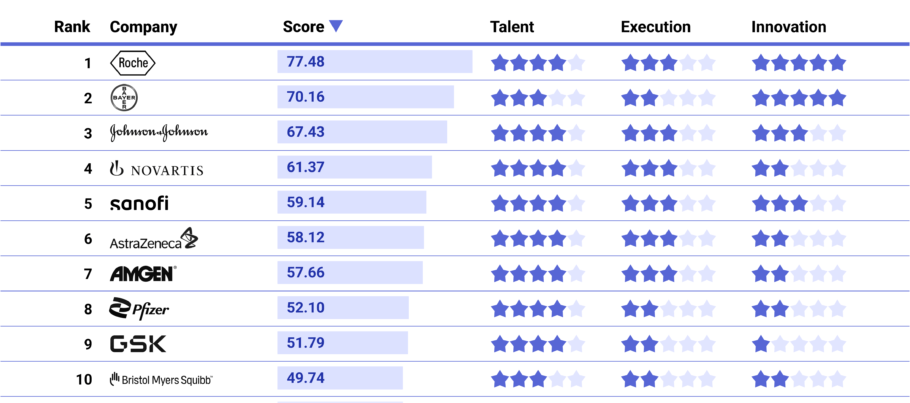
And these accumulations have also helped Roche become an "AI top performer" among the top pharmaceutical companies.In the latest Pharma AI Readiness Index released by CB Insights, based on enterprisesAI Talents, AI Project Execution, AI Innovation AchievementsRated across various dimensions. Roche ranked first in global pharmaceutical AI capabilities with a total score of 77.48. Positions 2 to 10 were held by Bayer, Johnson & Johnson, Novartis, Sanofi, AstraZeneca, Amgen, Pfizer, GSK, and Bristol-Myers Squibb respectively.
Since AI entered the large model era, big data has become a decisive factor for AI deep learning, and Roche, with its big data advantage, has further expanded cooperation.In November 2023, Genentech announced a multi-year strategic research collaboration with NVIDIA to transform generative AI models and algorithms.To become the next-generation artificial intelligence platform to accelerate drug discovery.Who will be the first to reap the benefits of AI: Sanofi, with its AI pharmaceutical strategy; Roche, with its advantage in medical big data; or AstraZeneca, expanding into AI-CRO services? We may soon find out.The medical digitalization market size grows by approximately 14% annually and is expected to exceed 900 billion US dollars by 2032, with AI-driven drug discovery undoubtedly being a significant component.。In 2024, we may be fortunate enough to see AIMany "Firsts" in Pharmaceutical Manufacturing.· END ·
--Featured Recommendations--