VCBeat Health
Contact Us
Home
China Healthcare Select
Insights
MNC China Lens
Vertical Industries
Services
Partnership Development
Market Entry Advisory
Ecosystem Engagement Advisory
About VCBeat
Why VCBeat
Log In
Home
Roche Exits Eight Early-Stage Clinical Programs to Refocus Pipeline on High-Value Assets
Feb 02, 2024 07:03 CST Updated 07:03
Share:
Roche
Oncology Drug Research, Development, and Manufacturing

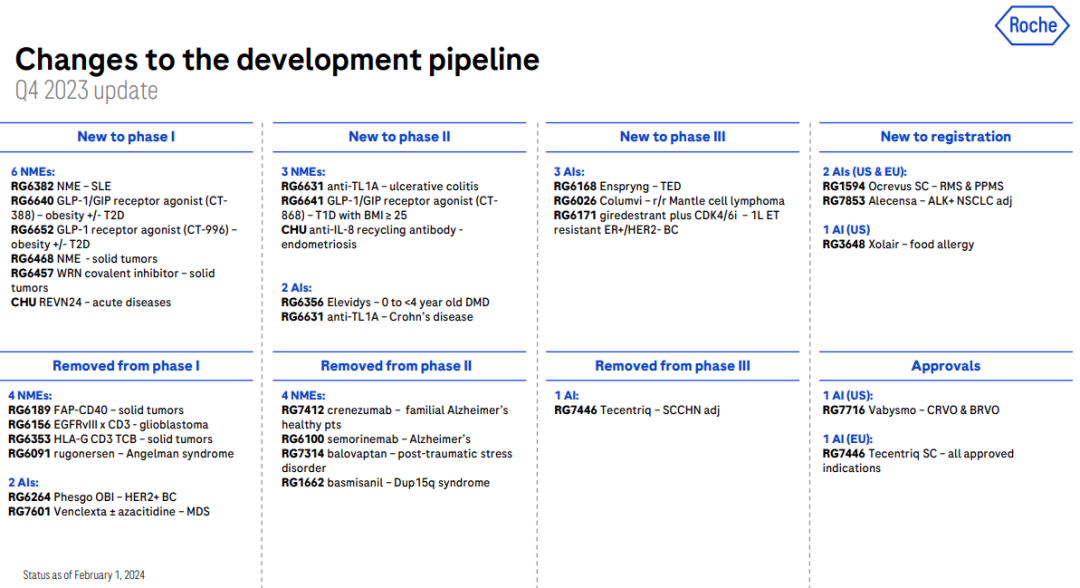
On February 1, Roche announced its 2023 performance and stated that it had removed eight oncology and neurology candidate drugs in Phase I and II stages from its pipeline, aiming to balance the overall portfolio value and accelerate the development of more valuable assets.
In this process, the balance of Roche's product pipeline shifted from neuroscience and oncology (to a lesser extent) towards immunology, cardiovascular, and metabolic disease areas. The number of neuroscience projects decreased from 18 to 12, although one project was transferred to another part of the R&D pipeline.
Points.
CEO Thomas Schinecker said that these resources would be transferred to "projects we want to accelerate." During Thursday's fourth-quarter earnings call, he also indicated similar reductions in production for the first quarter.
。
Basmisanil is a GABAA-α5 receptor negative modulator that was developed between 2016 and 2019 for the treatment of ischemic stroke and schizophrenia. Later, the discovery of EEG biomarkers in dup15q syndrome (a developmental disorder) sparked interest in treating the condition by reducing GABA activity in the brain. In 2022, Roche registered a Phase II trial targeting this disease; however, Roche now intends to abandon this drug.
Drug Development.
Roche also eliminated one
Small Molecule Diuretic
V1A Receptor Antagonist for Urinary Hormones
Balovaptan, which previously reached Phase III for the treatment of autism spectrum disorder but failed to make progress. Afterwards, Roche initiated a new Phase II study for post-traumatic stress disorder, which was completed last year. However, possibly due to unsatisfactory results, Roche decided to remove it from their product pipeline.
Before the Q4 earnings update, Roche partner AC Immune stated that Roche had returned the rights to the Alzheimer's candidate drugs crenezumab and semorinemab last month;
Details of the decision to abandon the Angelman syndrome candidate drug rugonersen were announced last year through the patient community.
In the field of oncology, Roche eliminated three Phase I candidate drugs.
Including a CD40/FAP bispecific antibody for the treatment of solid tumors, an EGFRvIII/CD3 bispecific antibody, and an HLA-G/CD3ε bispecific antibody.
The removal of pipelines also comes with the influx of other assets, including candidate assets acquired through the acquisition of Carmot and Telavant. In addition, Roche has advanced a WRN covalent inhibitor (a synthetic lethal target and the core of Roche's $135 million deal with Vividion) into Phase I clinical trials.
Copyright © 2024 PHARMCUBE. All Rights Reserved.
Welcome to forward, share, and reasonably cite. When citing, please clearly indicate the source of the article.
For reprint, please leave a message or send a message to the WeChat Official Account backend, and indicate the name and ID of the official account.
Disclaimer: The information in this WeChat article is for general reference only and should not be directly used as decision-making content. PharmaCube assumes no responsibility for any loss incurred by any party due to the use of the content herein.