Novartis Focuses on Radioligand Therapy with Seven Nuclear Medicine Pipeline Assets, Steering Clear of ADCs

Novartis
Drug Development and Manufacturing
On January 31, Novartis announced its 2023 financial report. The full-year net sales were $45.44 billion, representing a year-on-year increase of 10%.
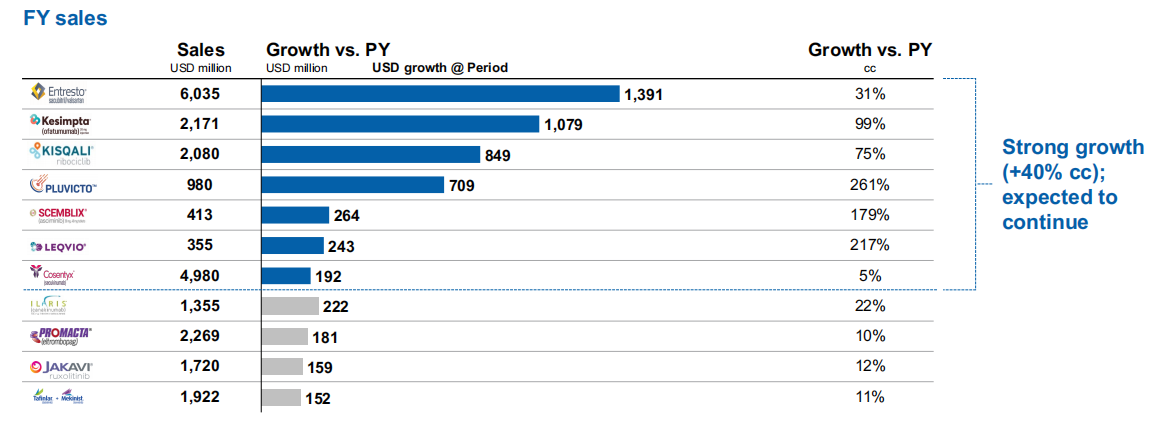
Novartis stated that the drivers of performance growth included the heart failure drug Entresto (60.35 billion USD, +31%), the multiple sclerosis treatment Kesimpta (21.71 billion USD, +99%), and the breast cancer treatment Kisqali (20.8 billion USD, +75%), among others.
In addition, New Modality is becoming the main driver of Novartis' performance growth. The sales of the radioligand therapy Pluvicto reached $980 million, a year-on-year increase of 261%; the sales of the small nucleic acid drug Leqvio were $355 million, a year-on-year increase of 217%.
Source: Novartis 2023 Annual Report PPT
After spinning off Sandoz, Novartis has transformed into a pure innovative pharmaceutical company, currently focusing on four core therapeutic areas: cardiovascular-renal-metabolic diseases, immunology, neuroscience, and oncology.
On the technology platform, in addition to traditional chemical and biologic drug platforms, Novartis is also vigorously developing its New Modality (novel therapy) platform, which mainly includes: RLT (radiopharmaceuticals), CAR-T, and small nucleic acid drugs.
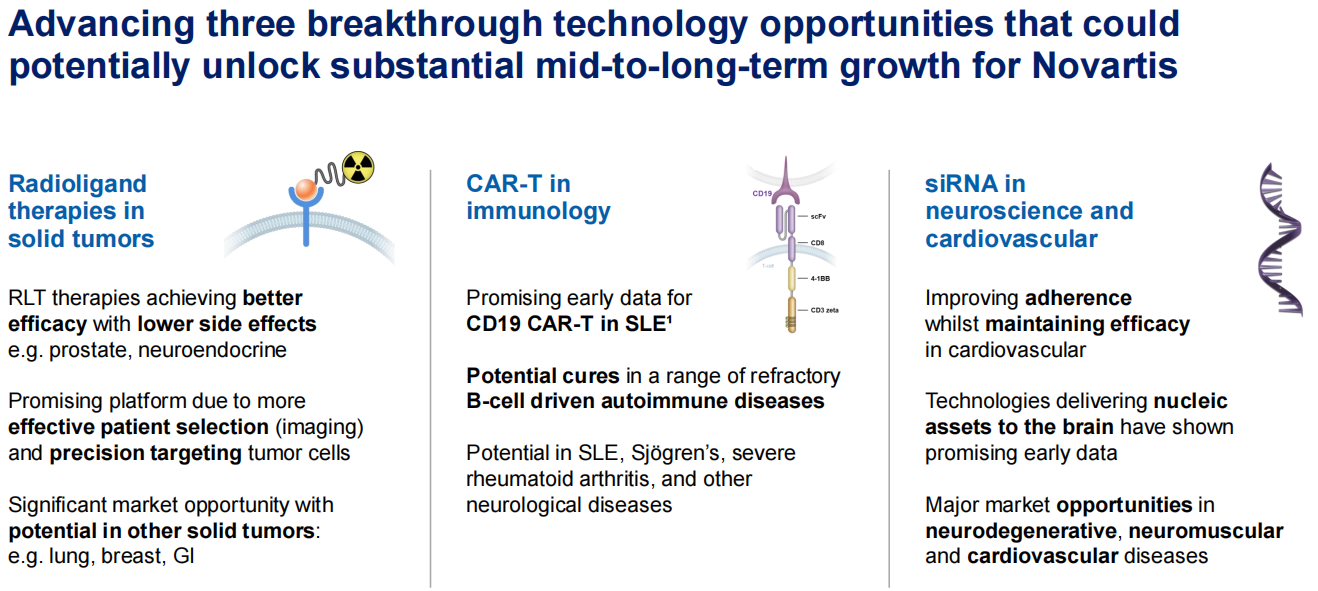
Image Source: Novartis JPM2024 PPT
RLT (Nuclear Medicine)
In the past two years, MNCs have been actively engaged in ADC deals and acquisitions, but Novartis has remained particularly calm, having not ventured into the ADC field in its major BD activities over the past five years. According to publicly available information, more than a decade ago, Novartis had also explored ADC technology; however, these ADC projects have now all disappeared from Novartis' pipeline.
At the JPM2024 conference, Novartis stated that they have been working on the ADC track for a long time but have not achieved positive progress. They believe that, compared to certain ADCs, radiotherapy may have safety advantages. Therefore, they hope to leverage their strengths and increase investment in radioligand therapy (RLT).
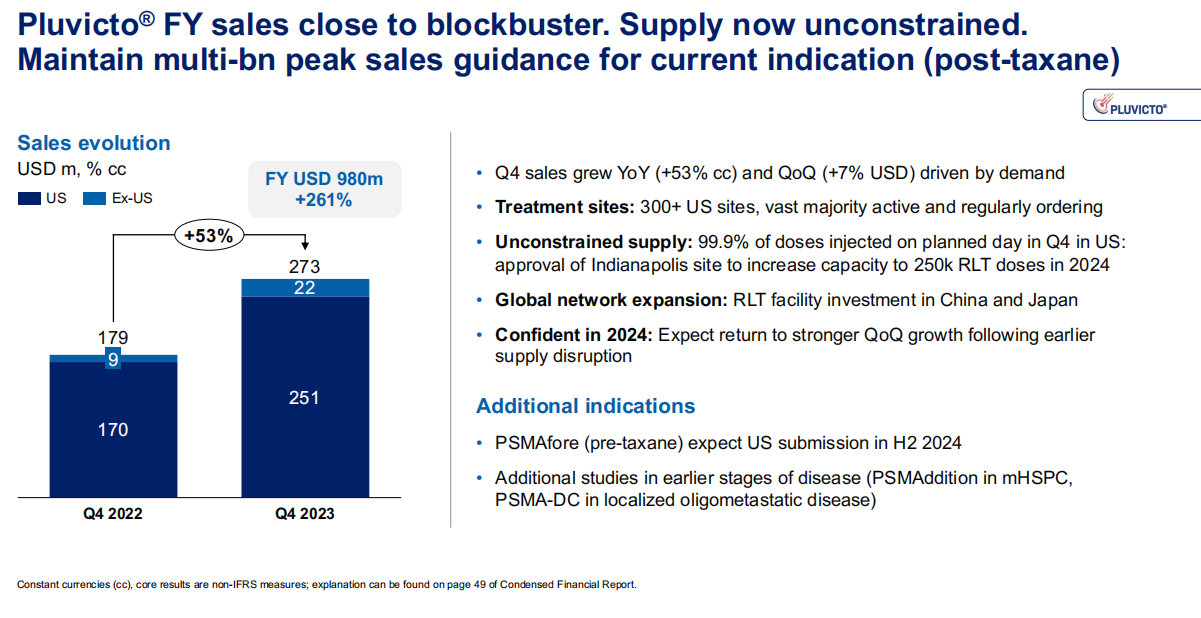
RLT has the advantages of good efficacy and low side effects, and is the most valued technology platform by Novartis in the field of solid tumors. Currently, two products have been launched, among which Pluvicto achieved sales of $980 million in 2023, just a step away from the billion-dollar mark.
Source of the image: Novartis 2023 Annual Report PPT
Pluvicto
Pluvicto (177Lu-PSMA-617) is a radioligand therapy administered intravenously, which combines a small molecule compound targeting PSMA with the therapeutic radionuclide lutetium-177. After entering the bloodstream, Pluvicto binds to prostate cancer cells expressing PSMA, and the radiation energy emitted by the radionuclide destroys the tumor cells and induces their apoptosis. In 2018, Novartis acquired Endocyte for a total price of $2.1 billion (a 54% premium), obtaining 177Lu-PSMA-617.
In March 2022, the US FDA approved Pluvicto for marketing, intended for third-line treatment of metastatic castration-resistant prostate cancer (mCRPC) in PSMA-positive patients. In its first year on the market, the drug achieved sales of $271 million, and in 2023, sales continued to increase, reaching $980 million for the full year, representing a 261% growth.
Novartis is also advancing Pluvicto for earlier lines of treatment and expanding its eligible patient population. At the ESMO 2023 Congress, Novartis presented data from the PSMAfore trial: compared to the androgen receptor pathway inhibitor (ARPI) treatment group, the Pluvicto group met its primary endpoint, demonstrating clinically meaningful and statistically significant benefits in patients with prostate-specific membrane antigen (PSMA)-positive metastatic castration-resistant prostate cancer (mCRPC), which is expected to propel Pluvicto towards first-line treatment.
Lutathera
Another radiopharmaceutical from Novartis, Lutathera, also achieved good results last year, with sales of $605 million, a year-on-year increase of 28%.
Lutathera (lutetium 177Lu dotatate) is a 177Lu-labeled somatostatin analog peptide. The peptide molecule DOTA-TATE binds with Lu-177 through a chelating agent, forming a novel composite drug. After Lutathera is injected into the patient's body, it captures tumor cells via receptor-ligand targeting recognition, then delivers the radionuclide into the tumor tissue. Lu-177 releases high-energy beta rays, ultimately killing the tumor cells. In 2017, Novartis acquired Advanced Accelerator Applications (AAA) for $3.9 billion, obtaining Lutathera.
Lutathera was launched in Europe and the United States in 2017 and 2018, respectively, for the treatment of gastrointestinal pancreatic neuroendocrine tumors (GEP-NETs) that are positive for somatostatin receptors. This is the first radioligand therapy approved by the FDA.
On January 19, 2024, Novartis announced the latest clinical data from the Phase 3 NETTER-2 trial of Lutathera as a first-line treatment for gastroenteropancreatic neuroendocrine tumors (GEP-NETs) at the ASCO-GI meeting. The primary endpoint, mPFS, was extended from 8.5 months to 22.8 months—nearly three times longer—with a 72% reduction in the risk of disease progression or death, and an overall response rate (ORR) reaching 43%. Novartis expects to submit a marketing application for first-line treatment of GEP-NETs in the EU this year while actively expanding into new indications such as SCLC and GBM. Sales of Lutathera are projected to peak at over $1 billion.
Following the success of Pluvicto and Lutathera, Novartis continues to expand its presence in the radiopharmaceuticals field:
In March 2023, Novartis partnered with Bicycle Therapeutics to develop, manufacture, and commercialize bicyclic peptide radiopharmaceutical conjugates (BRCs) targeting multiple oncology targets. Bicycle will receive a $50 million upfront payment and is eligible for up to $1.7 billion in development and commercial milestone payments. Bicycle is also eligible to receive tiered royalties on commercialized products.
In April 2023, Novartis entered into a collaboration with 3B Pharmaceuticals GmbH (3BP) to obtain the global exclusive rights for the development and commercialization of 3BP's FAP-targeted peptide technology, including the therapeutic and imaging applications of the drug FAP-2286. 3BP retained the development rights for the FAP-targeted peptide technology for diagnostic purposes. 3BP received an upfront payment of $40 million, along with potential development and commercial milestone payments of up to $425 million.
Currently, Novartis has 7 nuclear medicine pipelines, including 2 marketed products and 5 pipelines in Phase 1 clinical trials.
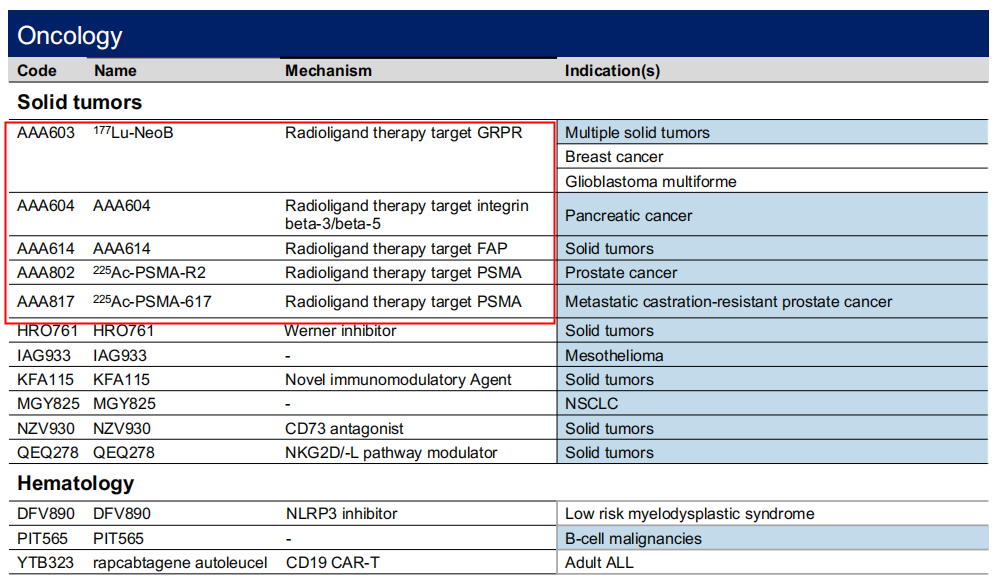
Source: Novartis 2023 Annual Report PPT
Due to radioactivity, the research and development, clinical trials, production, and use of radiopharmaceuticals are all subject to strict regulation. Moreover, radiopharmaceuticals require special hardware facilities for配套 production, logistics, and treatment scenarios, which has led to high barriers in the radiopharmaceuticals field. It is not easy for other companies to enter and compete, so Novartis will continue to dominate the radiopharmaceuticals field in the coming years.
In China, nuclear medicine started relatively late, but some companies have already made breakthroughs. For example, in January this year, the Tianjin Radiopharmaceutical Innovation Consortium led by Tianjin Hengrui, a subsidiary of Hengrui Medicine, was featured on CCTV's "News Broadcast" as a typical case of Tianjin accelerating the transformation of scientific and technological achievements. Its Lutetium [177Lu] Oxodotreotide Injection, HRS-4357 Injection, and HRS-9815 Injection were successively approved for clinical trials. Companies such as Grand Pharma and Raydio have also made breakthroughs in the field of radiopharmaceuticals, and in the future, radiopharmaceuticals will play a more important role in the anti-tumor field.
CAR-T
Novartis was one of the first pharmaceutical companies to enter the CAR-T field. In 2017, the world's first CAR-T drug, Kymriah, was approved by the FDA for marketing, and its developer was Novartis. In addition, Novartis has mature CAR-T production capacity, which can not only meet the production needs of its own products but also provide CDMO services for other companies.
In November 2023, Novartis partnered with Legend Biotech to co-develop Legend Biotech's specific DLL3-targeted Chimeric Antigen Receptor T-cell (CAR-T) therapy, with a potential deal value of $1.1 billion.
Not only in the field of oncology, Novartis has high hopes for the application of CAR-T in autoimmune diseases. However, the black box warning about the risk of secondary cancer poses significant uncertainty to its use in this area.
Small Nucleic Acid
In November 2019, Novartis acquired The Medicines Company for $9.7 billion, obtaining the small nucleic acid product Leqvio. In 2020, Leqvio was approved by the FDA for marketing. In 2023, the drug's sales reached $355 million, and Novartis expects that Leqvio’s annual peak sales will reach $3 billion.
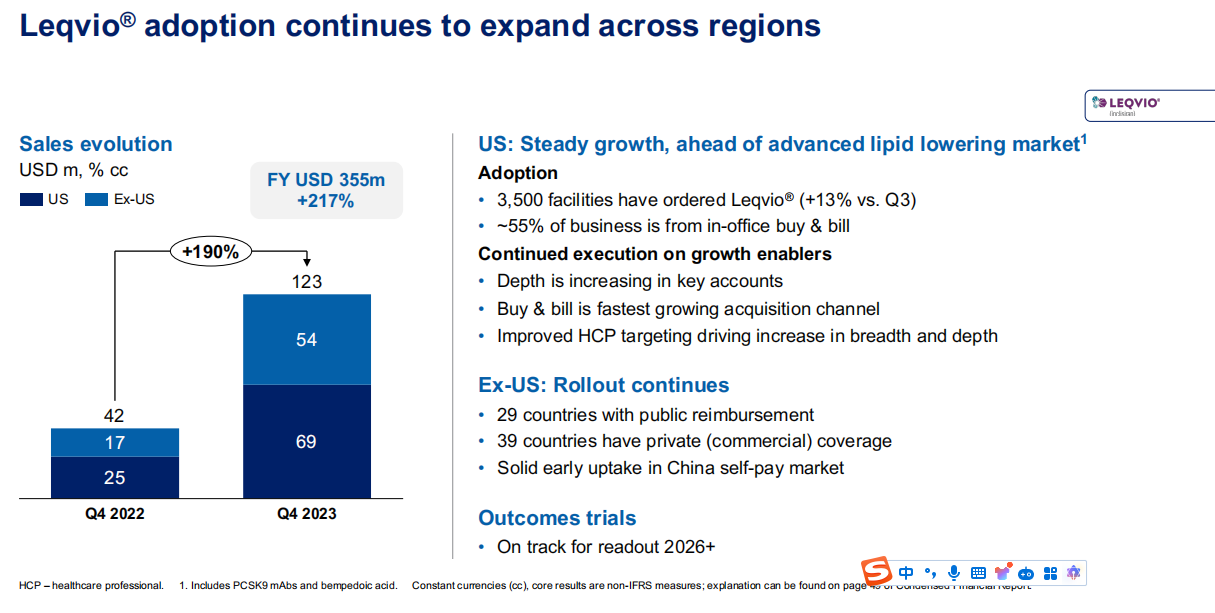
Source of the image: Novartis 2023 Annual Report PPT
After the success of Leqvio, Novartis has repeatedly increased its investment in small nucleic acid layouts:
In July 2023, Novartis announced the acquisition of DTx Pharma for up to $1 billion.
In August 2023, Novartis partnered again with Ionis, the pioneer of ASO nucleic acid drugs, acquiring the lipid-lowering ASO drug Pelacarsen.
In January 2024, Novartis entered into a collaboration with Argo Biopharma for multiple small nucleic acid pipelines, with a potential total deal value of up to $4.165 billion.
In addition to the cardiovascular field, Novartis also mentioned that the technology for delivering small nucleic acids to the brain has achieved initial success, making the treatment of neurological diseases with small nucleic acids another area highly valued by Novartis.
Summary
All signs indicate Novartis' dedication to emerging technologies/novel therapies, and it is precisely these cutting-edge strategies that have allowed Novartis to carve out a differentiated path, especially in the oncology field. Instead of focusing on PD-1 or ADC, Novartis has chosen to leverage radiopharmaceuticals, enabling it to stand out in this highly competitive arena.
References:
Novartis 2023 Annual Report
Shenwan Hongyuan Research: The Nuclear Medicine Industry Has Broad Prospects, with Policy and Demand Boosting Accelerated Industry Growth
Claudisiran: Novartis 2023 R&D Day: Peak sales below $2 billion won't even catch the eye!
Yaozhi Headlines: Over $40 Billion BD, Where Has Novartis Spent Its Money In Recent Years?

Editor: Liuli
Disclaimer: The views expressed in this article are solely those of the author and do not represent the position of Pharma Intelligence. We welcome exchanges and additional insights in the comment section. If you wish to reproduce this article, please be sure to credit the author and source. For issues related to the content, copyright, or other aspects of the work, please leave a message on this platform, and we will address it promptly.