

Roche Axes Five Neurology Drug Candidates to Make Way for GLP-1 Pipeline Expansion
Roche
Oncology Drug Research, Development, and Manufacturing
Recently, Roche announced its 2023 annual financial report, stating that it will remove five neurology assets and three oncology assets from its R&D pipeline. This includes two Alzheimer's disease (AD) treatments — Crenezumab and Semorinemab — to make room for a series of GLP-1 class drugs acquired through the $2.7 billion acquisition of Carmot Therapeutics ("Carmot").
In this regard, Roche CEO Thomas Schinecker stated that the aim of removing pipelines is to increase the overall portfolio value and accelerate the development of more valuable assets, shifting the balance of the R&D pipeline from neurology and oncology to immunology, cardiovascular, and metabolic fields in the process.
Roche Achieved Solid Results in 2023. Financial reports show that Roche's revenue reached 58.716 billion Swiss francs (approximately 65.627 billion US dollars) in 2023, with a 1% (CER, calculated in Swiss francs) increase in sales.
Among them, the four major driving platforms of oncology, neuroscience, immunology, and diagnostics became the main engines of Roche's revenue growth in 2023. Notably, Ocrevus (for multiple sclerosis), a neurology drug, achieved sales of 6.381 billion Swiss francs, representing a 13% increase year-over-year, making it Roche's best-selling product in 2023. Additionally, after years of consecutive declines, the oncology sector saw its first growth in 2023, generating 19.087 billion Swiss francs in revenue, marking a 4% year-over-year increase. The performance of products in the field of neurological disorders was also remarkable, with revenue reaching 8.445 billion Swiss francs in 2023, reflecting a 16% year-over-year increase.
After products in the fields of neurology and oncology contributed nearly half of Roche's revenue in 2023, the company chose to reshape its early clinical trial drug pipeline by eliminating eight candidate drugs in phases 1 and 2 of clinical trials within the neurology and oncology sectors. One of the purposes of this "streamlining" is to prepare for Roche's upcoming entry into the GLP-1 track.
On December 4, 2023, Roche announced that it had entered the final stage of acquiring Carmot. According to the terms of the agreement, Roche will pay Carmot an upfront payment of $2.7 billion. If certain milestones are achieved, Roche may make additional payments of up to $400 million to Carmot shareholders in the future. This acquisition is expected to be completed in the first quarter of this year.
Through this transaction, Roche will acquire all clinical and preclinical assets of Carmot. Carmot is a biotechnology company dedicated to the development of new drugs for metabolic diseases and cancer, utilizing its pioneering drug discovery technology, Chemotype Evolution (CE), to screen for new drugs. The company is currently focused on the development of GLP-1 class new drugs. With this acquisition, Roche will obtain three GLP-1 assets from the company with first-class potential in the fields of obesity and diabetes, which are:
CT-388:A once-weekly subcutaneous injection of a GLP-1/GIP receptor dual agonist for the treatment of obesity in both type 2 diabetic and non-type 2 diabetic patients. It has the potential to act as both a standalone and combination therapy to improve obesity and will be expanded to other indications. Carmot is currently conducting a multi-arm, double-blind, placebo-controlled Phase 1/2 clinical trial of CT388 to evaluate the safety and tolerability of this candidate drug in overweight or obese adult patients.
CT-868:A dual GLP-1/GIP receptor agonist administered once daily via subcutaneous injection for the treatment of overweight or obese patients with type 1 diabetes. Carmot is currently conducting a Phase 1 clinical trial of CT-868 in type 1 diabetes patients to evaluate its safety. Additionally, Carmot plans to conduct a double-blind, placebo-controlled Phase 2 proof-of-concept clinical trial of CT-868 in overweight or obese patients with type 1 diabetes to assess the drug's efficacy, safety, tolerability, and pharmacokinetics (PK). A clinical trial evaluating the impact of CT-868 on glycemic control in insulin-dependent type 2 diabetes patients is also planned.
CT-996:A once-daily oral small molecule GLP-1 receptor agonist for the treatment of patients with type 2 diabetes and obese patients without type 2 diabetes. Carmot is currently conducting a double-blind, placebo-controlled Phase 1 clinical trial of CT-996 in overweight or obese individuals as well as those with type 2 diabetes, aiming to evaluate the safety, tolerability, PK, and PD of the drug C-996.
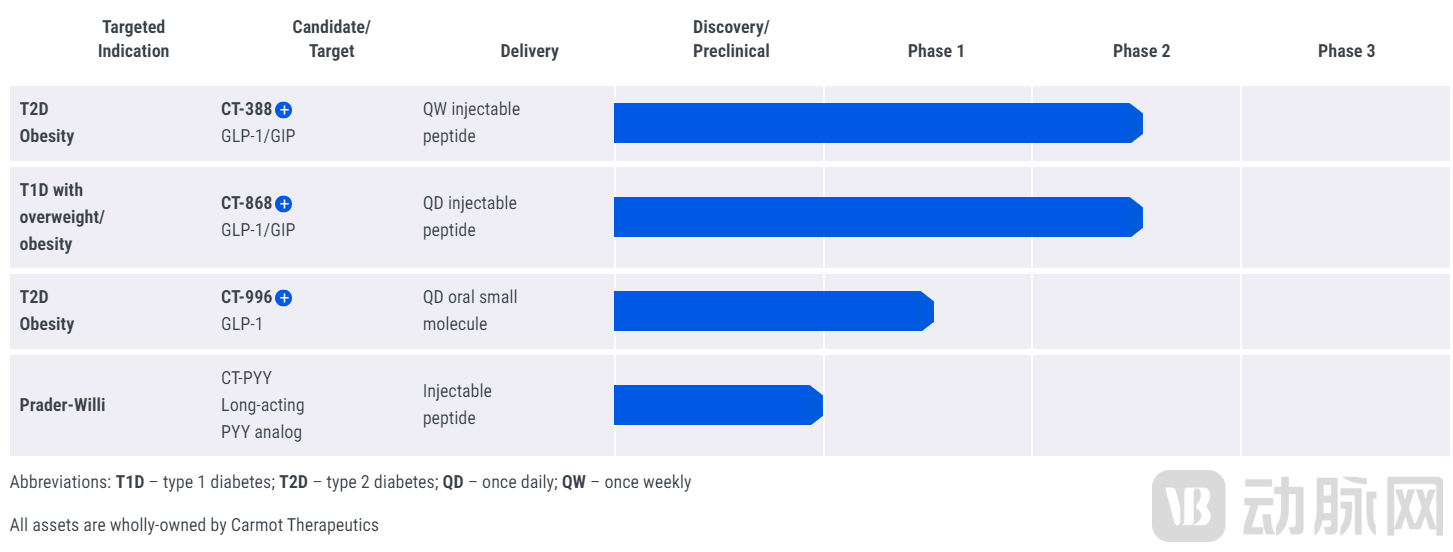 Carmot's R&D Pipeline
Source: Carmot official website
These three GLP-1 drugs fill the gap for Roche in the GLP-1 field, serving as the company's stepping stone into the booming GLP-1 market.
However, since the sudden rise and explosive popularity of GLP-1 in 2023, especially after Eli Lilly's tirzepatide (Zepbound) and Novo Nordisk's semaglutide injection Wegovy were successively approved for marketing, numerous companies have entered this billion-dollar market. Latecomers are gradually increasing and competing to make strategic moves. Indications have expanded from diabetes, obesity, and cardiovascular diseases to chronic kidney disease, while modes of administration have shifted from injections to oral forms. Competition in the GLP-1 field is becoming increasingly intense.
Despite the continuous "internal competition" in the GLP-1赛道, leading companies with approved and marketed drugs have already reaped substantial profits. According to Novo Nordisk's 2023 annual financial report, the company’s total annual revenue reached approximately $33.771 billion, representing a 31% year-on-year increase, with a net profit of about $12.1 billion, up 52% year-on-year. Notably, semaglutide generated sales of $21.201 billion in 2023. It is worth mentioning that the combined sales of the company’s GLP-1 products amounted to $23.9 billion, accounting for 70% of the total revenue.
According to Global Market Insights, the global GLP-1 drug market size is projected to grow from $11 billion in 2023 to $50 billion by 2030. Therefore, despite Novo Nordisk and Eli Lilly monopolizing nearly 90% of the GLP-1 market share with their first-mover advantage, while ramping up production capacity to capture the market and strengthening barriers across multiple dimensions to solidify their moats, Roche has resolutely decided to enter the market in hopes of claiming a share of this multi-billion-dollar opportunity.
Among the five neurology-related pipelines that have given way to GLP-1, there are two AD drugs that Roche has been committed to for nearly 18 years.
On January 22, 2024, AC Immune SA ("AC Immune") announced the termination of the cooperation agreement with Roche. AC Immune will regain global development and commercialization rights for two drugs used in the treatment and prevention of AD — Crenezumab, an anti-β-amyloid antibody, and Semorinemab, an anti-Tau antibody.
Crenezumab and Semorinemab are AD candidate drugs that Roche has been persistently developing for over 10 years.
In 2006, AC Immune exclusively licensed its anti-beta-amyloid program to Genentech. Under the collaboration agreement, Genentech paid AC Immune over $300 million in clinical and regulatory milestone payments (excluding royalties) for the rights related to Crenezumab.
In 2012, AC Immune entered into a second global exclusive license and research collaboration agreement with Genentech. Under the terms of the agreement, AC Immune received an undisclosed upfront payment and is eligible to receive research, development, and commercialization milestone payments for AD and other indications, totaling over 400 million Swiss francs (approximately $418 million at the then-prevailing exchange rate). Additionally, AC Immune is eligible to receive royalties on net sales of products arising from the collaboration.
In 2009, Roche acquired Genentech for $46.8 billion, since then, Crenezumab and Semorinemab have become the key pipelines of Roche in the AD field.
However, after more than a decade of relentless efforts by Roche and AC Immune on Crenezumab and Semorinemab, these drugs have "let them down," with clinical trials encountering multiple failures.
Since its development, Crenezumab has undergone eight clinical trials, but half of them have failed: In 2014, the Phase 2 clinical trial ABBY failed as Crenezumab did not delay or improve cognitive decline in patients with mild to moderate AD, missing the primary endpoint. In 2019, an interim analysis by the independent data monitoring committee indicated that Crenezumab's two Phase 3 clinical trials, CREAD1 and CREAD2, were likely to miss the primary endpoint, leading Roche to announce the termination of these two trials.
In June 2022, the Phase 2 clinical trial API ADAD failed, as Crenezumab did not slow or halt cognitive decline in AD patients, missing the primary endpoint. In November 2022, the two Phase 3 clinical trials GRADUATE 1 and GRADUATE 2 also failed, with Gantenerumab not only failing to meet the primary endpoint of slowing clinical decline but also achieving lower-than-expected levels of β-amyloid removal.
Semorinemab is no exception. In September 2020, in the Phase 2 clinical trial TAURIEL, Semorinemab missed all efficacy endpoints of the trial, failing to improve outcomes for patients with prodromal or mild AD. Since then, Semorinemab has become the first clinically failed Tau antibody and was rated by FiercePharma as one of the top ten failed clinical studies worldwide in 2020.
In November 2021, in the Phase 2 clinical trial LAURIET, semorinemab reduced the rate of cognitive decline in AD patients by 43.6% compared to placebo, achieving one of the primary endpoints of the trial. However, semorinemab did not achieve the other primary endpoint, as it had no impact on the decline in patients' daily functioning assessed by ADCS-ADL. Semorinemab also failed to reach several secondary endpoints of the trial.
Two consecutive clinical failures of two drugs have gradually dashed Roche's hopes, leading to thoughts of eliminating them. However, Carmot's GLP-1 assets have filled the gap in Roche's neuroscience and oncology fields.
Roche Chief Medical Officer Levi Garraway stated: Carmot's GLP-1 portfolio offers different routes of administration and the opportunity to develop combination therapies for treating obesity and other potential indications. They could be "the best in their class," with the potential to be used alongside muscle-protecting drugs in Roche’s pipeline, as well as possibly for other applications such as treating eye or brain diseases.
For a long time, the AD field has been a major disaster area for new drug development, with extremely high difficulties in research and development. Data released by the Pharmaceutical Research and Manufacturers of America shows that between 1998 and 2017, 146 Alzheimer's disease drugs globally failed during the clinical trial stage. Major pharmaceutical giants such as Johnson & Johnson, Pfizer, Eli Lilly, Merck, and Biogen have all faced setbacks and failures in this area.
According to statistics from the World Health Organization, approximately 55 million people worldwide suffer from AD. AD, along with other types of dementia, has become the seventh leading cause of death globally. However, incomplete statistics show that currently, only eight AD treatment drugs have been approved by the FDA for marketing. These drugs can only alleviate patient symptoms and do not reduce the pathological changes of AD, nor can they reverse or slow down the progression of the disease.
Among them, Biogen/Eisai's AD drug Aduhelm was approved for marketing by the FDA in June 2021, being the first AD drug approved for marketing by the US FDA in nearly 20 years.
However, Aduhelm is a highly controversial drug. In the two Phase 3 clinical trials initiated by Biogen — Emerge and Engage — Aduhelm demonstrated conflicting interim results. In the Engage trial, the primary endpoint did not show statistical significance. At the time, Biogen acknowledged the failure of Aduhelm and announced the termination of both trials. Additionally, the British Alzheimer's Association also expressed doubts about the efficacy of Aduhelm.
Nevertheless, Aduhelm still successfully entered the market. However, the FDA required Biogen to conduct a Phase 4 confirmatory study (Envision study) after Aduhelm's launch. Despite this, Aduhelm did not become a blockbuster product. From its market entry until the end of 2021, its sales were only $3 million; in 2022, the drug’s total annual sales reached $4.8 million; and in the first nine months of 2023, sales were less than $11 million.
To this end, at the beginning of 2022, Eisai first announced the abandonment of Aduhelm, handing it over entirely to Biogen. Biogen also recently announced the cessation of sales and development of Aduhelm.
But there is still good news in the field of AD treatment drugs. After announcing the termination of the sales and development of Aduhelm, Eisai and Biogen jointly advanced the development of another AD drug, Leqembi. Living up to expectations, Leqembi was approved by the FDA for marketing in July 2023, becoming the first new AD drug to receive full FDA approval in 20 years. Meanwhile, on January 9, 2024, China's National Medical Products Administration announced that Leqembi had been approved in China. The drug is expected to be launched domestically in mid-July this year for the treatment of mild cognitive impairment and mild Alzheimer's disease dementia caused by AD.