

Breakthroughs in Gene Therapy: Advances in Retinitis Pigmentosa, Autism, and Hearing Loss

Johnson & Johnson
Medical Device R&D and Manufacturer
Johnson & Johnson's Ophthalmic Gene Therapy Intended for Breakthrough Therapy Designation
On February 4, the CDE website showed that Johnson & Johnson's AAV5-hRKp.RPGR intravitreal injection solution was proposed to be included in the breakthrough therapy, for the treatment of patients diagnosed with RPGR pathogenic variant-associated X-linked retinitis pigmentosa (RPGR-XLRP).
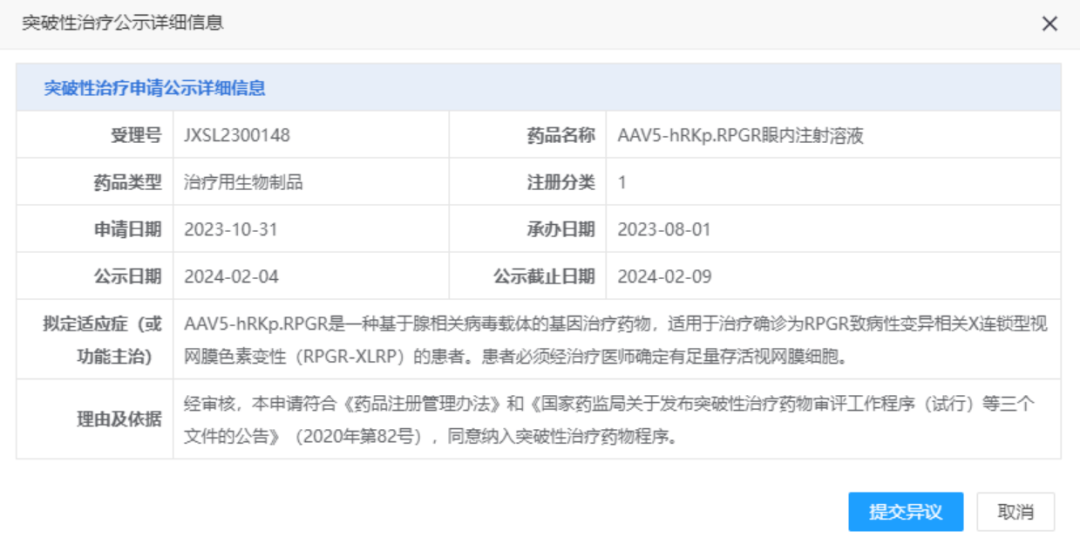
AAV5-hRKp.RPGR (JNJ-5340, botaretigene sparoparvovec) is a gene therapy drug based on an adeno-associated virus vector, designed to treat XLRP caused by variations in the open reading frame 15 (RPGR ORF15) of the eye-specific RPGR gene. It is currently in Phase III clinical trials for the treatment of X-linked retinitis pigmentosa.
In 2019, Johnson & Johnson signed a collaboration with MeiraGTx to develop gene therapies for inherited eye diseases, including JNJ-5340, as well as two other gene therapy drugs for achromatopsia, JNJ-5288 and JNJ-5301. By the end of 2023, Johnson & Johnson acquired the development rights for botaretigene sparoparvovec in a deal worth up to $415 million.
World's First AAV Gene Therapy for Autism Approved for Clinical Trials
Recently, Jaguar Gene Therapy announced that the U.S. Food and Drug Administration (FDA) has approved the company's IND application for its AAV gene therapy JAG201, which aims to address severe neurodevelopmental disorders caused by SHANK3 gene variants or deletions, covering inherited autism spectrum disorder (ASD) and Phelan-McDermid Syndrome (PMS).
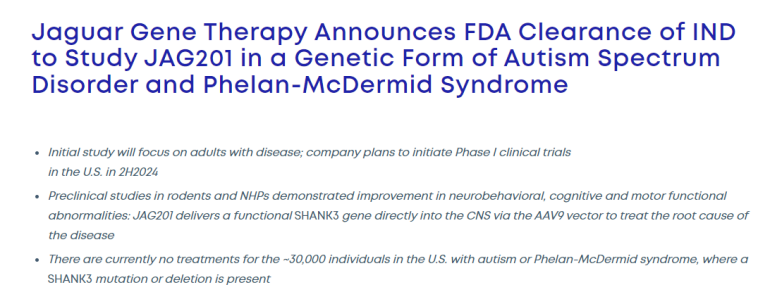
Currently, there are approximately 30,000 patients with ASD or PMS in the United States who have SHANK3 mutations or deletions and no available treatments. Defects in the SHANK3 gene lead to synaptic dysfunction, disrupting communication between neurons. Specifically, this genetic defect reduces the levels of several key receptors and signaling proteins at excitatory synapses, impairing synaptic formation and function. Since normal synaptic function is an essential prerequisite for all neuronal physiological activities, including higher cognitive functions and learning, defects in the SHANK3 gene can cause severe neurological disorders.
JAG201 delivers a minimized functional SHANK3 gene via the AAV9 vector, targeting neurons in the central nervous system. Administered through a one-time unilateral intracerebroventricular injection, the therapy effectively distributes the drug throughout the brain and spinal cord. By providing an appropriate level of SHANK3 gene expression, it can durably restore synaptic function essential for learning and memory, thereby significantly improving neurodevelopment and maintaining cognitive, communication, social, and motor skills. The company plans to initiate a Phase I trial in the United States in the second half of this year, focusing on adult patients with ASD or PMS who have SHANK3 mutations or deletions.
Chinese Gene Therapy Restores Hearing in 5 Children
Recently, the top medical journal *The Lancet* published the clinical trial results of gene therapy conducted in children with hereditary deafness by a research team led by the Eye, Ear, Nose and Throat Hospital of Fudan University, including scientists from Harvard Medical School.Trial results showed that among six children with autosomal recessive deafness 9 (DFNB9), five experienced significant hearing improvement after receiving gene therapy.
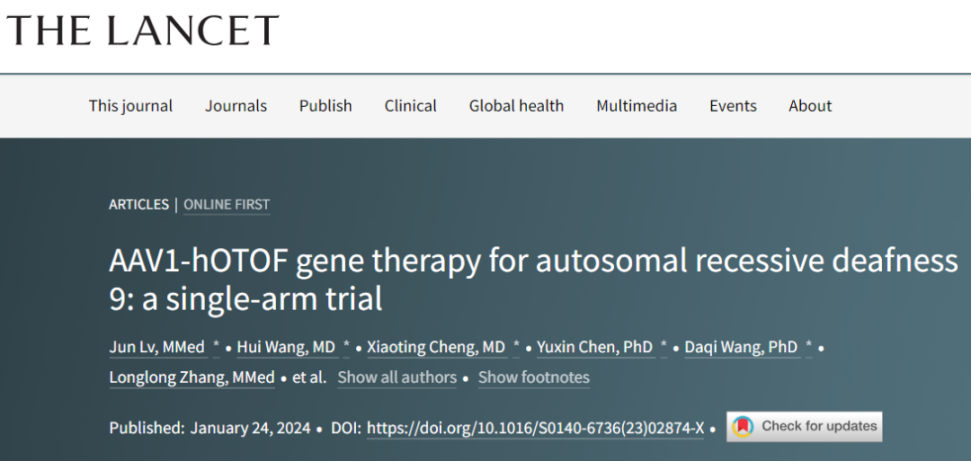
The press release noted that this is the first clinical trial of gene therapy conducted in children with DFNB9.The test results showed the safety and effectiveness of gene therapy in the clinical treatment of patients with hereditary deafness.




www.yyjjb.com.cn
Insight into Industry Trends

"Pharmaceutical Economy Herald"
Academic Official Account
Focusing on the Frontiers of Oncology Academia

Terminal Official Account