Johnson & Johnson Announces Positive Phase III VIVACITY Trial Results for Nipocalimab in Generalized Myasthenia Gravis and Submits Regulatory Filings

Johnson & Johnson
Healthcare Product Manufacturers, Health Service Providers

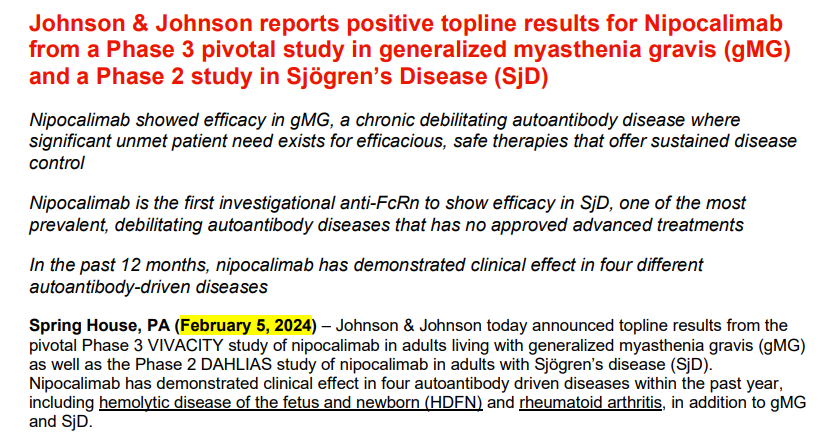
On February 5, Johnson & Johnson announced positive results from the pivotal Phase III VIVACITY study of FcRn antibody nipocalimab for the treatment of generalized myasthenia gravis (gMG) and the Phase II DAHLIAS study for the treatment of Sjögren's syndrome. Next, Johnson & Johnson plans to collaborate with global regulatory authorities to bring nipocalimab to gMG patients.
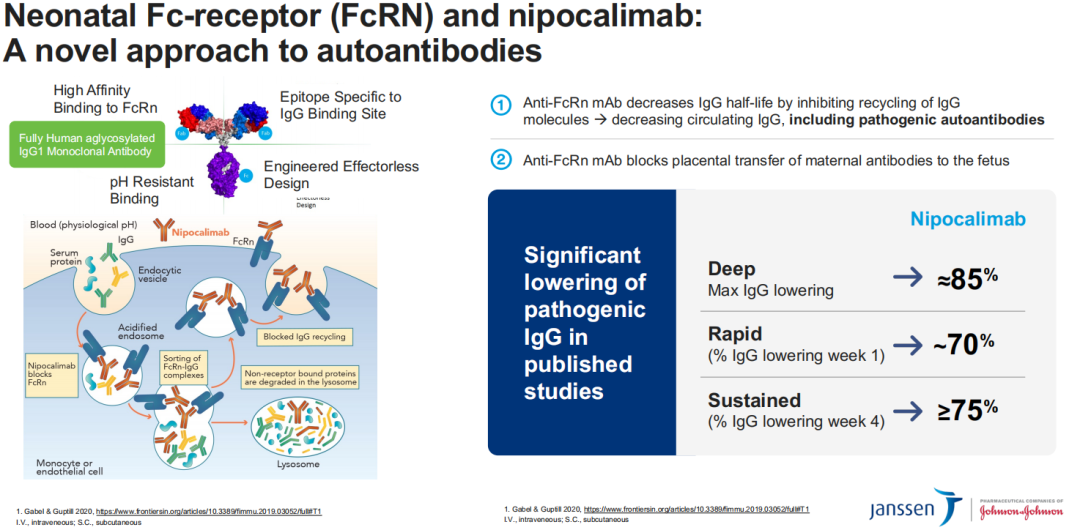
Nipocalimab is an investigational high-affinity, fully human, glycosylated, effector-less monoclonal antibody that selectively blocks FcRn to reduce levels of circulating immunoglobulin G (IgG) antibodies, including pathogenic autoantibodies and alloantibodies.
Nipocalimab was initially developed by AnaptysBio and later sold to Momenta. In August 2020, Johnson & Johnson acquired Momenta for $6.5 billion, gaining ownership of this drug.
Phase III VIVACITY Study Meets Primary Endpoint: Compared with the placebo group, patients in the nipocalimab group achieved a statistically significant reduction in MG-ADL scores from baseline during weeks 22 to 24, reaching the primary endpoint. gMG is a chronic, lifelong, rare, and highly debilitating autoantibody-driven neuromuscular disease characterized by fluctuating muscle weakness.
Previously, two FcRn antibodies have been approved by the FDA for marketing: efgartigimod (developed by Argenx/Zai Lab) and rozanolixizumab (developed by UCB), both of which are indicated for the treatment of gMG.Efgartigimod has shown promising commercial prospects, with sales exceeding $400 million in its first full year on the overseas market in 2022.
Phase II DAHLIAS study also met the primary endpoint, with the nipocalimab group showing a statistically significant reduction in clinical ESSDAI score from baseline at week 24 compared to the placebo group. These data indicate that Nipocalimab has become the first anti-FcRn therapy to demonstrate efficacy in Sjögren's syndrome, one of the most common and debilitating autoantibody diseases, for which there are currently no approved advanced treatments.
Notably, Novartis recently stated in its financial report that it has decided to discontinue the development of the BTK inhibitor remibrutinib for Sjögren's syndrome.
Katie Abouzahr, MD, Vice President and Head of Johnson & Johnson’s Autoantibody and Maternal-Fetal Immunology Disease Area, stated: "Johnson & Johnson is committed to addressing the significant unmet needs of patients suffering from these chronic, debilitating, autoantibody-driven diseases. We are the only company developing anti-FcRn therapies across three key areas of autoantibody diseases, with proof-of-concept achieved in each: gMG validated in the rare autoantibody space, HDFN validated in maternal-fetal immunology, and Sjögren’s syndrome and rheumatoid arthritis validated in prevalent rheumatology."
Copyright © 2024 PHARMCUBE. All Rights Reserved.
Welcome to forward, share, and reasonably cite. When citing, please clearly indicate the source of the article in a prominent position;For reprint, please leave a message or send a message to the WeChat Official Account backend, and indicate the name and ID of the official account.
Disclaimer: The information in this WeChat article is for general reference only and should not be directly used as decision-making content. PharmaCube assumes no responsibility for any loss incurred by any party due to the use of the content herein.