

Beyond AlphaFold2: Generative AI Platform NeuralPLexer Powers Iambic Therapeutics’ Clinical-Stage Oncology Pipeline

Iambic Therapeutics
Small Molecule Therapy Developer
▎Edited by the WuXi AppTec content team
The advent of the artificial intelligence (AI) model AlphaFold has revolutionized the field of protein three-dimensional structure prediction and protein design. Empowering the discovery and development of innovative drugs using AI models has become a hot topic in the biopharmaceutical field. Today, Iambic Therapeutics announced,Using the company's unique generative AI platform NeuralPLexer to predict the three-dimensional structure of protein/ligand complexes, as well as research on the impact of drug molecules on the conformation of these complexes.Nature Machine IntelligencePublished on.The press release pointed out that NeuralPLexer outperformed other cutting-edge AI models, including AlphaFold2, in multiple metrics.
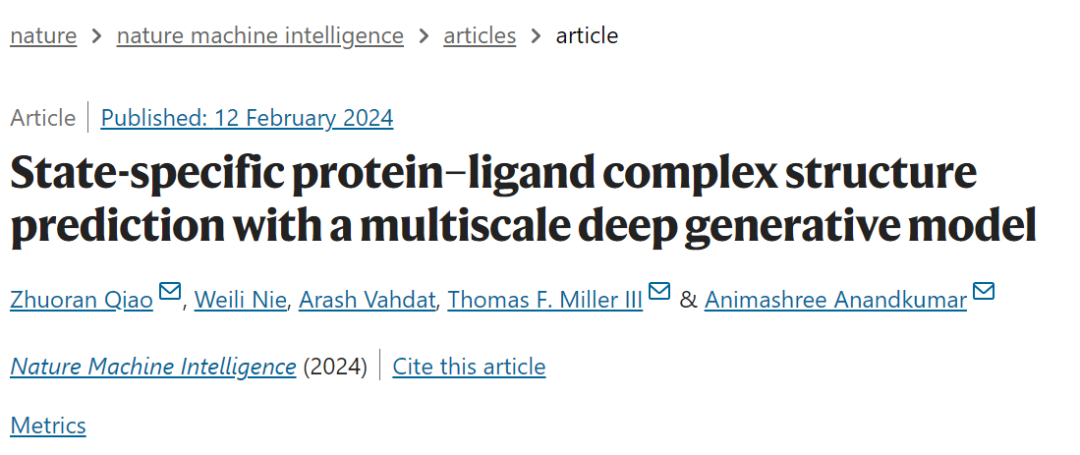
In this study, NeuralPLexer outperformed other existing models in predicting protein-ligand blind docking and flexible binding site structures. In predicting the overall structures of protein-ligand complexes involving large-scale conformational changes or newly discovered ligand-binding proteins, NeuralPLexer demonstrated superior performance compared to AlphaFold2.

The NeuralPLexer2 model, trained by the company in October 2023, significantly improved upon existing methodologies. In addition to enhancing the prediction accuracy of innovative targets, the research team also greatly expanded the model's application scope to include nearly all categories of biological structures, adding protein/protein complexes, cofactors, post-translational modifications, and protein/nucleic acid complexes, covering almost all structures in the Protein Data Bank (PDB).
In terms of predictive performance,NeuralPLexer2 predicts the success rate of protein/ligand complex structures at 75%, and when amino acid information near small molecule ligands is provided to the model, the success rate can be increased to 93%.
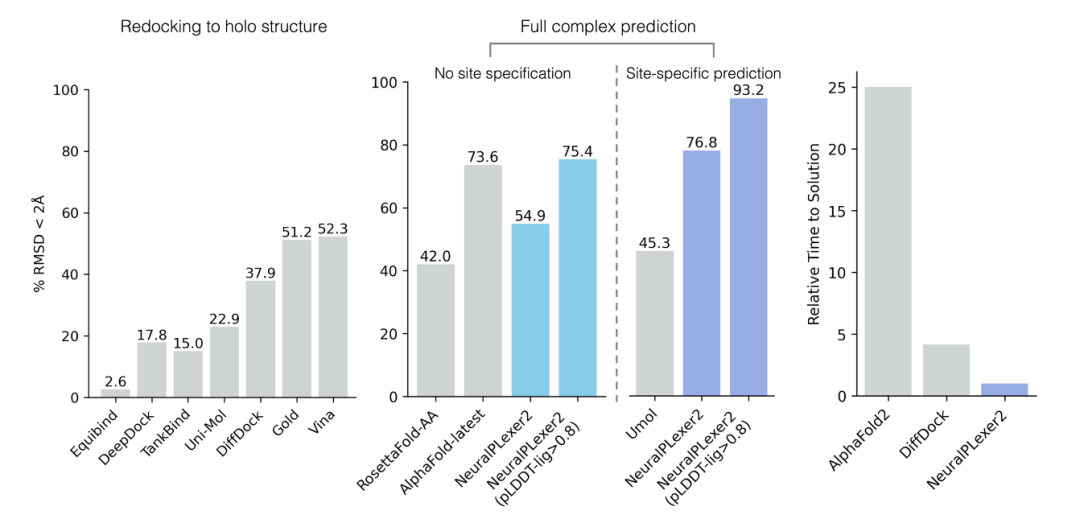
▲NeuralPLexer2's performance in predicting protein/ligand complex structures (Image Source:Reference [2])
It is worth mentioning that the structural prediction speed of NeuralPLexer2 has also been significantly improved. The white paper published by Iambic Therapeutics, Inc. points out,NeuralPLexer2 predicts 50 times faster than AlphaFold2!Provides the opportunity to conduct ultra-large-scale virtual screening and study ligand-binding-induced conformational changes across the proteome.
Iambic Therapeutics has successfully applied this system to the discovery and development of innovative drugs. The company's leading drug candidate, IAM1363, was discovered through this technology platform.It is a selective, brain-penetrant HER2 small molecule inhibitor that can inhibit both wild-type and oncogenic HER2 mutant proteins while avoiding off-target inhibition of the epidermal growth factor receptor (EGFR), thereby enhancing drug safety and expanding the therapeutic window.In preclinical studies, IAM1363 demonstrated over 1000-fold selectivity for HER2 compared to EGFR. The IND application for IAM1363 has been approved by the U.S. FDA, with clinical development expected to commence in early 2024. Notably,This R&D project took less than two years from initiation to clinical trials.
Another investigational therapy by the company, IAM-C1, is a selective CDK2/CDK4 dual inhibitor. Compared to the already approved CDK4/CDK6 inhibitors,IAM-C1 does not inhibit the functions of related CDKs such as CDK1, CDK6, and CDK9, and therefore may achieve better safety by reducing dose-limiting toxicity.
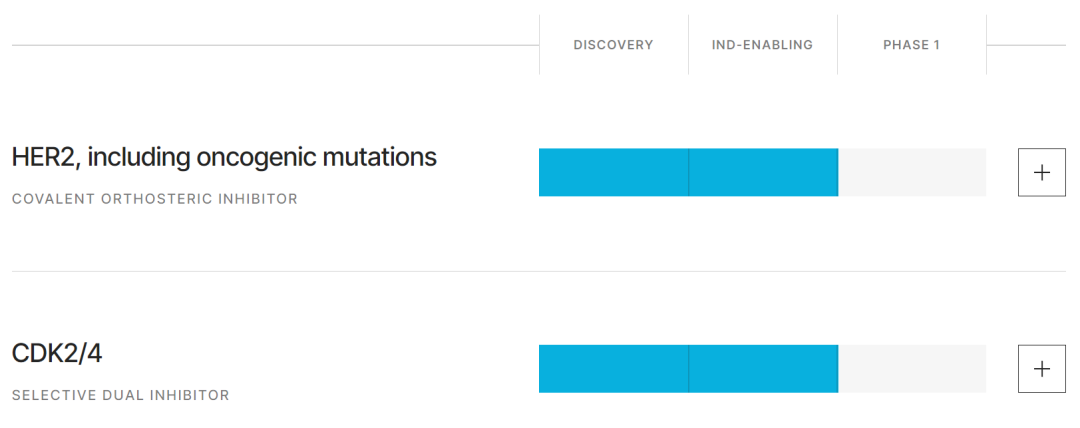
▲IMain R&D Projects of Iambic Therapeutics (Image Source: Iambic Therapeutics Official Website)
Following breakthroughs in predicting the three-dimensional structures of proteins, AI models are increasingly being used for the discovery and development of innovative drugs. Large pharmaceutical companies are also making moves in this field. Earlier this year, Eli Lilly and Novartis reached agreements with Isomorphic Labs.$3 Billion R&D Collaboration, leveraging the new generation AlphaFold technology to develop small molecule therapies for multiple targets. CHARM Therapeutics, co-founded by David Baker, a pioneer in protein design and professor at the University of Washington, also reached a research collaboration with Bristol-Myers Squibb last year. The partnership utilizes its DragonFold protein/ligand co-folding model to develop innovative small molecule compounds.
Laksh Aithani, CEO of CHARM, told the content team of WuXi AppTec in an interview that the strategy of computer simulation is not limited by therapeutic areas and can be used in any protein-related therapeutic fields. Besides improving existing drugs, AI models are expected to find molecules that bind to allosteric pockets of proteins, thereby targeting proteins without natural binding sites. He looks forward to the next five years,Using computer simulation methods, not only can small molecules that bind to traditionally difficult-to-drug targets be identified, but these molecules can also be used to modulate the function of the targets. This will be a significant advancement in this field.
Related Reading:How Does This Rising Star Plan to Challenge the "Undruggable" Limits Using Deep Learning Technology? | Rapid New Molecules

Everyone is watching



WuXi AppTec provides integrated, end-to-end new drug research and development and production services for the global biopharmaceutical industry, covering a wide range of services including chemical drug R&D and production, biological research, preclinical testing and clinical trial R&D, as well as cell and gene therapy R&D, testing, and production.If you have relevant business needs, please feel free to click on the image below to fill in the specific information.
▲If you have any business needs, please long press to scan the QR code above, or click "Read more" at the end of the article to access the business对接 platform and fill in your business needs information.

▲To learn more about the application of cutting-edge technologies in the biopharmaceutical industry, please long-press and scan the QR code above to access "WuXi Live Studio" and watch live discussions and exciting replays on related topics.

Share,PointLike,In View,Focusing on Global Biomedical Health Innovation