Five New Drugs Approved in China in January 2024: Hengrui Medicine, HealthCare Bio Among Winners with Strong Start

Hengrui Pharma
Innovative and High-Quality Pharmaceutical Developer
Eli Lilly
Global Pharmaceutical R&D and Production Company
Pfizer
Pharmaceutical R&D Developer

In the first month of the New Year, five new drugs have been successfully approved in China, respectively.Eisai/BiogenTheLecanemab Injection(GladCare)、Eli LillyTheGalcanezumab Injection(Enjiale)、Jilin Huisheng Biopharmaceutical Co., Ltd.TheProline Gaglinet Tablets(Huiyoujing)、PfizerTheRimegepant Sulfate Orally Disintegrating Tablets(Lotek)AndHengrui PharmaTheTadalafil Fumarate Injection(Aisute)。
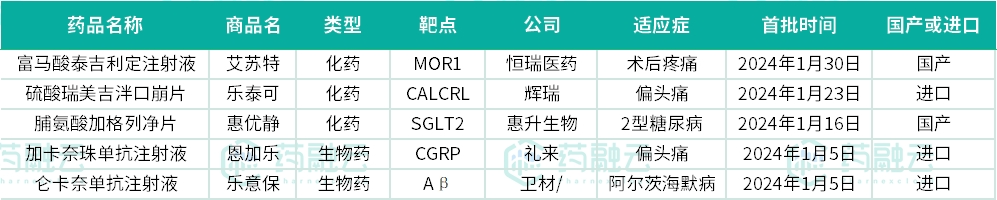
Source: PharmaCloud China Drug Evaluation Data
China's First Alzheimer's Biologic: Lecanemab Injection
LecanemabIs an anti-amyloid(Aβ)Fibril antibody, also jointly developed by Eisai and Biogen. Amyloid deposition is one of the hallmark features of the AD patient's brain.LecanemabBy binding to soluble Aβ aggregates and promoting their clearance, it has the potential to alter AD pathology and slow disease progression. The FDA has granted this therapy Fast Track designation, Priority Review status, and Breakthrough Therapy designation. In January 2023, the FDA granted accelerated approval.LecanemabUsed to treat Alzheimer's disease, making it the second innovative Alzheimer's therapy targeting β-amyloid in recent years.(In 2021, Aducanumab developed by Eisai/Biogen was approved, being the first one.)。
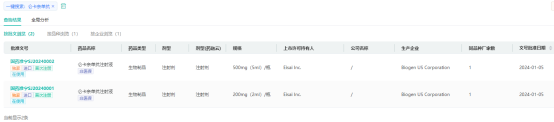
Source: PharmaCloud China Drug Approval Data
According to the November 2022 issue of The New England Journal of Medicine(NEJM)The results of the Phase 3 Clarity AD trial, published on, involving nearly 2000 patients with early Alzheimer's disease,LecanemabHighly statistically significant results were shown in reducing clinical decline. Regarding the Clinical Dementia Rating-Sum of Boxes (CDR-SB), the mean changes from baseline were 1.21 points for the treatment group and 1.66 points for the placebo group, indicating a 27% reduction in clinical decline for the treatment group compared to the placebo group. All key secondary endpoints in the treatment group also demonstrated statistically significant differences compared to the placebo group, including measures specifically assessing cognitive abilities such as ADAS-Cog14, Alzheimer's Disease Composite Score (ADCOMS), and the ADCS MCI-ADL scale used to evaluate patients' daily living abilities. In terms of safety, 0.7% of participants in the lecanemab group and 0.8% in the placebo group died. Investigators concluded that no deaths were related to lecanemab or amyloid-related imaging abnormalities.(ARIA)Related. In addition, 14.0% of participants in the lecanemab group and 11.3% in the placebo group experienced serious adverse events, while 88.9% and 81.9% of participants experienced adverse events, respectively. The most common adverse events in the lecanemab group included infusion reactions and ARIA-H.(Combined cerebral microbleeds, massive cerebral hemorrhage, and superficial siderosis)、ARIA-E(Edema/Effusion), headache, and falls.
In the Chinese market, except for GV-971(Shanghai Green Valley Pharmaceutical's Mannitol Sodium Capsules, which have been subject to significant controversy)In addition, the approved drugs are mainly cholinesterase inhibitors, which generally show insufficient efficacy and can only control disease symptoms in the short term. They are unable to target the underlying pathogenic mechanisms to slow disease progression. In January 2023,LecanemabIt has been approved through the FDA's accelerated approval pathway. In July of the same year, the FDA announced that the drug would be converted to regular approval. This also made the drug the first AD medication to receive full FDA approval in 20 years. This timeLecanemabApproved in China, offering a new treatment option for the vast population of Alzheimer's patients.
Heavyweight CGRP Monoclonal Antibody, Eli Lilly's New Migraine Drug: Galcanezumab Injection

GalcanezumabIt is a humanized IgG4 monoclonal antibody that can bind to calcitonin gene-related peptide.(CGRP)By binding to and blocking CGRP from interacting with its receptor, the drug achieves the therapeutic goal of preventing migraines. It was first approved by the U.S. FDA in September 2018 for the preventive treatment of migraines in adults. In June 2019, the FDA further announced its approval.GalcanezumabFor the treatment of adult patients with episodic cluster headaches, reducing the frequency of attacks.
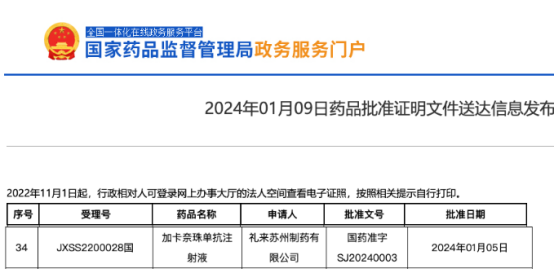
Source: NMPA official website
The approval for the preventive treatment of adult migraine in China this time is mainly based on aGalcanezumabPositive Results from the Phase III CGAX Study in Chinese Patients. The CGAX study is a prospective, global, multicenter, randomized, double-blind, placebo-controlled phase III trial that enrolled 520 patients with episodic migraine, primarily Chinese patients. Participants were randomly assigned in a 1:1 ratio to receive 120mg of galcanezumab once per month during the 3-month double-blind treatment period.(Loading dose of 240mg)Or placebo treatment.
The results of the CGAX study showed that the primary endpoint was the number of headache days per month.(MHD)Above,GalcanezumabThe treatment group was significantly superior to the placebo group. Among the four key secondary endpoints evaluating the impact of migraines on function, MSQ scores(Quality of Life Score), 50% response rate (The proportion of patients with a ≥50% reduction in headache days from baseline., with 75% and 100% response rates, the treatment group also outperformed the placebo group, consistent with the results of major global studies that have been completed. Additionally, the study also showedGalcanezumabThe safety profile was favorable, with the severity of adverse events mostly being mild to moderate. No serious adverse events or fatalities occurred.
From the perspective of global sales in 2022, the overall growth rate of CGRP/CGRPR antagonists slowed compared to 2021 but still steadily increased by 26% to reach USD 3.171 billion. AbbVie's Ubrelvy®, Eli Lilly's Emgality®, Amgen/Novartis' Aimovig®, and Pfizer's Nurtec® dominate the main market share, with a combined revenue of USD 2.494 billion, accounting for a high percentage of 78.7%. It is hoped that drugs targeting this mechanism in China can bring new treatment options to the vast number of migraine patients.
The 2nd Chinese-Made SGLT2 Inhibitor: Proline Gaglinid Tablets
Proline/GliflozinIs a sodium-glucose cotransporter 2(SGLT2)Inhibitors, by inhibiting SGLT2, reduce the reabsorption of filtered glucose, lower the renal threshold for glucose, and thereby increase urinary glucose excretion. The drug's market launch provides a new treatment option for adult patients with type 2 diabetes. Jiajialiejing Tablets are Class I innovative drugs in China’s SGLT-2 inhibitor category. While effectively controlling blood sugar, this product also offers potential benefits in cardiovascular and renal protection, and has already obtained 28 patents in multiple countries and regions including China, the United States, Europe, Japan, South Korea, and Hong Kong. Jiajialiejing is developed by Sihe Pharmaceuticals.(0460.HK)Jilin Huisheng Biopharmaceutical Co., Ltd., a non-wholly owned subsidiary, independently developed the product. The molecular structure was identified in 2012, and after 12 years of development with an investment of hundreds of millions of yuan, it was finally approved for marketing in 2024.
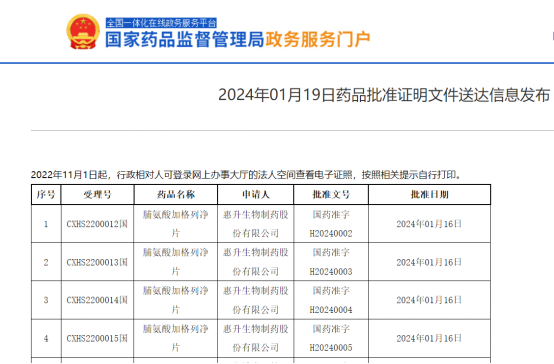
Source: NMPA official website
Proline/GliflozinThe clinical Phase III research data show that it not only has significant hypoglycemic efficacy(The reduction in glycated hemoglobin from baseline was up to 1.4%.), while also providing multiple benefits such as lowering blood pressure, reducing weight, and improving blood lipids, with a low risk of hypoglycemia and overall good safety. Compared horizontally with the Phase III clinical data results of similar SGLT-2 inhibitor products already on the market, Jaglelin shows similar or even better results.
At the end of 2021, Hengrui's self-developed new drug, Henglietinib, was approved, becoming the first SGLT2 new drug produced in China. The product quickly entered the medical insurance through national negotiations and is expected to rapidly increase in volume. China has a large number of diabetes patients, a big market, and many drugs. However, due to reasons such as price and access, the penetration rate of new hypoglycemic drugs is still not high, such as SGLT2, DDP4, GLP-1 and other drugs, which have relatively low market shares. Compared with developed countries in Europe and America, there is still a significant gap. It is hoped that more diabetes patients will have access to higher quality treatment options.
A New Generation of Powerful Oral CGRP Receptor Antagonist: Rimegepant Sulfate Orally Disintegrating Tablets
RimegepantRimegepant, which targets a key component of migraines by reversibly blocking the CGRP receptor, thereby inhibiting the biological cascade that leads to migraine attacks.RimegepantIt is currently the first and only orally disintegrating tablet formulation of a CGRP receptor antagonist, offering the advantages of convenient administration, rapid onset, and high bioavailability. It effectively blocks key pathways involved in migraine pathogenesis, providing fast and sustained relief of headache and related symptoms. The administration method is convenient, with no contraindications or effects related to cardiovascular diseases. In February 2020, the drug received its first approval in the United States, and in May 2021, it was approved for expanded indications. Subsequently, it was approved for marketing in Europe in April 2022. This innovative drug is the world's first and only medication approved by both the U.S. FDA and the EU for both acute treatment and preventive treatment of migraines.
Pfizer reached a cooperation with Biohaven for a total of $1.24 billion in November 2021, acquiring the rights to two CGRP antagonists, including an oral migraine drug.Rimegepant(Nurtec ODT)Rights outside the United States, and Zavegepant(Developing intranasal + gel dual formulations simultaneously)the U.S. regional rights. Subsequently, in May 2022, Pfizer acquired Biohaven for $11.6 billion. These two transactions clearly demonstrate the MNC's confidence in CGRP-targeted drugs.
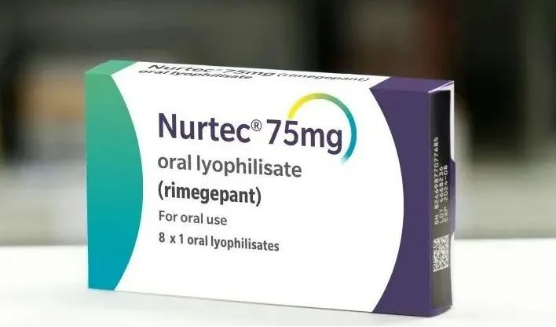
Rimegepant Orally Disintegrating TabletsIs the first oral CGRP receptor antagonist to demonstrate positive results in a pivotal trial in China. In this study, patients achieved the co-primary endpoints of pain relief and relief from the most bothersome symptom two hours after a single oral dose of 75mg. Patients experienced rapid pain relief and elimination of the most bothersome symptom within 45 minutes, returned to normal function within 60 minutes, and achieved pain freedom within 90 minutes; the sustained efficacy lasted up to 48 hours for most patients; it also showed good safety and tolerability, consistent with previous clinical trial results in the United States.
From the official commercial launch in March 2020 to December 31, 2021,RimegepantSales have reached $526 million. In terms of commercialization, oral medications offer strong convenience and low cost, with clear advantages. However, in the Chinese market, CGRP drugs are significantly more expensive compared to triptans. The path for these new drugs in the domestic market is not without challenges and warrants continued attention.
China's First Self-Developed Opioid Analgesic Innovation Drug: Tigilidine Fumarate
TegilidifumarateIt is a full agonist of opioid receptors, specifically the μ-subtype of opioid receptors.(MOR)It has relative selectivity and is managed as an anesthetic drug. Research data shows that this drug not only has significant analgesic effects and a rapid onset of action, effectively delaying the rebound of postoperative pain and the need for additional analgesia, but also significantly reduces the incidence of common adverse reactions such as nausea, vomiting, and respiratory depression while ensuring analgesic efficacy. This greatly enhances the comfort and safety of patients during treatment.
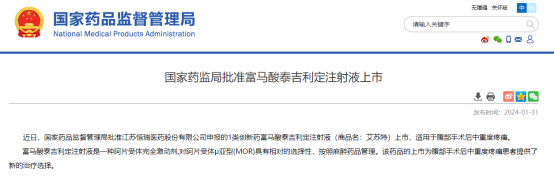
Source:NMPA Official Website
In December 2021, Hengrui Pharma announced the Phase 3 clinical study evaluating Tegilimab Injection.(SHR8554-301)The primary endpoint results met the pre-specified superiority criteria set forth in the protocol. This study evaluated the efficacy and safety of Tegilidine for postoperative pain relief after abdominal surgery. A total of 528 subjects were enrolled in the study, and those who reported a resting pain score of ≥4 at any time within 4 hours after the end of surgery were randomized in a 1:1:1:1 ratio to receive either Tegilidine Injection 0.75mg, SHR8554 Injection 1.0mg, morphine, or placebo. The study results demonstrated that Tegilidine Injection effectively treated moderate to severe pain following abdominal surgery and significantly improved subjects' satisfaction with pain management.
In addition to moderate to severe pain after abdominal surgery, Taiji Rding has also initiated a Phase II/III clinical trial for postoperative analgesia in orthopedic surgery.(Registration Number: NCT05375305/CTR20220639), the recruitment of subjects was completed in February 2022. On December 29, 2023, according to the CDE official website, Hengrui PharmaTegilid Fumarate InjectionSubmitted for marketing approval for the indication of post-orthopedic surgery pain relief. The drug's market entry provides a new treatment option for patients with moderate to severe pain after surgery, and we look forward to the early approval of its new indications.

END
Reply to the keyword " in the backgroundReport", access dozens of exclusive reports produced by Pharma Intelligence
Reply to the keyword " in the backgroundCSCO", to obtain the 2023 CSCO guidelines
Reply to the keyword " in the backgroundASCO", Obtain 2023 ASCO Abstract by Cancer Type
Reply to the keyword "First Generic in 2022", Obtain the list of first generic drugs approved in 2022
Reply to the keyword " in the backgroundMedical Insurance", obtain the 2022 medical insurance catalog
Contact us to experience more professional services from PharmaCloud. | ||||
WillDiscussion CombineWork | GardenDistrict TakeWu | Database Consultation | Customization Service | Media Cooperation |