Innostellar Biotherapeutics Presents Promising Phase I Clinical Data of LX102 Gene Therapy for nAMD at Angiogenesis 2024 Conference

Innostellar Biotherapeutics
Innovative Gene Therapy Drug Research, Development, and Manufacturing
Recently, Innostellar Biotherapeutics was invited by the internationally renowned ophthalmology expert Professor Philip Rosenfeld to present a special report on the clinical trial results of its self-developed LX102 gene therapy for nAMD at the Angiogenesis, Exudation, and Degeneration 2024 conference.
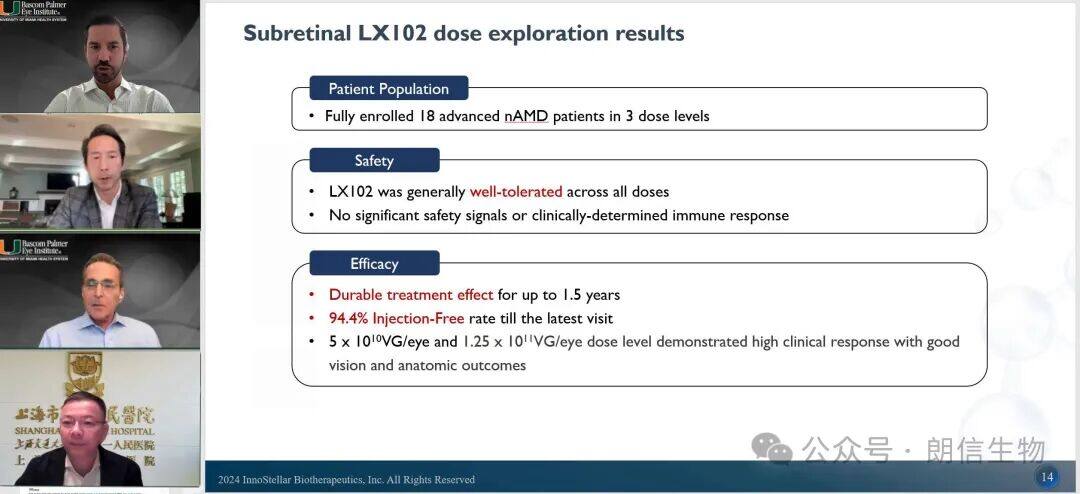
Professor Sun Xiaodong from the National Clinical Research Center for Ocular Diseases and the First People's Hospital of Shanghai reported in detail on behalf of the principal investigators of the project regarding Innostellar Biotherapeutics' LX102 IIT (investigator-initiated clinical research conducted by the First People's Hospital of Shanghai) 1-2 year results and China Phase I clinical trial outcomes. LX102 has accumulated over 20 cases of clinical data, demonstrating good safety and efficacy.
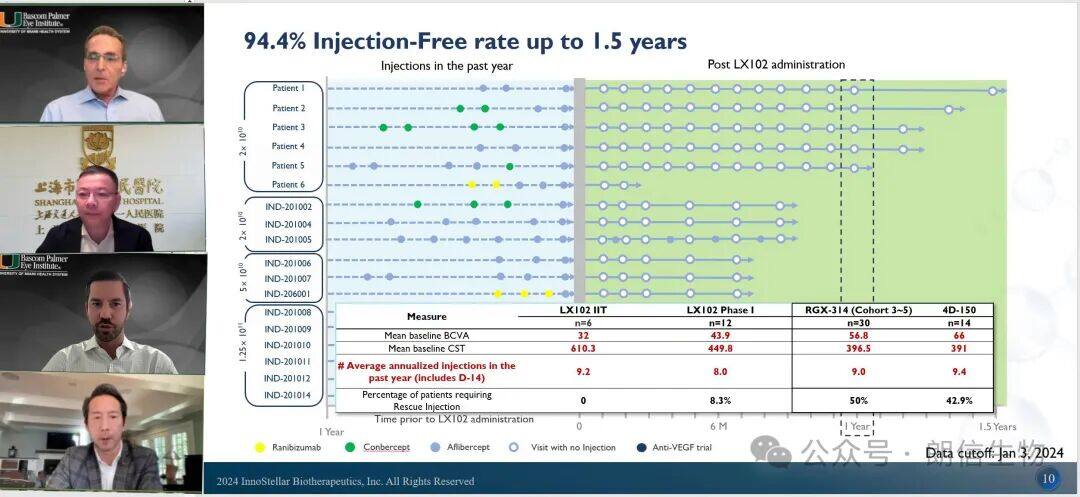
The first subject treated with LX102 has been followed up for a maximum of 18 months post-dosing, maintaining stable and improved vision without any supplementary treatment.In the Phase I study, all (9/9) medium- and high-dose subjects treated with LX102 did not require supplemental treatment with anti-VEGF agents.; Research on vision improvement is similar to existing antibody or fusion protein drugs,All studies have shown that the activity of ocular lesions has been stably controlled.The average age of patients in this group was 71 years. Before receiving LX102 treatment, the average annualized number of anti-VEGF treatments was 8 to 9 times, comparable to participants enrolled in similar foreign investigational products. After receiving LX102 treatment, the proportion of participants requiring supplemental treatment was significantly lower than that of similar foreign investigational products, with all observed lesions showing improvement. Among patients who completed the 6-month follow-up after dosing, only one case (1/11) required antibody supplementation therapy, and the effective dose was lower.Showed a superior trend.
The other two gene therapy drugs at this conference also reported their respective clinical trial results. The latest Phase II clinical study results of 4D-150 showed that, six months after administration, 50% (10/20) of the low-dose group and 37% (7/19) of the high-dose group received supplemental anti-VEGF treatment. Preliminary results from the latest Phase II clinical study of ABBV-RGX-314 for subretinal injection in treating nAMD indicated that, six months after administration, approximately 33% of subjects (4/15 in the medium-dose group and 6/15 in the high-dose group) required supplemental anti-VEGF treatment. (Source: conference data)
The meeting also reported the results of a previous IIT study by Innostellar Biotherapeutics on intravitreal injections for nAMD, with a follow-up period of 18-24 months. The results showed similar efficacy data, with clinical improvements lasting over two years in some cases, and no patients required supplemental treatment (0/6).
The participating experts had a heated discussion on the above results. Compared with other existing approved or researched long-acting treatment methods, gene therapy achieves more stable lesion control (2 years or even longer) through a single administration and is accumulating an increasing amount of efficacy and safety data. It is the most promising candidate drug to solve the problem of the current need for long-term repeated invasive administration in AMD treatment. Regarding the route of administration, the presenters pointed out that subretinal injection is the only gene therapy administration method proven by RCT and verified by commercialized drugs. Before LX102 subretinal administration, there is no need for preventive application of corticosteroids, and no drug-related immune-inflammatory reactions were found during the trial, showing good potential in the treatment of common diseases like AMD.Safety Advantages. The current efficacy results also prove that LX102, through optimized molecular design and improvements combined with subretinal localized drug delivery, can achieve better effects on the outer retina.Lesion-specific expression,and is also expected to play an advantage in the treatment of refractory PCV subtypes in the future.
The results released at this conference represent the first international disclosure of formal clinical trials for LX102, a nAMD gene therapy product independently developed in China, providing strong clinical evidence for the safety and efficacy of LX102 as a leading nAMD gene therapy product.
Age-related Macular Degeneration (AMD) is one of the most common blinding eye diseases in the elderly. Neovascular AMD, also known as wet age-related macular degeneration (nAMD), can cause severe acute vision loss. Although it accounts for only 10%-20% of AMD cases, it is responsible for 90% of AMD-related blindness. The current standard treatment typically involves intravitreal injections of anti-VEGF drugs at intervals of one or two months, with patients requiring an average of 6-12 injections per year, some needing lifelong treatment. Interruption or insufficient treatment leads to a decline in long-term therapeutic effects and irreversible vision loss. As a technological breakthrough, gene therapy is expected to significantly reduce the frequency of injections required for nAMD patients and may become a first-line maintenance therapy for nAMD in the future.
Since 2021, Innostellar Biotherapeutics has collaborated with the National Clinical Research Center for Ocular Diseases to conduct an Investigator-Initiated Trial (IIT) on the gene therapy LX102 for nAMD, making it the first gene therapy drug in China for this indication to be tested in humans. Although the number of cases in this one-year follow-up data is small, all patients have shown good and stable anti-VEGF efficacy lasting up to one year after a single dose. Compared with similar drugs abroad, this product demonstrates good safety and efficacy at lower doses. On December 20, 2023, the Phase II clinical trial of LX102 was officially launched at the National Clinical Research Center for Ocular Diseases, marking the beginning of patient enrollment for Phase II. Innostellar Biotherapeutics looks forward to enabling patients to benefit more from anti-VEGF treatment through gene therapy, achieving long-term stability and maintaining a normal quality of life with a single injection.
The Angiogenesis Conference is an authoritative meeting in the field of international ophthalmology and retinal disease new drug development. Hosted by the Bascom Palmer Eye Institute of the University of Miami Miller School of Medicine, the top-ranked ophthalmology hospital in the United States for 15 consecutive years, since 2004 until now. After multiple rounds of selection by experts in the field, it gathers the latest clinical research results for thematic reports, focusing on the diagnosis and new therapy development research of ocular neovascularization, exudative, and degenerative diseases.The participants include outstanding scientists and clinical experts from various fields of ophthalmic new drug development and research, such as the National Eye Institute of the United States, the top ten ophthalmology centers in the United States, and globally renowned new drug R&D enterprises. With the leading release of results from several significant ophthalmic products, including Regeneron's Aflibercept, Novartis' Brolucizumab, Roche's Faricimab, and Apellis’ APL-2, its scale and influence have continued to expand globally, becoming a core forum for the release and discussion of pre-market research findings of new ophthalmic drugs.
Professor Philip Rosenfeld, as an authoritative expert in retinal diseases in the United States, is the principal investigator and research project leader of several groundbreaking clinical trials for age-related macular degeneration (AMD). He has played a decisive role in the clinical trials of anti-vascular endothelial growth factor (VEGF) therapy, as well as in the diagnosis and disease management of macular diseases using OCT. He is considered one of the leaders in new drug development and translational clinical research in the field of ophthalmology. Throughout his career, Dr. Philip Rosenfeld has received numerous prestigious awards, including the Senior Achievement Award from the American Academy of Ophthalmology (AAO), the Richard and Hinda Foundation Award from the Macula Society, and the J. Donald Gass Award from the Retina Society.
In recent years, ophthalmic gene therapy has developed rapidly worldwide. Innostellar Biotherapeutics was invited to participate in the Angiogenesis conference this time, where it exchanged ideas with numerous peers. The clinical results presented at the conference once again confirmed the superior efficacy trend of the company’s products within similar research. This achievement is based on Innostellar Biotherapeutics' profound understanding and accumulated expertise in ophthalmic AAV molecular design, clinical-grade production processes, and extensive clinical development experience.
About LX102 Injection
LX102 Injection, an nAMD gene therapy independently developed and manufactured by Innostellar Biotherapeutics, has a clear mechanism of action and demonstrated efficacy. The product uses an AAV vector to deliver DNA expressing an anti-VEGF fusion protein into retinal cells, ensuring long-term expression of the anti-VEGF protein within the patient’s eye. In investigator-initiated clinical studies conducted previously, LX102 showed good tolerability and long-term efficacy in improving vision among multiple patients. LX102 received clinical approval from China’s CDE on December 23, 2022, and from the U.S. FDA on December 22, 2023.
About Innostellar Biotherapeutics
Innostellar Biotherapeutics Co., Ltd. is dedicated to the research, development, and manufacturing of innovative gene therapy drugs. Established in 2020, the company focuses on urgent needs in the treatment of genetic disorders and chronic diseases, building a foundation for the development of a multi-pipeline product portfolio.
Innostellar Biotherapeutics focuses on ocular disease products as the breakthrough point for gene therapy, developing safe and precise gene replacement and gene editing technologies to achieve clinical applications of gene therapy. The company has established a research and development team and platform production technology for gene therapy across multiple systemic diseases. Two products have officially received IND approval, both demonstrating good safety and efficacy trends in current clinical trials. LX101, used to treat RPE65 mutation-related inherited retinal dystrophy (IRD), is the first IRD gene therapy product in China to receive clinical trial approval, with over 15 patients completing more than one year of follow-up. Innostellar Biotherapeutics concentrates on gene therapy for hereditary and chronic ocular diseases, possessing a solid foundation for the development and industrialization of multiple pipeline products. The company closely collaborates with renowned clinical medical scientists both domestically and internationally, enhancing innovation capabilities to develop gene therapy products with greater efficiency and higher quality, ultimately applying them in clinical practice.