

Novartis Accelerates Leadership in GRPR-Targeted Theranostic Radiopharmaceuticals with CDE Acceptance of [177Lu]Lu-NeoB and [68Ga]Ga-NeoB Clinical Trial Applications in 2024

Novartis
Drug Development and Manufacturing
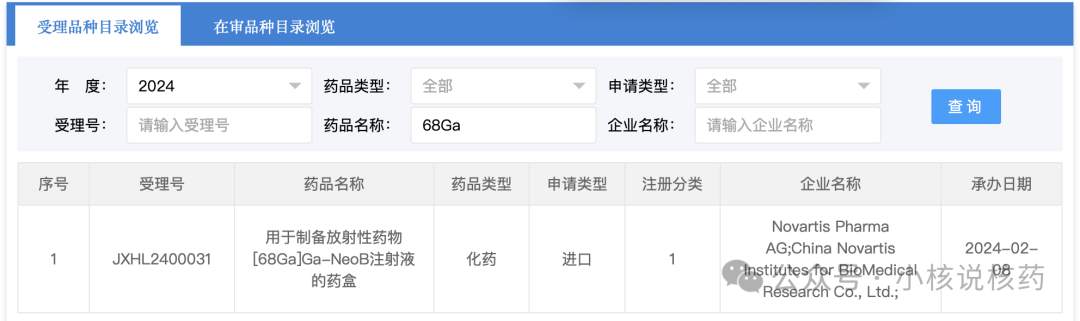
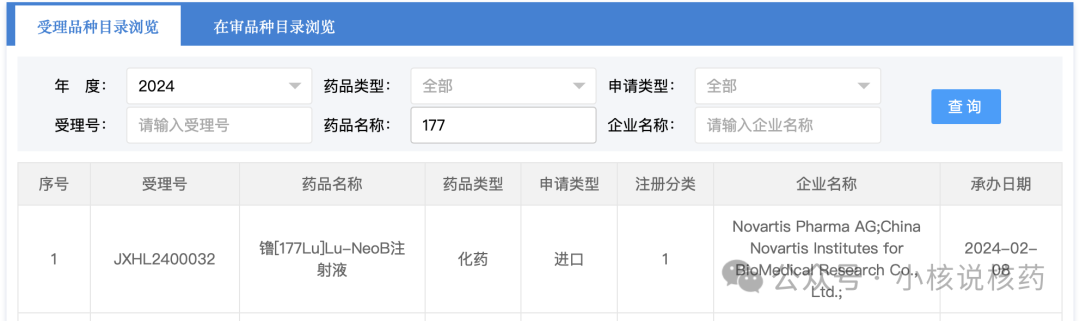
2024 is destined to be the year of nuclear medicine, with Novartis once again accelerating to lead the way in GRPR-targeted theranostic radiopharmaceuticals. While China was immersed in celebrating the Lunar New Year's Eve, Novartis' therapeutic radiopharmaceutical[The clinical trial application for [177Lu]Lu-NeoB Injection and its companion diagnostic radiopharmaceutical [68Ga]Ga-NeoB Injection kit has been accepted by the CDE.IndividualPersonViewPoint,VisionHornBureauLimit,WelcomeWelcomeFingerCorrect!
01
Novartis New Nuclear MedicineNeoBOMB1
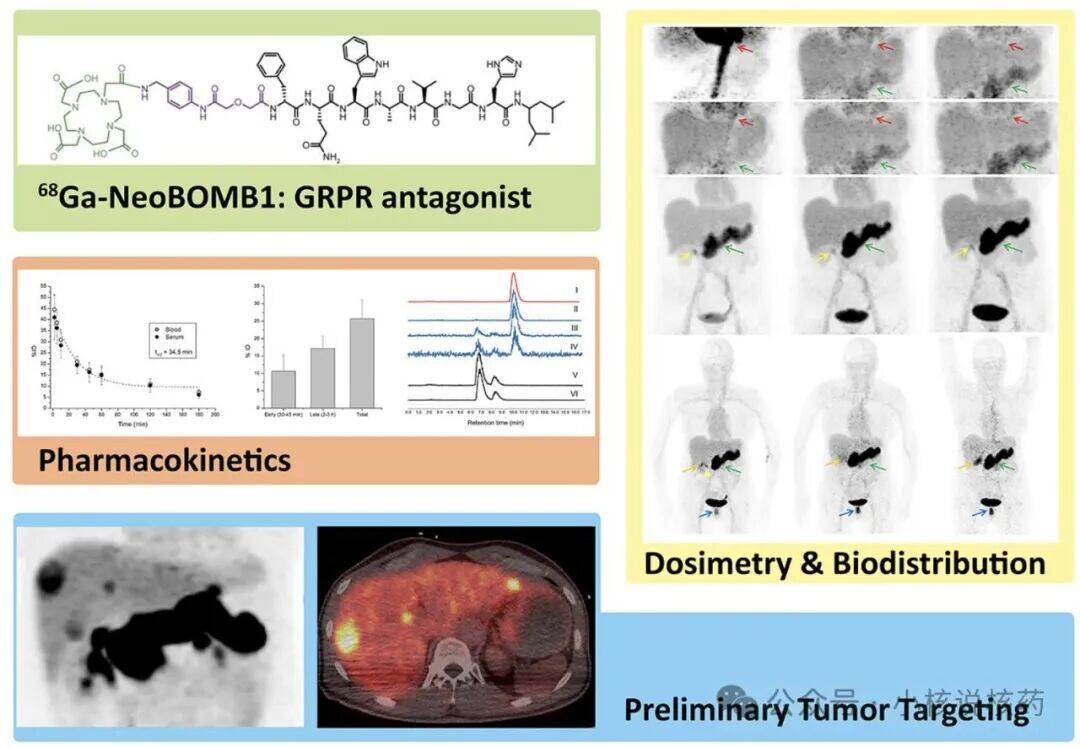
1. Novartis' diagnostic radiopharmaceutical 68Ga-NeoBOMB1 is undergoing Phase II clinical trials.
GRPr is expressed in 83% of estrogen receptor (ER)-positive breast cancers and 75-100% of prostate cancers.2017Simone U. DalmAndResearcher Ingrid L. BakkerPublished this in the JNM journalA Novel Radiolabeled GRPR Antagonist for Cancer TreatmentNeoBOMB1,Patent belongs toAdvanced Accelerators Applications (Novartis,US9839703B2)。In the same yearProfessor Richard P. Baum published this drug in the JNM journalPreclinical and First Clinical Results for the Treatment of Prostate Cancer,Results showed68Ga-NeoBOMB1 Quickly Targets Pathological Lesions, Achieving High-Contrast Imaging with Transformative Potential.
 Journal of Nuclear Medicine December 2020, 61 (12) 1749-1755;
A Phase I/IIa clinical trial (EudraCT 2016-002053-38) enrolled six patients with histologically confirmed GIST and unresectable primary or metastatic lesions, providing safety data for 68Ga-NeoBOMB1. HoweverTo date, several radiolabeled GRPR-targeting ligands (such as AMBA, RM2, and NeoBOMB1) based on the amphibian GRP analog bombesin have been introduced clinically for cancer diagnosis and radionuclide therapy. However, it has been reported that in both patients and preclinical animal models, a common trend is the high physiological accumulation of these GRPR-targeting radiotracers in normal organs, particularly in the pancreas and gastrointestinal tract.The high uptake of GRPR-targeted radiopharmaceuticals in the pancreas may not only affect lesion detection but also limit the maximum tolerated dose for targeted radioligand therapy applications.Whether the pancreas is at risk and should be considered a dose-limiting organ in GRPR-mediated PRRT has also been studied by several research groups.Preclinical studies show that [177Lu]Lu-NeoB is well-tolerated after repeated dosing.
02
Clinical Research on 177Lu-NeoBOMB1
 Clinical Research on 177Lu-NeoBOMB1
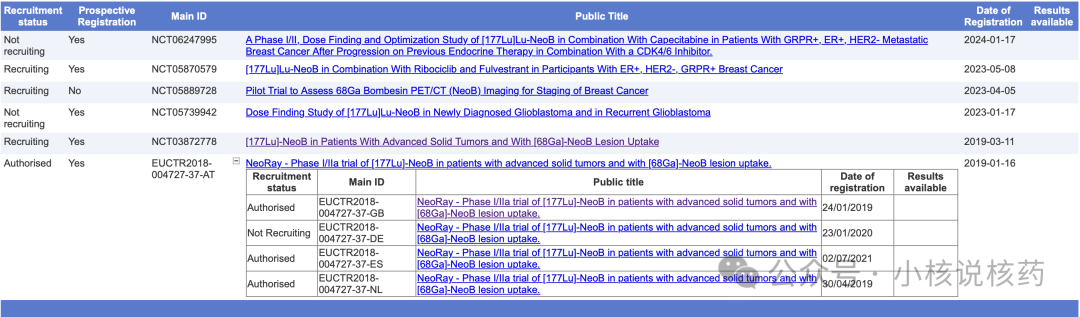
1. Solid Tumors NCT03872778:The purpose of this first-in-human (FIH) study of [177Lu]-NeoB is to investigate the safety, tolerability, pharmacokinetics (PK), distribution, radiation dosimetry, and anti-tumor activity of [177Lu]-NeoB in patients with advanced solid tumors known to overexpress GRPR and exhibit [68Ga]-NeoB lesion uptake.Is aPhase I/IIaThe study includes a dose-escalation phase (Phase I) and an expansion phase (Phase IIa).Regions where the trial is conductedInUnited States; Austria; France; Netherlands; Spain; United Kingdom; Germany.
2.GlioblastomaNCT05739942:Glioblastoma (GBM) is the most common and aggressive primary brain tumor with a high mortality rate. The current standard of care (SoC) for newly diagnosed GBM includes a combination of the alkylating agent temozolomide (TMZ) with radiotherapy (RT). This study aims to improve patient outcomes by combining the current standard of care with radioligand therapy [177Lu]Lu-NeoB.Phase Ib Dose Exploration Study Evaluating [177Lu]Lu-NeoB in Combination with Radiotherapy andTMZSafety and activity in treating newly diagnosed glioblastoma, as well as safety and activity as a single-agent therapy for recurrent glioblastoma.
3.Breast CancerPET ImagingNCT05889728:There are few published literatures thatGa-NeoB PET imaging compared with currently accepted imaging modalities for detecting progressive metastatic breast cancer. Given the previously published findings in ER/PR+ HER2- preclinical tumors,ThisPhase IIb Pilot StudyWillEvaluation of Ga-NeoB'sDiagnostic and Therapeutic Potential of PET/CT (NeoB) Imaging for Staging ER/PR + HER2- Metastatic Breast Cancer PatientsParticularly in assessing the heterogeneity level of active malignant tumor sites compared to FDG PET.
4.Breast CancerNCT05870579:Phase 1b, Single-Arm, Multicenter, Open-Label, Dose-Finding Study to Evaluate [177Lu]Lu-NeoBUnitedRibociclib and FulvestrantCombination therapy for patients with ER+, HER2-, GRPR+ metastatic breast cancer that has recurred during or within 12 months after completing prior (neo)adjuvant ET (escalation portion), or advanced disease.
5. Breast Cancer NCT06247995:InIIn the phase study, progression occurred after prior endocrine therapy combined with CDK4/6 inhibitors.In adult patients with GRPR+, ER+, HER2- metastatic breast cancer, determine the recommended dose (RD) and administration regimen of [177Lu]Lu-NeoB in combination with capecitabine. In the Phase II study, evaluate the preliminary anti-tumor activity of two different doses/regimens of [177Lu]Lu-NeoB in combination with capecitabine (dose optimization).
03
Clarity CorporationGRPR-Targeted Nuclear Medicine:64Cu/67Cu-SAR-BBN
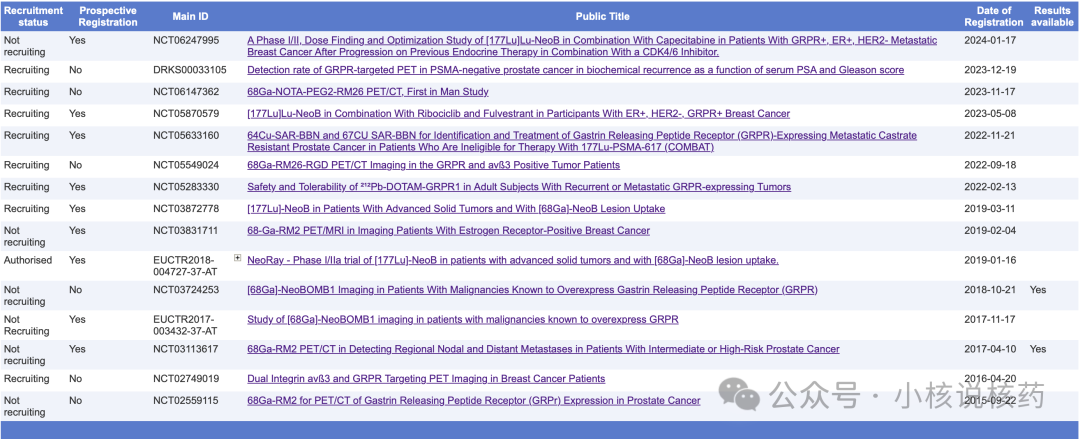
1.Other ongoing researchGRPrNuclear Medicine
Clarity Pharmaceuticals' 64Cu-SAR-BBN and 67Cu-SAR-BBN,Karolinska University Hospital68Ga-NOTA-PEG2-RM26, 68Ga-RM26-RGD from Peking Union Medical College Hospital,68Ga-NOTA-BBN-RGD、 Orano Med LLC²¹²Pb-DOTAM-GRPR1, andTechnetium-99m DB8 ([99mTc]Tc-DB8) is also in the race.
2.Clarity's Phase II Clinical Probe64Cu-SAR-Bombesin
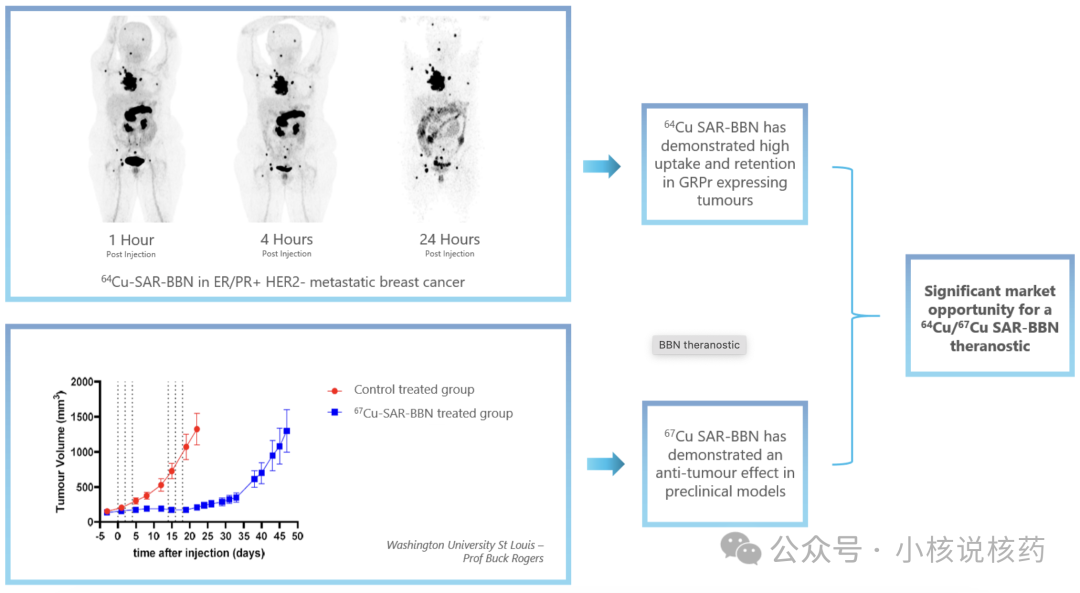
Clarity is developing SAR-Bombesin as a therapeutic agent for breast cancer and prostate cancer, utilizing 64Cu and 67Cu for theranostic applications.Future opportunities for the product include imaging and treatment of other GRPr-positive cancers, which open up a huge market opportunity for SAR-Bombesin due to the high incidence or limited treatment options for these types of cancer patients.November 2023,Clarity Pharmaceuticals AnnouncesIn its U.S. diagnostic trial SABRE (NCT05407311) for PSMA-negative prostate cancer participants, 50 patients have undergone 64Cu-SAR-Bombesin imaging.

Looking forward to more stable preclinical probes and low pancreatic uptake probes gradually entering clinical research.