

Five Next-Generation GLP-1 Therapies Poised to Transform Obesity and Diabetes Treatment

Pfizer
Pharmaceutical R&D Developer

AstraZeneca
Biopharmaceutical Manufacturer

Eli Lilly
Global Pharmaceutical R&D and Production Company

Boehringer Ingelheim
Developer of Innovative Drugs and Therapies

Zealand Pharma
Innovative Drug Developer

Amgen
Developer of Treatment Drugs for Serious Diseases
▎WuXiEdited by Kant Content Team
As Novo Nordisk's semaglutide and Eli Lilly and Company's tirzepatide have shown remarkable results in the treatment of type 2 diabetes and obesity, many healthcare professionals and patients are highly anticipating whether these glucagon-like peptide-1 (GLP-1) receptor agonists can also be applied to other obesity-related indications and whether drug-related side effects can be further improved. With continuous investment in this field, the development of the next generation of GLP-1 drugs has begun. Recently, the industry media Endpoints News listed five highly anticipated next-generation GLP-1 therapies, and the WuXi AppTec content team will introduce the "unique features" of these therapies based on publicly available information.
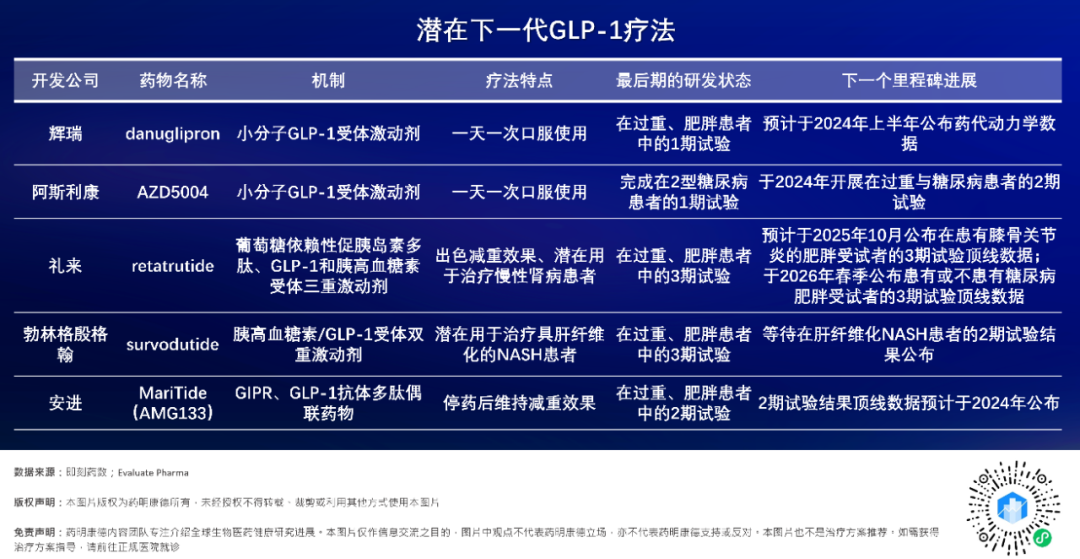
▲5 Potential Blockbuster Next-Gen GLP-1 Therapies (Image Source: WuXi AppTec Content Team, Reorganized and Tabulated Based on Reference [1])
Therapies under research:danuglipron
Developer Company:Pfizer
Danuglipron, developed by Pfizer, is a small molecule GLP-1 receptor agonist.Unlike large molecule GLP-1 analogs, they can be administered orally in a more convenient manner and are not restricted by food or timing of administration.
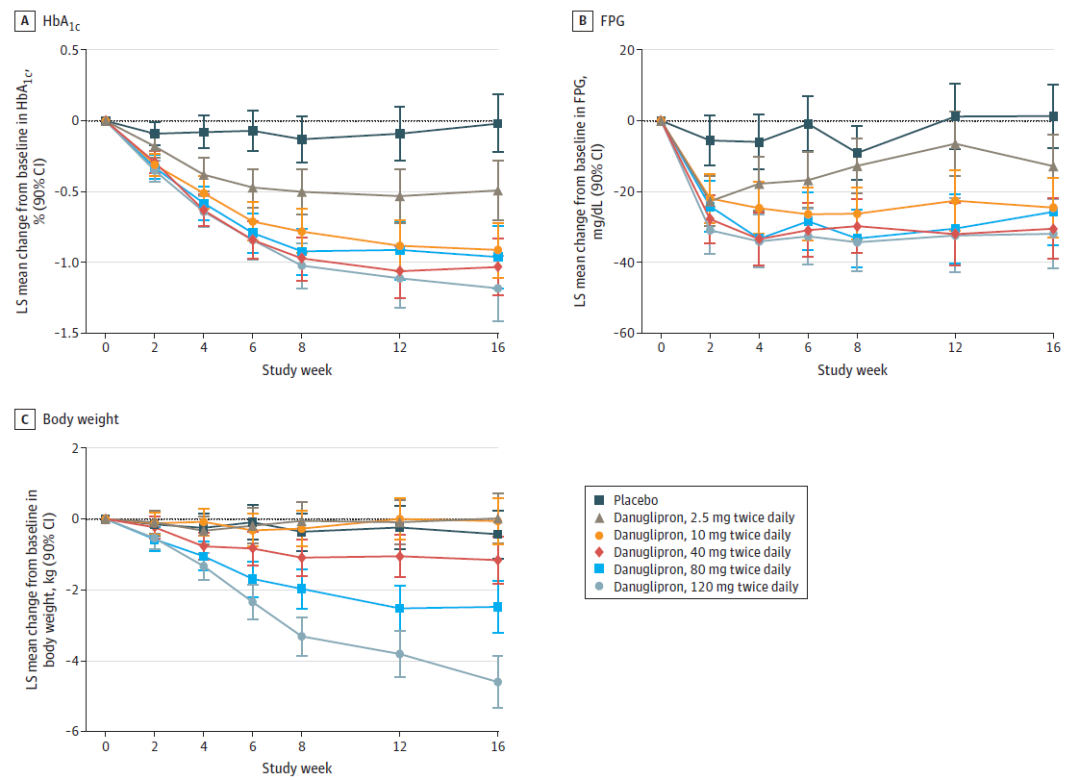
In May last year, Pfizer announced the results of the Phase 2b clinical trial of danuglipron. The data showed that, in patients with type 2 diabetes,Danuglipron significantly reduced patients' glycated hemoglobin (HbA1c), fasting blood glucose levels, and body weight. In patients receiving the highest dose of danuglipron, HbA1c decreased by 1.16 percentage points, and body weight was reduced by 4.17 kilograms.This result was published inJAMA Network OpenAbove. Currently, danuglipron with different formulations, administered once daily, is under examination in Phase 1 clinical trials, which are expected to be completed in May this year. Dr. Mikael Dolsten, Chief Scientific Officer of Pfizer, recently noted,If danuglipron shows good safety results in Phase 1 trials, it may proceed directly to Phase 3 clinical trials after a lead-in period.
Therapies under research:AZD5004
Development Company:AstraZeneca
AstraZeneca in November last year with EccogeneReach an Exclusive Agreement, with a potential total of $1.825 billion, acquired the small molecule GLP-1 receptor agonist ECC5004 (also known as AZD5004) for the rights to its potential treatment of obesity, type 2 diabetes, and other comorbidities.
AZD5004 is a once-daily, low-dose small molecule GLP-1 receptor agonist that has demonstrated promising efficacy and safety in preclinical studies. AZD5004 is currently undergoing Phase 1 clinical trials in the United States involving healthy volunteers and patients with type 2 diabetes.Preliminary results show that, compared with placebo, the drug demonstrated positive weight loss and blood glucose reduction effects at low doses of 10 mg and 30 mg, with an oral bioavailability greater than 70%, and showed good tolerability.AstraZeneca plans to launch two Phase II clinical trials of AZD5004 for the treatment of obesity and type 2 diabetes later this year.
Sharon Barr, Ph.D., Executive Vice President of Biopharmaceuticals R&D at AstraZeneca, pointed out,AstraZenecaChronic kidney disease (CKD) and heart failure drug Farxiga, along with its investigational oral PCSK9 inhibitor, may potentially be combined with this GLP-1 receptor agonist as a treatment option.

Developer Company:Eli Lilly
Retatrutide (LY3437943) is Eli Lilly and Company's investigational triple agonist targeting glucose-dependent insulinotropic polypeptide, GLP-1, and glucagon receptors., developed for the treatment of type 2 diabetes and obesity patients. The phase 2 trial clinical results published in June last year showed,83% of obese or overweight adult patients using a 12 mg dose achieved at least a 15% weight reduction after 24 weeks of treatment.According to the report by STAT, an industry media outlet,This is the drug that has achieved the highest weight loss reduction to date.In terms of safety, the most common adverse events in patients receiving retatrutide were gastrointestinal adverse events; these events were dose-related, mostly mild to moderate in severity, and the adverse events could be partially alleviated by using a lower starting dose (2 mg vs 4 mg).
In addition, Eli Lilly is testing retatrutide in Phase 3 trials for obese patients with knee osteoarthritis, as well as for obese patients with or without diabetes, with data expected to be released in 2025.This investigational therapy is also being evaluated in a Phase 2 trial to determine whether it can improve kidney function in overweight and obese patients with CKD.
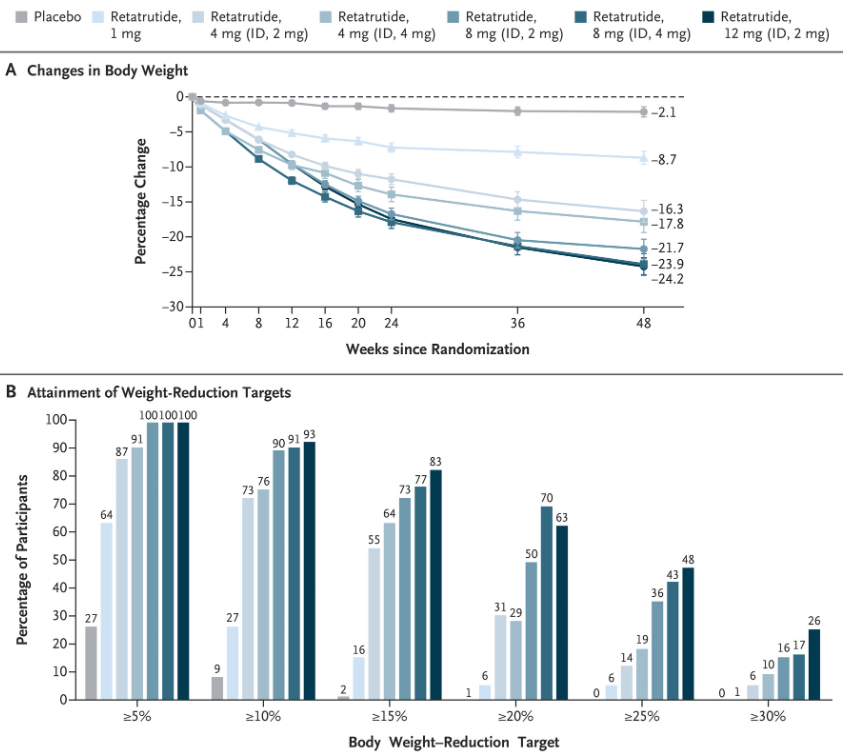
▲REtrutide Trial Efficacy Results (Image Source: Reference [4])
Therapies under research:survodutide
Development Company:Boehringer Ingelheim and Zealand Pharma
Survodutide (formerly known as BI 456906) is a dual glucagon/GLP-1 receptor agonist., which can simultaneously activate GLP-1 and glucagon receptors, is crucial for controlling metabolic functions. Results from a Phase 2 trial published in June of last year showed that 40% of overweight or obese patients without type 2 diabetes who received a weekly subcutaneous injection of survodutide for up to 46 weeks, using the highest dose of up to 2 doses of survodutide, experienced approximately 19% weight loss, compared to 0% in the placebo group.
Survodutide is currently under examination in multiple clinical trials.One of the most anticipated Phase 2 trials examined the drug's efficacy in treating patients with non-alcoholic steatohepatitis (NASH) and liver fibrosis, with results expected to be released in the first half of this year.In addition, two Phase 3 trials examining the weight-loss effects of survodutide have also been initiated, with each trial targeting obese/overweight patients with or without type 2 diabetes.
Carinne Brouillon, Head of Human Pharma at Boehringer Ingelheim, pointed out in an exclusive interview with Endpoints News that she believesSurvodutide's uniqueness lies in its potential to become "the first anti-obesity drug that suppresses appetite, increases energy expenditure, and directly impacts the liver."。

Image Source: 123RF
Therapies under research:MariTide
Developer Company:Amgen
MariTide (AMG133) is a potential "first-in-class" investigational antibody-peptide conjugate that conjugates two GLP-1 analogs at specific sites of a monoclonal antibody targeting the gastric inhibitory polypeptide receptor (GIPR), activating the GLP-1 receptor while inhibiting GIPR.Activation of GLP-1 receptors can delay gastric emptying and suppress appetite, thereby achieving weight loss. On the other hand, many genetic epidemiological studies have shown that a decrease in Body Mass Index (BMI) across individuals of different ethnic backgrounds is associated with low expression levels of GIPR.
At the beginning of this month, Amgen published in the Nature sub-journalNature MetabolismPublished onMariTidePreclinical studies and Phase 1 clinical trial results. Clinical trial results show that obese patients only need one injection per month at a high dose.MariTideAfter 85 days of treatment, body weight can be reduced by 14.5% (approximately 26 jin).Notably, these patients were still able to maintain a 11.2% reduction in body weight after 150 days of discontinuation.Amgen is conducting a Phase 2 clinical trial to explore the use of high-doseMariTideAfter reducing the patient's weight, use a lower dose ofMariTideOr maintain weight loss with less frequent dosing.
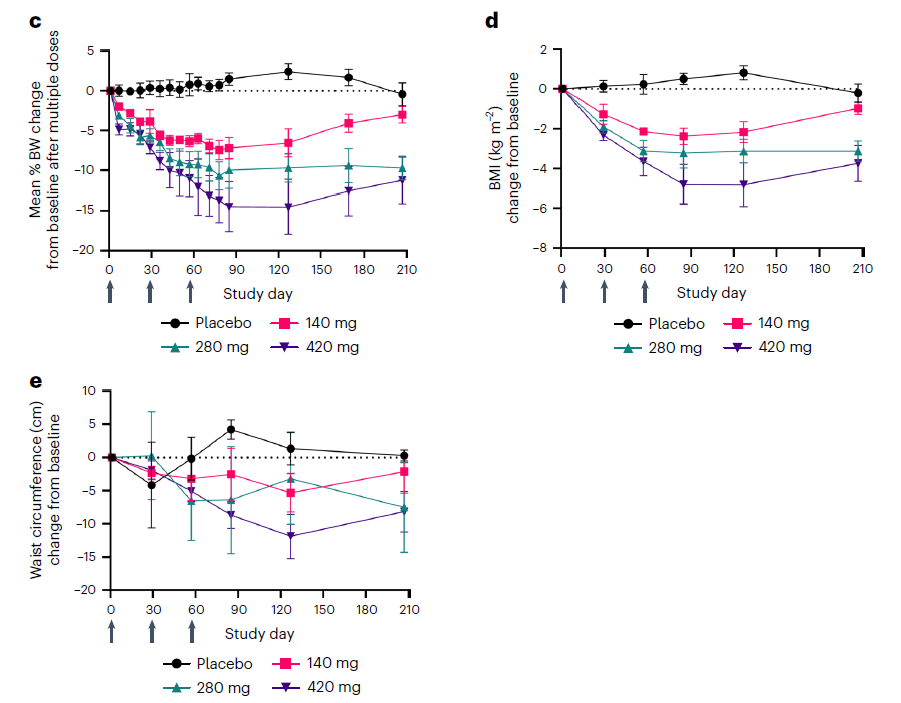
▲In the multi-dose escalation cohort, patients' weight, BMI, and waist circumference all showed dose-dependent decreases (Image source:Reference [2])

Everyone is watching






▲To learn more about the application of cutting-edge technologies in the biopharmaceutical industry, please long-press and scan the QR code above to access "WuXi Live Studio" and watch live discussions and exciting replays on related topics.
References:
[1] 'Obesity plus': What’s next for GLP-1s? Retrieved February 16, 2024 from https://endpts.com/obesity-plus-whats-next-for-glp-1s/
[2] JP Morgan Healthcare Conference AstraZeneca. Retrieved February 16, 2024 from https://www.astrazeneca.com/content/dam/az/Investor_Relations/events/AZ-JPM-2024-presentation.pdf
[3] Saxena et al., (2023). Efficacy and Safety of Oral Small Molecule Glucagon-Like Peptide 1 Receptor Agonist Danuglipron for Glycemic Control Among Patients With Type 2 Diabetes A Randomized Clinical Trial. JAMA Network Open, doi:10.1001/jamanetworkopen.2023.14493
[4] Jastreboff AM. et al. “Triple–Hormone-Receptor Agonist Retatrutide for Obesity — A Phase 2 Trial” (2023) N Engl J Med. DOI: 10.1056/NEJMoa2301972
Disclaimer: The content team of WuXi AppTec focuses on introducing the research progress in global biopharmaceuticals and health. This article is for information exchange purposes only, and the views expressed in the article do not represent the position of WuXi AppTec, nor does it imply that WuXi AppTec supports or opposes these views. This article is not a recommendation for treatment plans. For guidance on treatment options, please consult a reputable hospital.
Copyright Statement: This article is from the WuXi AppTec content team. Individuals are welcome to share it on their social media platforms, but unauthorized reproduction by media or institutions in any form to other platforms is strictly prohibited. For authorization to reproduce, please reply with "reprint" on the "WuXi AppTec" WeChat Official Account to obtain the reprint guidelines.


Share,PointLike,In View,Focusing on Global Biomedical Health Innovation