Denali Therapeutics and Sanofi's RIPK1 Inhibitor SAR443820/DNL788 Fails to Meet Primary Endpoint in Phase 2 ALS Trial

Denali Therapeutics
Biopharmaceutical Manufacturer

Sanofi
Pharmaceutical R&D Developer
On February 16, it was disclosed in a regulatory filing that the Phase 2 Himalaya trial (with a total of 305 participants) for RIPK1 inhibitor SAR443820/DNL788, which Denali Therapeutics is co-developing with Sanofi to treat amyotrophic lateral sclerosis (ALS, or Lou Gehrig's disease), failed to meet its primary endpoint on the ALS Functional Rating Scale (ALSFRS-R). Following the news, Denali’s stock price dropped nearly 8% during early trading on Friday.
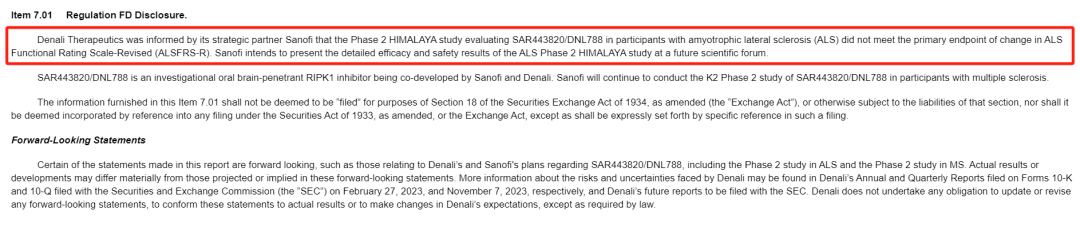
Source: Announcement
SAR443820/DNL788 is an effective, selective, brain-penetrant small molecule inhibitor of RIPK1, a key signaling protein in the tumor necrosis factor receptor pathway and a regulator of inflammation and cell death. Increased RIPK1 activity in the brain leads to neuroinflammation and necroptosis, contributing to neurodegeneration. In preclinical models of Alzheimer's disease, ALS, and other autoimmune and neurological disorders, RIPK1 inhibition has demonstrated beneficial effects.
Previously, according to a January 8 press release from Denali Therapeutics, Sanofi has completed the Phase 2 trial of SAR443820/DNL788 for the treatment of multiple sclerosis (MS), enrolling a total of 174 participants.
In Sanofi's latest earnings report, it was stated that SAR443820/DNL788 will enter Phase 3 clinical trials later this year. However, the unexpected failure of the Phase 2 trial has led investors to question these plans.
Denali's collaboration with Sanofi dates back to November 2018, when the two parties announced a partnership to develop multiple RIPK1 inhibitor candidate drugs. This deal provided Denali with $125 million in upfront funding and potential milestone payments exceeding $1 billion in the future.
According to the press release at the time, the two companies mainly planned to develop DNL747 and DNL758. DNL747 is a brain-penetrant small molecule inhibitor of RIPK1, primarily investigated for the treatment of Alzheimer's disease, amyotrophic lateral sclerosis (ALS), and multiple sclerosis (MS), and was in the early clinical stage at that time; DNL758 is a small molecule inhibitor of RIPK1 that does not penetrate the brain, mainly studied for the treatment of systemic inflammatory diseases such as rheumatoid arthritis and psoriasis, and was in the preclinical stage at that time.
The collaboration also includes other RIPK1 inhibitor molecules in preclinical stages.
ALS is a rare neurological disease that destroys nerve cells in the brain and spinal cord responsible for muscle movement, leading to progressive paralysis and death. The late British physicist Stephen Hawking suffered from this disease.
In the research and development of drugs for treating ALS, numerous innovative therapies have frequently encountered obstacles. For instance, the Phase 2 clinical trial of pegcetacoplan, which targets C3, failed to meet both primary and secondary endpoints, and the antisense oligonucleotide (ASO) drug WVE-004 showed no clinical benefits after 24 weeks of treatment.
To date, the U.S. FDA has only approved three drugs for the treatment of ALS — Radicava from Mitsubishi Tanabe, the generic drug Riluzole, and Relyvrio from Amylyx Pharmaceuticals.
Notably, in addition to its RIPK1 inhibitor candidate, Denali also has another late-stage clinical drug in development for the treatment of ALS.

Source: Denali official website
DNL343 is a First-in-class candidate drug for the treatment of ALS, primarily aimed at modulating the activity of eIF2B. eIF2B is an intracellular protein complex that regulates protein synthesis and is essential for neuronal health and function. When neurons experience stress, such as occurs in ALS and other neurodegenerative diseases, eIF2B activity is suppressed, leading to impaired protein synthesis and the formation of "stress granules," which are considered precursors to TDP-43 aggregation—a hallmark pathology of ALS. DNL343 is designed to activate eIF2B, thereby restoring protein synthesis, dispersing TDP-43 aggregates, and enhancing neuronal survival.
References:
Announcements and Official Website

Editor: Baiji
Disclaimer: This article is a reprint from PharmNet. All images and text are copyrighted by the original author. The purpose of the reprint is to convey more information and does not represent the views of this platform. If there are any issues regarding content, copyright, or other problems, please leave a message on this platform, and we will address it promptly.