

Gilead Halts Global Solid Tumor Trials of CD47 Antibody Magrolimab Amid Clinical Setbacks

Gilead Sciences
Antiviral Drug Developer

Recently, pharmaceutical giant Gilead announced that it has suspended its CD47 monoclonal antibodyMAgrolimab is being studied globally for solid tumors, but on February 7, Gilead Sciences announced it would no longer further develop the drug.MAgrolimab is used for the treatment of hematological tumors.
Suspend CD47 Monoclonal Antibody Related Projects
Magrolimab was originally developed by Forty Seven, a leading company in CD47 research. It is a CD47 blocker and macrophage checkpoint inhibitor designed to prevent cancer cells from evading immune attacks. In December 2019, Forty Seven announced the Phase Ib clinical trial data of Magrolimab, which showed promising and sustained efficacy in high-risk myelodysplastic syndromes (MDS) and acute myeloid leukemia (AML), drawing significant attention to Forty Seven. In March 2020, Gilead Sciences acquired Forty Seven for $4.9 billion and obtained this drug. Subsequently, Magrolimab has been developed as a monotherapy or in combination with other drugs for the treatment of various hematologic malignancies and solid tumors. It remains the most advanced program in the CD47 field and continues to attract widespread attention.
However, the development progress of Magrolimab has not been smooth. In January 2022, researchers discovered a significant difference in suspected unexpected serious adverse reactions among various study groups, leading to a partial clinical hold by the FDA on Gilead’s Magrolimab-related studies. However, three months later, after reviewing the integrated safety data from each trial, the FDA lifted the hold. In July 2023, Gilead announced the termination of the Phase 3 ENHANCE study of Magrolimab combined with azacitidine for the treatment of high-risk MDS. After data analysis, Magrolimab failed to demonstrate therapeutic efficacy. The safety data from this study were consistent with the known characteristics of Magrolimab and typical adverse events observed in this patient population. On August 21, Gilead announced that the FDA had placed a partial clinical hold on Magrolimab trials in AML patients.
At the beginning of February this year, Gilead Sciences announced the terminationMAgrolimab for the Treatment of AML in Phase III ENHANCE-3 Study, FDA Will...MThe studies of agrolimab for MDS and AML have been placed on full clinical hold. These decisions were primarily based on the recommendation of the independent data monitoring committee, which reviewed key data from the planned interim analysis of overall survival (OS) in the ENHANCE-3 trial. In this analysis,MAgrolimab combined with azacitidine and venetoclax showed no therapeutic effect, and an increased risk of death was observed, primarily due to infections and respiratory failure.
Preliminary analysis of clinical trial data from two additional studies targeting high-risk MDS (ENHANCE) and TP53-mutated AML (ENHANCE-2) also indicates thatMIn the agrolimab treatment group, there was an increased risk of patient mortality and no therapeutic effect of the drug; based on these results, Gilead Sciences stated it will no longer proceed with further development.MAgrolimab is used to treat blood diseases.
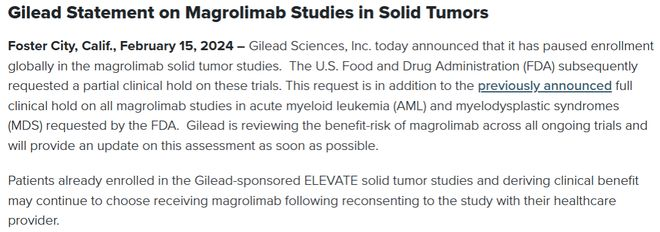
On February 15, Gilead announced that it had suspendedMMagrolimab's global solid tumor studies. This trial suspension is a supplement to the FDA's request one week ago to suspend magrolimab in all studies for MDS and AML (including related expanded access programs).
In addition, the Gilead-sponsored ELEVATE solid tumor studies affected by partial clinical holds include: Phase II study for the treatment of head and neck squamous cell carcinoma (NCT04854499), Phase II study for the treatment of solid tumors (NCT04827576), Phase II study for the treatment of triple-negative breast cancer (NCT04958785), and Phase II study for the treatment of colorectal cancer (NCT05330429).
CD47: A Rocky Road
CD47 is one of the popular targets in the field of tumor immunotherapy in recent years. It can be widely expressed on the surface of different cancer cells and has been hailed as the next PD-1/L1 and the birthplace of the next blockbuster. After Gilead Sciences invested heavily in the CD47 track, AbbVie, Pfizer, and Roche also followed suit.
But the road to CD47 research has not been smooth, apart from Gilead Sciences stumbling, other companies have also "fallen flat on their faces."
In September 2020, AbbVie reached a collaboration with I-Mab for the CD47 antibody lemzoparlimab, with a total deal value reaching $2.9 billion. However, in August 2022, AbbVie decided to halt the global Phase 1b clinical trial of lemzoparlimab in combination with azacitidine and venetoclax for the treatment of MDS and AML. In September 2023, AbbVie "returned" I-Mab's lemzoparlimab. In early February this year, I-Mab announced that, as part of its strategy to transform into a U.S.-based biotech company, it would spin off its operations and assets in China. According to its latest disclosure, in April 2023, the first patient was dosed in a China Phase 3 registrational clinical study of lemzoparlimab combined with azacitidine as a first-line treatment for HR-MDS, making it the first CD47 antibody in China to enter Phase 3 clinical trials.
In January 2023, Arch Oncology, supported by Roche, announced the discontinuation of clinical development of the CD47 antibody, with most of the company's employees having left. In August 2023, ALX Oncology announced that it would terminate two clinical studies of the CD47 inhibitor Evorpacept: the ASPEN-02 study, which combines azacitidine for the treatment of MDS, and the ASPEN-05 study, which combines azacitidine and venetoclax for the treatment of AML. ALX Oncology stated that although Evorpacept was well-tolerated, its combination with azacitidine did not show significantly better treatment effects compared to azacitidine alone.
Although CD47 drugs have encountered many setbacks, many companies are still competing in this field. According to statistics, there are currently over a hundred drugs targeting the CD47 checkpoint in clinical research worldwide, involving drug types such as monoclonal antibodies, bispecific antibodies, and fusion proteins. In China, companies like I-Mab Biopharma, Innovent Biologics, ImmuneOnco Biopharmaceuticals, Hengrui Pharmaceuticals, and HanX Biopharmaceuticals are involved.Pharmaceuticals, Zai Lab, Akeso Biopharma, and CSPC Pharmaceutical Group, among other companies, are all actively investing in CD47.
In November 2023, Imming Oncology announced that the FDA had granted orphan drug designation to IMM01, a SIRPαFc fusion protein targeting CD47, in combination with azacitidine for the treatment of chronic myelomonocytic leukemia (CMML). IMM01 is reported to be the first Chinese-produced STRPa-Fc fusion protein to enter clinical trials and is being developed for the treatment of various blood cancers and solid tumors in combination with other drugs.
In December 2023, Akeso Biopharma presented positive Phase Ib clinical research results at the 65th American Society of Hematology (ASH) Annual Meeting. The study evaluated its CD47 monoclonal antibody (AK117) in combination with azacitidine (AZA) for the treatment of higher-risk myelodysplastic syndromes (HR-MDS). The results showed that AK117 combined with azacitidine reduced anemia and transfusion requirements in newly diagnosed HR-MDS patients, demonstrating good safety and significant efficacy.
Recommended Reading

Fully Open for Business, Welcome to Visit >>




For advertising, conference cooperation, corporate communication, etc., please contact 400-689-7892.