

Domestic Cell Therapy Enters High-Growth Phase: Precision Bio投入 Over ¥700 Million to Tackle Advanced Cancers
Precision Biotech
Gene and Cell Therapy Developer
In recent years, driven by technology, policy, and market forces, cell and gene therapies have shown rapid development, demonstrating promising results in the treatment of major diseases such as cancer, and bringing new hope to many patients, especially those with advanced cancer. As a novel precision-targeted therapy, CAR-T therapy is becoming increasingly recognized, and China's CAR-T cell therapy sector has experienced rapid growth in recent years.
Since 2017, the U.S. Food and Drug Administration (FDA) has approved six CAR-T cell products for the treatment of patients with advanced relapsed or refractory blood cancers. In the Chinese market, there are currently four CAR-T products available, with over 25 CAR-T products still under development.
"CAR-T primarily targets cancer patients in the late stage with a life expectancy of about 3 to 6 months, especially those with leukemia and multiple myeloma," said Professor Qian Cheng, Chairman and Chief Scientist of Chongqing Precision Biotech Co., Ltd.
In November last year, the official website of the Center for Drug Evaluation (CDE) under the National Medical Products Administration (NMPA) of China announced that the pCAR-19B autologous cell infusion preparation submitted by Chongqing Precision Biotech Co., Ltd. has been approved for inclusion in the "Breakthrough Therapy Designation," mainly for the treatment of leukemia in children and adolescents. This product is expected to be approved for marketing this year.
The "14th Five-Year Plan for the Pharmaceutical Industry" points out that the increasing maturity of next-generation biotechnologies, represented by gene therapy, cell therapy, synthetic biology, and bispecific antibodies, provides broad opportunities for the pharmaceutical industry to seize the new round of scientific and technological revolution and industrial transformation. The "Plan" mentions under the "Pharmaceutical Innovation Product Industrialization Project" that priority will be given to developing immunotherapy products such as chimeric antigen receptor T cells (CAR-T) and chimeric antigen receptor NK cells (CAR-NK) targeting new targets and indications, as well as stem cell therapies, gene therapies, and specific immune globulins.
"Thanks to the platform built by the government and the capital market's financing support for enterprises, biopharmaceutical companies like ours, which require huge upfront investment costs, can smoothly carry out research and development work and continue to explore future trends in gene and cell drug development," said Professor Qian Cheng.
Long-term, high-risk investment is the only way for biopharmaceutical science and technology innovation companies to achieve long-term development. It is reported that Chongqing Precision Biotech Co., Ltd. is a high-tech enterprise jointly established by a technical team led by renowned precision medicine scientist Professor Qian Cheng and ZhiFei Bio (ZhiRui Investment), a listed company.In the eight years since its establishment, Chongqing Precision Biotech Co., Ltd. has invested over 700 million yuan in platform construction, product development, and clinical trials, building a comprehensive industrial chain for cell therapy research, development, transformation, production, and preparation.。
"The astronomical treatment costs are a threshold for CAR-T therapy. Currently, the price range of the four products approved and marketed in China is 999,000 RMB/injection to 1.29 million RMB/injection. For previous participants in clinical trials, Chongqing Precision Biotech Co., Ltd. covers the treatment expenses of the participants. 'We will comprehensively track every detail of the participants' treatment. Only by thoroughly studying the clinical data can we gain a deeper understanding of the product and provide the best guarantee for its future market launch,' said Professor Qian Cheng."
Currently, there is no CAR-T product for the treatment of relapsed/refractory B-cell acute lymphoblastic leukemia in children and adolescents approved for marketing in China. pCAR-19B is the first CAR-T product in China to enter pivotal clinical trials. Professor Qian Cheng stated, "Over the past eight years, we have been granted more than 50 national patents, and four new biologic drugs classified as Class 1 by the state have been approved to enter registration clinical trials."
CAR-T therapy is a personalized treatment method that utilizes the body's own immune system. Through genetic engineering, the CAR gene, which artificially recognizes specific tumor antigens, is introduced into T cells to construct CAR-T cells, which are then infused back into the patient's body.
From the treatment process of CAR-T, it is necessary to extract cells from patients in the hospital. The cell samples are then sent to pharmaceutical companies via refrigerated transportation. After the cells are cultured and processed, they are transported back to the hospital through frozen transportation for medication and transplantation for the patient.
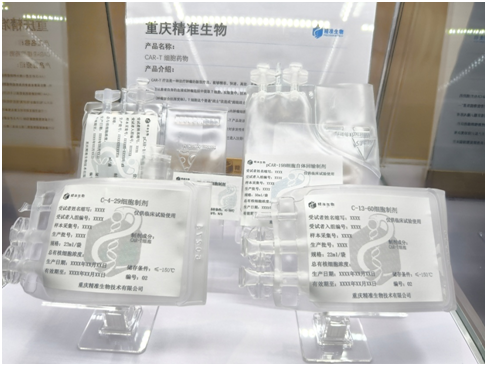
Cell Preparation Medicine Bag.
In this phase, Chongqing Precision Biotech Co., Ltd. has reached an in-depth cooperation with Hitachi to launch a cell therapy traceability system, providing digital full-process traceability for CAR-T treatment. Liu Suming, General Manager of the Life Science Solutions Division of Hitachi Solutions (China) Co., Ltd., stated, "The digital traceability platform plays a role in preventing confusion and errors, ensuring the safety of patients' treatment. It also strengthens close collaboration among multiple parties, improves efficiency, and will positively impact cost reduction and time savings in the future."
In recent years, China's cancer prevention and treatment system has been further improved, with a significant enhancement in overall diagnostic and treatment capabilities. Data shows that the overall 5-year cancer survival rate in China increased from 40.5% in 2015 to 43.7% in 2022, indicating positive progress in prevention and control efforts.
For CAR-T, this novel therapy, although the high cost is a challenge that hinders its accessibility, the burden of CAR-T therapy will gradually ease with the support from commercial insurance and other aspects. Moreover, companies can progressively lower product prices by securing multi-channel financing, accelerating commercialization processes, achieving a positive R&D cycle, and realizing cost reduction and efficiency improvement.
Recently, Fosun Kite announced that its CAR-T product Yikaida will launch China's first lymphoma value-based payment plan. The original price of 1.2 million yuan per injection for CAR-T treatment will be refunded up to 600,000 yuan for eligible patients if complete remission (CR) is not achieved after using Yikaida.
Regarding the high treatment costs of CAR-T, Professor Qian Cheng stated, "Whenever there is a new project, we will continue to recruit volunteer patients. For products that have already been commercialized, we will develop second-generation and third-generation products, which will still require participants for clinical trials. The updated products will be researched and developed with a focus on higher performance, better safety, and lower cost, gradually reducing the treatment expenses for patients."
As more and more CAR-T cell therapy drugs come to market, competition is becoming increasingly fierce. According to Frost & Sullivan data, China's CAR-T therapy market size (calculated at cost price) is expected to increase from 200 million yuan in 2021 to 8 billion yuan in 2025, with a compound annual growth rate of 151.0%. With the approval of additional CAR-T products, the market size is projected to reach 28.9 billion yuan by 2030. (Reported by Li Fang, Economic Daily of China)
E.N.D
Previous article recommendations:
The World's First TIL Cell Therapy Priced at $515,000
2023 CAR-T Test Results Released
Review of New Drugs in China in 2023
CGT CDMO Leader Acquired for Billions
CRO Enterprises "Stockpiling Monkeys" at High Prices
Another CXO Terminates IPO, Once Gained HighLing and SequoiaLead Investment
WuXi AppTec Releases Open Letter to Customers! Further Responds to U.S. Legislative Draft
Koshva Innovative TCR-T Cell Therapy Submits for Clinical Trial
Hengrui Medicine Opens New Continent: First Gene Therapy Product Submits for Clinical Trial
Milestone: The World's First TCR-T Cell Therapy Innovative Drug Submitted for Marketing Approval
From a profit of 330 million to losses, the CXO leader encounters a major crisis
Abogen Biosciences mRNA Tumor Drug Submits for Clinical Trial
Review of 46 Well-Known Immune Cell Therapy Companies in China and Abroad
A CAR-NK Cell Therapy Company to Cease Operations
First Clinical Approval for In Vivo RNA Editing Therapy
Surging 96%, a Gene Therapy Company Successfully IPOs with a Market Value of $2.25 Billion
Global CDMO Giant Lonza to Close Guangzhou Plant, Lay Off 300 Employees
Disclaimer: The content of this article is intended for knowledge sharing. All content is for reference only and does not constitute any advice.