

TYK Medicines Files for Hong Kong IPO with Deuterated Osimertinib Challenger to Take on AstraZeneca

TYK medicines
Innovative Drug Developer for Tumors and Immuno-Oncology

AstraZeneca
Biopharmaceutical Manufacturer
On February 16, AstraZeneca announced that the FDA had approved a new indication for osimertinib, to be used in combination with chemotherapy as a first-line treatment for non-small cell lung cancer patients with EGFR mutations. Compared to monotherapy, the combination regimen extended the median PFS of osimertinib from 16.7 months to 25.5 months.
The competition for third-generation EGFR-TKIs has intensified, and naturally, AstraZeneca wants to maintain the leading position of Osimertinib. In China, Almonertinib, Furmonertinib, and Befotertinib are striving to catch up, with many other participants wanting to join in. Recently, TYK Medicines (Zhejiang TYK Pharmaceuticals Co., Ltd.) has initiated its IPO process on the Hong Kong Stock Exchange.TYK Medicines also has a third-generation EGFR-TKI drug currently in Phase III clinical trials, which will target this market in 2025 as a deuterated version of Osimertinib.
TYK Medicines was founded in 2017, focusing on targeted therapies for lung cancer, breast cancer, etc., with more than ten clinical pipelines. The most core of these is TY-9591, which is said to not only retain the advantages of Osimertinib but also shield its metabolic site.A potential best-in-class third-generation EGFR inhibitor.
Currently, TYK Medicines has no products on the market. From 2022 to September 2023, the companyNet loss accumulates to 578 million yuan.

Deuterium Substitution: A "Me-Better" Strategy
Wu Yusheng, the founder of TYK Medicines, has been working in the biopharmaceutical field for over 24 years. Previously, Wu Yusheng worked at Schering-Plough for more than a decade. However, at that time, he was not responsible for anticancer drugs but for the research and development of new drugs for thrombosis, obesity, and Alzheimer's disease.
In the early years of China's biopharmaceutical industry, Wu Yusheng returned to China and successively founded Taizhong Hongnuo and TYK Medicines, focusing on the highly anticipated anticancer drug sector at the time. In its initial stages, TYK Medicines benefited from a series of government support programs, with both the company’s facilities and new drug R&D platform funded by the government, including equipment investments reaching 160 million yuan.Zhejiang Changxing also provides TYK Medicines with 70 mu of land for the construction of a formulation factory.
At that time, Wu Yusheng confidently stated that in the future, TYK medicines would go abroad and become a multinational pharmaceutical company.
Wu Yusheng chose the shortcut of deuteration for a well-established star drug, which only requires modifying the molecule of the existing product to obtain a better drug. Deuteration is considered the simplest way to break through compound patents and reduce the risks of new drug development.TYK Medicines has chosen to improve the CDK4/6 inhibitor Palbociclib and Osimertinib.Thus, there are two deuterated drugs, TY-9591 and TY-302, in the pipeline.
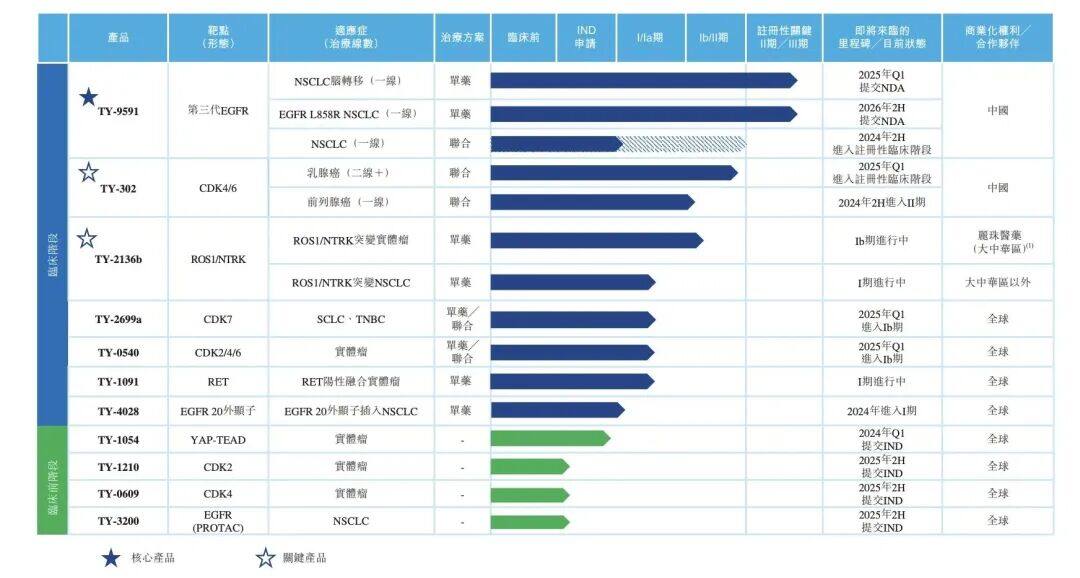
Source: TYK Medicines Prospectus
TY-9591 is aimed directly at defeating Osimertinib. The prospectus disclosed,TY-9591 is the world's only EGFR inhibitor currently undergoing registrational clinical trials for head-to-head direct comparison of Osimertinib efficacy.A Phase Ib clinical trial result showed that TY-9591 as a first-line treatment for non-small cell lung cancer patients with EGFR L858R mutation had a median PFS of 19.3 months, surpassing osimertinib's 14.4 months.
TYK Medicines also takes pride in the indication of TY-9591, which is brain metastasis in non-small cell lung cancer (NSCLC). The brain is the most common site of metastasis for non-small cell lung cancer. According to Frost & Sullivan, the incidence of brain metastases in advanced NSCLC patients is close to 25% at diagnosis, and during treatment, 30% to 55% of patients develop brain metastases. In this area, none of the existing third-generation EGFR inhibitors have been specifically designed for this indication.
The prospectus disclosed that TY-9591 has demonstrated superior efficacy compared to the existing standard treatment, even surpassing the performance of Osimertinib.The 1b and Phase 2 clinical results of TY-9591 showed that, in non-small cell lung cancer patients with brain metastases, the intracranial ORR reached 100% after single-agent treatment. Relying on radiotherapy and chemotherapy, the intracranial objective response rate of patients is only 23%-45%, while the intracranial objective response rate of Osimertinib is 77%.

The Embarrassment of Being Late for Me-better
"Deuteration" seems to be a shortcut for me-better, but the premise is the ability to follow up quickly.
The biggest problem with TYK medicines' TY-9591 is that it arrived too late. The prospectus shows,TY-9591 Monotherapy for First-Line Treatment of Brain Metastasis in EGFR-Mutant Non-Small Cell Lung Cancer is in Phase 2 Clinical Trials, with Patient Enrollment Expected to Complete in the Third Quarter of This Year.The fastest registrational Phase 3 clinical trial for NSCLC with EGFR L858R mutation is still expected to complete patient enrollment by the fourth quarter of this year.
However, China's third-generation EGFR market has largely taken shape over the past few years: Osimertinib, Aumolertinib, Furmonertinib, and Befotertinib are competing head-to-head. In 2022, Osimertinib dominated with sales reaching 4.386 billion yuan, while Aumolertinib and Furmonertinib ranked second and third, respectively. Due to its late entry, Befotertinib’s market potential has been widely questioned by outsiders; its estimated peak sales in 2023 were around 150 million yuan, which was less than 20% of Furmonertinib's 2022 sales.

Not a few players aim to challenge the dominance of Osimertinib. Johnson & Johnson's Amivantamab combined with Lazertinib outperformed Osimertinib in a head-to-head trial and has already applied for marketing approval in China last October; Betta Pharmaceuticals, CT Tianqing, and Qilu Pharmaceutical have all laid out plans for fourth-generation EGFR-TKIs.TY-9591 is now in an awkward situation, with a high mountain in front and pursuers behind.
TYK Medicines, which has no products on the market, is facing a funding crunch. As of 2022, TYK Medicines' only income came from a cooperation agreement signed with Livzon Pharmaceutical in August 2020. Under the agreement, TYK Medicines transferred the Greater China rights of a research product to Livzon Pharmaceutical.As of September 2023, TYK Medicines had only 80.306 million yuan in cash and cash equivalents, far from enough to cover its R&D expenditure of 189 million yuan.
The current financing environment is not as favorable as it was back then, and the Hong Kong stock market listing has become a crucial lifeline for TYK Medicines’ fundraising. However, given the current state of the Hong Kong stock market, the amount of financing that can be obtained is also very limited.
Overall, TYK medicines is still a step behind, missing the best timing for market competition and financing.
Author | Yang Xixia
Editor|Jiang Yun, Jia Ting
Operation | Twenty Thirteen
Image source | Visual China
Statement: Original content by Jian Shi Ju, please do not reprint without permission.


If there are any issues with the content, please contact us by email:
jianshiju@boyamedia.com
Business Consultation: 13288688512