Innovent's IGF-1R-Targeted Therapy Nears Launch as Domestic Innovation in Thyroid Eye Disease Accelerates

Innovent
High-end Biologics Developer

Pro-heal
Innovative Drug Developer
On February 20, new progress was announced regarding drugs targeting IGF-1R for the treatment of thyroid eye disease by Innovent Bio and Shanghai Zenas Biotechnology Co., Ltd. The phase 3 trial of Innovent Bio's IBI311 succeeded, and the renewed clinical application for Shanghai Zenas Biotechnology’s injectable ZB001 has been accepted. Today, we analyze in detail the current status of R&D for drugs targeting IGF-1R for thyroid eye disease in China.
The world's first product with a sales peak forecast of $3.85 billion
Thyroid Eye Disease (TED) is an autoimmune disease that affects ocular tissues and is the most common orbit-related condition in adults. The estimated annual incidence rate of TED is 16 per 100,000 individuals (female) and 2.9 per 100,000 individuals (male), with a prevalence of 0.1-0.3%.
Currently, the first-line treatment for moderate to severe active TED is intravenous glucocorticoid pulse therapy, which has issues such as unsatisfactory improvement in proptosis and systemic side effects related to hormones, indicating a significant unmet clinical need. Second-line treatments include repeated hormone pulses, combined orbital radiotherapy, or other immunomodulatory agents. Biologics such as Teprotumumab (target: IGF-1R), Tocilizumab (target: IL-6), and Rituximab (target: CD20) are recommended by the EUGOGO guidelines, the Chinese Clinical Diagnosis and Treatment Guidelines for Thyroid Eye Disease (2022), and the consensus on Thyroid Eye Disease from the American Thyroid Association and European Thyroid Association as second-line treatments for moderate to severe active TED.
However, no targeted drugs for the treatment of thyroid eye disease have been approved in China, while antibody biologics targeting IGF-1R have been included in recommended treatment guidelines by multiple clinical treatment protocols both in China and internationally. Particularly for TED with significant exophthalmos, antibody biologics targeting IGF-1R can be considered as the first-line treatment.
IGF-1R is a transmembrane tyrosine kinase receptor that plays a role in development, metabolism, and immune regulation, and is overexpressed in OFs, B cells, and T cells of TED patients. Blocking the activation of the IGF-1R signaling pathway mediated by related ligands such as IGF-1 or agonistic antibodies reduces the expression of downstream inflammatory factors, thereby inhibiting hyaluronic acid and other glycosaminoglycan synthesis caused by OF activation, and alleviating inflammatory responses; suppressing OF differentiation into adipocytes or myofibroblasts, thus reducing disease activity in TED patients and improving symptoms and signs such as proptosis, diplopia, and ocular congestion and edema.
Currently, the only globally approved IGF-1R antibody is Teprotumumab developed by Horizon Pharma (approved at the end of 2019), marketed under the brand name Tepezza. In its first year on the market, it achieved sales of $820 million, and by 2022, sales had more than doubled to $1.966 billion. The market anticipates its peak sales could reach $3.85 billion.
On October 6, 2023, Amgen acquired Horizon for approximately $27.8 billion in equity value. According to Amgen's latest financial report in 2023, the sales of Tezepelumab from the acquisition date to December 31, 2023, were $448 million.
But Tepezza is expensive. According to reports, the price of one vial of Tepezza is as high as $14,900 (approximately 100,000 yuan), and a full course of treatment typically requires eight vials, used every three weeks, with a total cost of approximately $119,000. Currently, Tepezza has not yet been launched in China, and through legitimate overseas purchasing channels, the purchase price for one vial is around 150,000 yuan.
However, China is also about to welcome the launch of a domestically produced IGF-1R antibody, and other innovative drugs targeting the same site are also being vigorously developed.
Innovent Bio:
Phase 3 Data Comparable to Tepezza, May Drive Prices Down
Today (February 20), Innovent Bio's official WeChat account announced that the Phase 3 registrational clinical study (RESTORE-1) of its self-developed recombinant anti-insulin-like growth factor 1 receptor (IGF-1R) antibody injection (research code: IBI311) conducted in Chinese subjects with Thyroid Eye Disease (TED) has met the primary endpoint. The company also stated that it will submit a marketing application to the National Medical Products Administration (NMPA) as soon as possible.
RESTORE-1 (CTR20223393) is a multicenter, randomized, double-blind, placebo-controlled Phase 2/3 clinical study evaluating the efficacy and safety of IBI311 in subjects with TED.
The study results showed:
Primary endpoint achieved: At week 24, the proportion of responders in terms of proptosis (defined as a reduction of ≥2mm from baseline in the study eye without an increase of ≥2mm in the fellow eye) was significantly higher in subjects treated with IBI311 compared to the placebo group. The proptosis response rates for the study eyes were 85.8% in the IBI311 group and 3.8% in the placebo group, with a difference of 81.9% between the two groups (95% CI: 69.8%-93.9%, P<0.0001).
Achieved key secondary endpoints: such as the overall response rate of the study eye (proportion of subjects with ≥2mm reduction in proptosis from baseline and ≥2-point improvement in clinical activity score), percentage of subjects with a Clinical Activity Score (CAS) of 0 or 1 for the study eye, and change in proptosis of the study eye from baseline, all of which were successfully achieved; IBI311 showed significantly greater improvements in these indicators compared to the placebo group.
In terms of safety, IBI311 demonstrated a generally good safety profile throughout the study period, with no serious adverse events reported. The efficacy trends and safety characteristics observed in the Phase III stage of the RESTORE-1 study were highly consistent with the results from the Phase II stage.
IBI311 Meets or Exceeds Primary Endpoint Compared to Tepezza Clinical Data. Tepezza's market approval was primarily based on a randomized, placebo-controlled Phase 2/3 OPTIC study. The study results showed that after 24 weeks of treatment, the proptosis response rates for the study eyes in the Tepezza group and the placebo group were 82.9% and 9.5%, respectively, with a difference of 73.4% between the two groups (P<0.001), and no worsening in the fellow eyes. Other secondary endpoint data are as follows: baseline diplopia improved by at least one grade in 67.9% of the Tepezza group and 28.6% of the placebo group (P<0.001); complete resolution of diplopia occurred in 53% and 25%, respectively. In terms of safety, most adverse events associated with Tepezza treatment were graded as mild to moderate, were manageable during the trial, and rarely led to discontinuation or interruption of treatment.
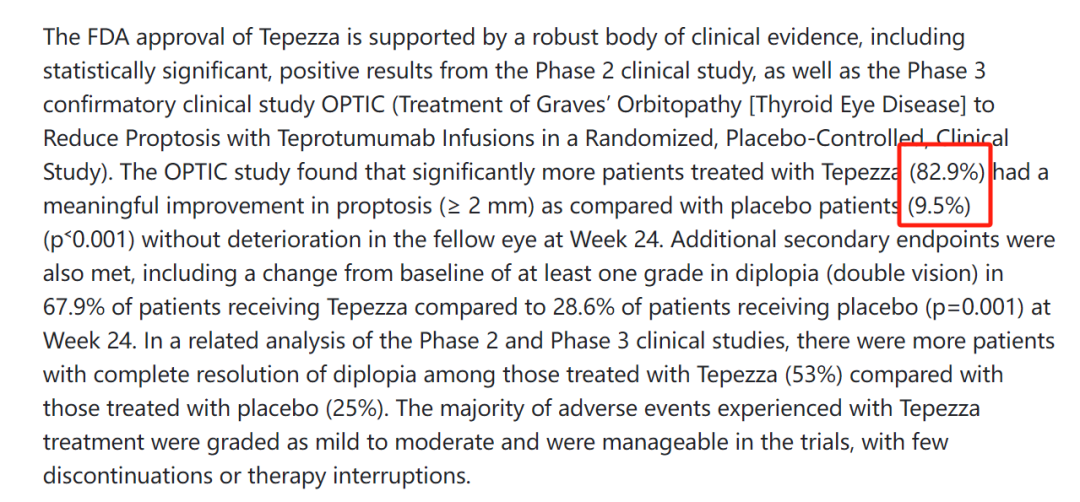
Image source: drugs.com
If Innovent Bio's IBI311 is successfully approved for marketing, it will fill the gap in targeted treatment for thyroid eye disease in China, and the price is also expected to be lower.
Other IGF-1R Innovative Drugs in Development:
Extended Half-Life, Subcutaneous Injection
On the same day, the official website of China's NMPA announced that the clinical application for ZB001 Injection from Shanghai Zenas Biotechnology Co., Ltd. had been accepted. This marks the third time Zenas Biotechnology has had its clinical application for ZB001 accepted by the NMPA.

ZB001 is a humanized monoclonal antibody with differentiated characteristics, targeting IGF-1R, and is being developed for the treatment of TED. According to an earlier press release from Zenas Bio, ZB001 was obtained from Viridian Therapeutics, and Zenas Bio holds the rights to develop, manufacture, and commercialize the product in Greater China. Clinical trials are being conducted simultaneously in China and the United States, with Phase 1/2 clinical studies already initiated in both countries. A search on the Chinadrugtrials platform shows that there are currently two clinical trials recruiting participants.

Source: chinadrugtrials.org
Shanghai Zenas Biotechnology Co., Ltd. has another IGF1R monoclonal antibody, ZB011, also acquired from Viridian Therapeutics. Unlike ZB001, ZB011 incorporates half-life extension technology to further enhance dosing and convenience.
In addition, there is PHP1003 Injection developed by Pro-heal Pharmaceuticals, which also targets IGF-1R for the treatment of TED. Preclinical studies of PHP1003 have demonstrated good safety and significant efficacy. Moreover, compared to Tepezza's intravenous infusion, PHP1003 is developed as a subcutaneous injection formulation, offering better convenience of use. Last year, it entered clinical trials to evaluate the safety, tolerability, and pharmacokinetic characteristics of single/multiple doses of PHP1003 administered via intravenous infusion or subcutaneous injection, and to determine the maximum tolerated dose (MTD), providing a safe dosage range for later clinical trial protocols.
References:
Innovent Bio Official WeChat.
New Progress in IGF-1R Targeted Drugs, Pro-heal Pharmaceuticals Takes the Lead!, BioValley, 2022-05-14.

Editor: Bai Ji
Disclaimer: This article is a reprint from Pharmaron's content. The images and text are the original property of the author, and the purpose of the reprint is to convey more information. It does not represent the views of this platform. If there are any issues related to the content, copyright, or other aspects, please leave a message on this platform, and we will address it promptly.