

Leadership Transition at AbbVie: Navigating the Post-Humira Era Amid Imbruvica Competition

AbbVie
Innovative Drug Developer
As the former "king of drugs" changes hands, AbbVie is also seeking new opportunities.
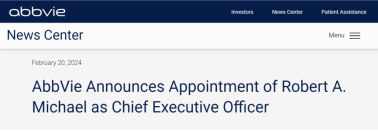
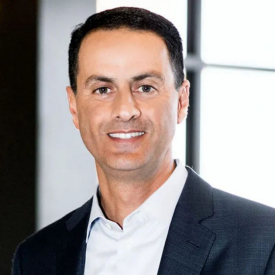
On February 20, AbbVie announced that its board of directors unanimously elected Robert A. Michael, the current president and chief operating officer (COO), to succeed Richard A. Gonzalez as chief executive officer (CEO). The appointment will take effect on July 1, 2024.
Since AbbVie was spun off from Abbott in 2013, Richard A. Gonzalez has been serving as CEO. During his tenure, AbbVie's market value has increased from an initial $54 billion to $310.3 billion today.

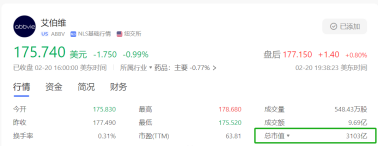
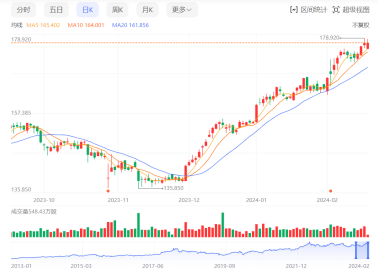
 At the founding of AbbVie, Richard A. Gonzalez had already set a goal: to establish an independently operated company that would maintain long-term leadership in the industry. Today, with its flagship product Humira and medical aesthetics giant Allergan, AbbVie has become one of the largest biopharmaceutical companies globally and has leaped into the top five pharmaceutical companies by market value.
A New Decade Has Arrived, and AbbVie Faces Multiple Growth Challenges. How to Cultivate New Growth Points and Unlock the Potential of New Products Will Be Key Questions for New CEO Robert A. Michael to Address in the Future. Every Move Made by Him and AbbVie From This Point Forward Will Be Critically Important.
Before AbbVie's spin-off from Abbott, Richard A. Gonzalez had worked at Abbott for 30 years, during which he held positions such as President and COO of Abbott, President and COO of Abbott’s Medical Products Group, and Vice President and General Manager of U.S. and Canada Diagnostic Operations.
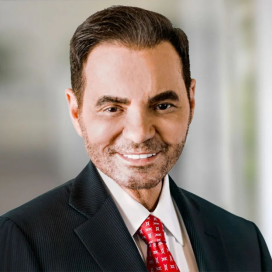

Newly Appointed CEO Robert A. Michael's career at AbbVie also began with the spin-off, leading AbbVie’s first financial planning organization and serving as Vice President of Financial Planning and Analysis. In 2018, Robert was appointed Chief Financial Officer; in 2021, he was appointed Vice Chairman of Finance and Commercial Operations; in 2022, he was appointed Vice Chairman and President; and in 2023, he was appointed President and COO.

Since its establishment, under the leadership of former CEO Gonzalez, AbbVie has continuously expanded its business through mergers, acquisitions, and collaborations. From 2015 to 2023, AbbVie received FDA approval for 12 new drugs, among which Venclexta and Epkinly were co-developed, three were in-licensed, and six originated from acquisitions:
In 2015, AbbVie acquired Pharmacyclics for $21 billion, gaining the blockbuster blood cancer drug Imbruvica.
In 2016, AbbVie acquired Stemcentrx for $5.8 billion, obtaining the DLL3-targeted ADC drug Rova-T to expand into the small cell lung cancer field. Unfortunately, due to Rova-T's poor efficacy, AbbVie completely terminated the project in 2019.
In 2020, AbbVie entered into a $3.9 billion collaboration with Genmab to license the bispecific antibody drugs epcoritamab and ABBV-383. In May last year, epcoritamab (brand name: Epkinly) received FDA approval for marketing to treat relapsed or refractory diffuse large B-cell lymphoma (R/R DLBCL).
In 2023, AbbVie acquired ImmunoGen, a publicly listed ADC drug company, for $10.1 billion in cash, obtaining the "first-in-class" antibody-drug conjugate (ADC) Elahere (mirvetuximab soravtansine), to enter the solid tumor market.
In recent years, the nervous system has become the second most popular disease area for new drug development after oncology, and AbbVie, keeping up with the trend, has also invested heavily in this field.
In 2020, AbbVie spent $63 billion to acquire Allergan, gaining the aesthetic star products Botox (Botulinum Toxin) and Juvederm, as well as neurology products Botox Therapeutics, and two new migraine drugs Ubrelvy (ubrogepant) and Qulipta (atogepant).
In 2022, AbbVie announced the acquisition of Syndesi Therapeutics, headquartered in Belgium, for $1 billion, expanding its neuroscience portfolio.
In 2023, AbbVie acquired Cerevel Therapeutics for $8.7 billion, strengthening its presence in the field of neuroscience. This acquisition will grant access to Tavapadon, a D1/D5 agonist currently in Phase III clinical trials for Parkinson's disease; Emraclidine, a selective positive allosteric modulator (PAM) of the muscarinic acetylcholine receptor M4, which is in Phase II clinical trials for schizophrenia and Phase I for Alzheimer's disease psychosis. Additionally, Cerevel has Darigabat, an α2/3/5 selective GABAA receptor PAM in Phase II clinical trials for treatment-resistant epilepsy and panic disorder, as well as a potential "best-in-class" kappa opioid receptor (KOR) candidate.OR) antagonist CVL-354, currently in Phase 1 clinical trials.
Notably, former CEO Gonzalez stated at the 2016 JPM conference that AbbVie would target the $50 billion blood cancer market. Over the past seven years, AbbVie's flagship product, ibrutinib, has become one of the world’s leading anti-blood cancer drugs, achieving a dominant position in the BTK inhibitor market.
However, not only has the "Sword of Damocles" of Humira's patent expiration already fallen, but Imbruvica has also faced a siege from competing products, with sales now on the decline.
Ibrutinib, the world's first-generation BTK inhibitor to be launched, has always been the performance cornerstone of AbbVie in the field of hematological oncology. However, starting from the first half of 2022, Ibrutinib has shown a decline, with sales reaching $2.008 billion, a year-on-year decrease of 10.4%. In contrast, its competitor BeiGene's Zanubrutinib achieved a significant global sales growth of 1.514 billion yuan, marking a year-on-year increase of 262.9%.
As of now, there are six BTK inhibitors approved worldwide, including AstraZeneca's acalabrutinib, BeiGene's zanubrutinib, Gilead and Ono Pharmaceutical's tirabrutinib, InnoCare Pharma's orelabrutinib, and Eli Lilly's pirtobrutinib, which was approved in January 2023, in addition to ibrutinib.In addition, more than 30 BTK inhibitors, such as LOXO-305, MK-1026, BN102 (AS-1763), and HMPL-760, are already in the clinical stage.In addition, drugs such as BMS-986142, PRN1008, and ONO-4059 are also under development.
In China's BTK inhibitor market, Simcere Pharmaceutical's BTK inhibitor Ibrutinib capsule received marketing approval from the National Medical Products Administration (NMPA), becoming the first generic version of this product. In addition, other pharmaceutical companies in China, such as Hisun Pharmaceutical and Zhengda Tianqing, are also closely following the development of BTK inhibitors, working on the generic versions of Ibrutinib.
The core product faces significant market challenges, and the new phase requires confronting even greater obstacles.
In fact, the financial report handed over to the new CEO Robert was not ideal.
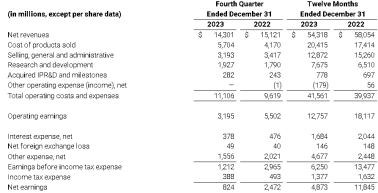
Not long ago, AbbVie announced its 2023 financial results, with total annual revenue of $54.318 billion, a decrease of 6.88% compared to the same period last year. The cost of sales was $20.415 billion, an increase of 14.70% year-on-year. Due to the rise in the cost of sales, the gross profit margin dropped from 70.00% last year to 62.42%, which is relatively low among pharmaceutical giants. Marketing and general administrative expenses were $12.872 billion, a decrease of 18.55% year-on-year, while R&D investment was $7.675 billion, an increase of 15.18%. Operating profit was $12.757 billion, a decrease of 42.02% year-on-year. Net profit was $4.873 billion, a decrease of 143% year-on-year.

AbbVie's pillar product Humira generated $14.404 billion in revenue, a year-on-year decrease of 32.2%. Currently, to compensate for the decline in Humira’s performance, AbbVie hopes to make up for it with the immunological drugs IL-23 antibody Skyrizi (risankizumab) and JAK inhibitor Rinvoq (upadacitinib).
In 2023, Skyrizi's revenue reached $7.7 billion, a 50% increase from 2022; Rinvoq's sales were $3.9 billion, growing by 57%. The combined sales of both will exceed $10 billion and are expected to surpass Humira by 2027, reaching a peak revenue of $27 billion.
However, although the two major new products have made joint efforts, they still cannot offset the impact of the patent cliff of the blockbuster drug Humira, with sales in the immunology pipeline shrinking by 9.6% year-on-year.

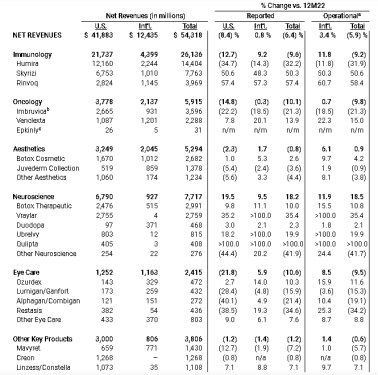
AbbVie's oncology pipeline also features three key products: Imbruvica (ibrutinib), Venclexta (venetoclax), and Epkinly (epcoritamab), with combined sales reaching $5.915 billion. However, due to the impact on the ibrutinib market, the overall pipeline's sales declined by 10.1%.
AbbVie's medical aesthetics, neuroscience, and ophthalmology pipelines primarily originate from Allergan. The revenues of the three pipelines were $5.294 billion, $7.717 billion, and $2.415 billion, respectively. Among the three pipelines, only the neuroscience sector experienced growth (+18.2%), while medical aesthetics and ophthalmology declined by 0.8% and 10.6%, respectively. Interestingly, Botox sales continued to grow, reaching $5.7 billion, making it a cash-generating powerhouse.
In 2023, AbbVie has made quite a few adjustments.
In March, AbbVie abandoned CX-2029 from CytomX Therapeutics, a first-in-class potential CD71-targeted conditionally activated ADC drug.
In July, AbbVie returned JAB-3068 and JAB-3312, SHP2 inhibitors developed by Jacobio, based on its portfolio and strategic decisions.
In September, AbbVie successively terminated three collaborations, adding Harpoon's CD3/BCMA/albumin tri-specific antibody HPN217, I-Mab's CD47 monoclonal antibody lemzoparlimab, and Caribou's allogeneic CAR-T to the list of returned products.
Not only has AbbVie adjusted its external collaborations, but it has also cut some internal pipelines, including all cystic fibrosis (CF) projects.
Beyond the strategy of 'letting go', AbbVie has 10 neuroscience products with 14 indications currently in clinical trials. The neuroscience pipeline generated $7.717 billion in revenue in 2023, representing an 18.2% year-over-year increase, and is set to become AbbVie's next growth engine.
In addition, the oncology field is also a key focus for AbbVie, with revenue reaching $5.915 billion in 2023. The sales of the blood cancer product BCL-2 inhibitor Venetoclax (Venclexta) have maintained double-digit growth for several consecutive years, with sales reaching $2.8 billion in 2023, a year-on-year increase of 13%.
Former CEO Gonzalez stated, "Now is a good time to hand over the role of CEO to Rob. The business is performing exceptionally well and is in a strong position for the long term. Our pipeline includes several promising candidates to sustain the company's future growth."
Industry insiders believe that AbbVie has made a critical move at the start of a new decade by decisively withdrawing from fields with unclear prospects, doubling down on tracks they firmly believe in, and continuously deepening their strengths in key business segments. In the highly uncertain race of innovative drug development, there is no permanently safe harbor for players to dock, and only by actively embracing change, like AbbVie, can one navigate through cycles and secure long-term success.
Editor: Shuwen


www.yyjjb.com.cn
Insight into Industry Trends

"Pharmaceutical Economy Newspaper"
Academic Official Account
Focus on the Frontier of Oncology Academia

Terminal Official Account