Merck's $2.2 Billion HIF-2α Inhibitor Belzutifan Granted Priority Review by China's CDE

MSD
Pharmaceutical R&D and Manufacturer
On February 21, the CDE website showed that MSD's HIF-2α inhibitor Belzutifan was proposed for priority review. The indications are von Hippel-Lindau (VHL) disease-associated renal cell carcinoma (RCC), central nervous system (CNS) hemangioblastoma, or pancreatic neuroendocrine tumors (pNET).
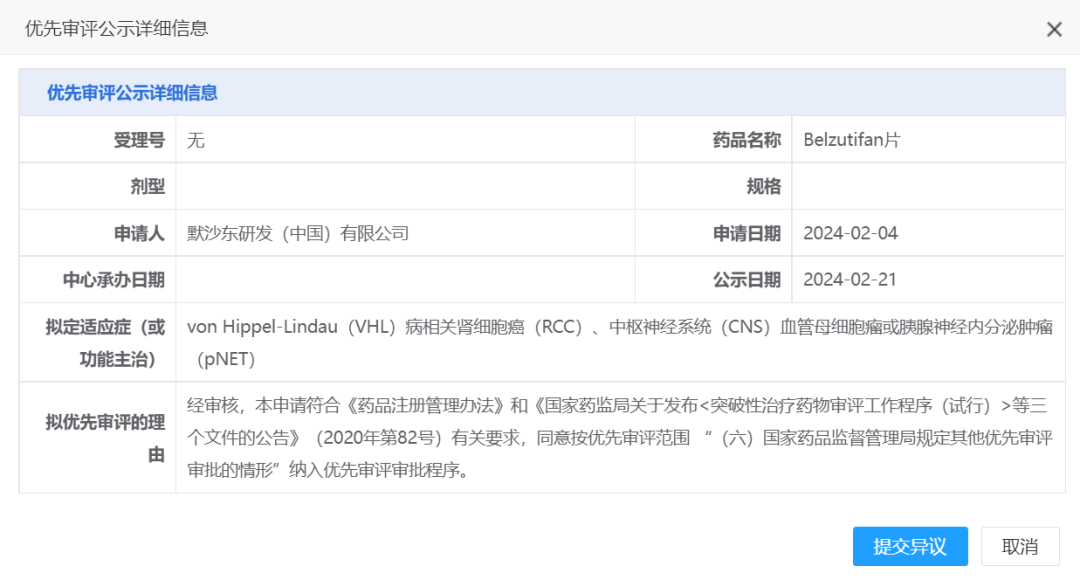
Belzutifan (MK-6482, formerly known as PT2977) was initially developed by Peloton Therapeutics. In May 2019, Merck & Co., Inc. (MSD) acquired Peloton Therapeutics for an upfront payment of $1.05 billion and milestone payments of $1.15 billion, thereby obtaining Belzutifan.
HIF, or hypoxia-inducible factor, is a key oncogenic driver in renal cell carcinoma. Belzutifan, as an HIF-2α inhibitor, blocks cell growth, proliferation, and prevents abnormal blood vessel formation by inhibiting the heterodimerization of HIF-2α and HIF-1β, thereby achieving anti-cancer efficacy.
The trade name of Belzutifan is Welireg, and its approved indications in the United States include:
In August 2021, it was approved for the treatment of von Hippel-Lindau (VHL) disease-associated renal cell carcinoma (RCC), central nervous system (CNS) hemangioblastoma, or pancreatic neuroendocrine tumors (pNET), as the first HIF-2α inhibitor drug approved by the U.S. FDA.
In December 2023, it was approved for patients with advanced renal cell carcinoma who have previously received treatment with a programmed death receptor-1 (PD-1) or programmed death ligand-1 (PD-L1) inhibitor and a vascular endothelial growth factor tyrosine kinase inhibitor (VEGF-TKI).
According to MSD's 2023 financial report, Belzutifan's total revenue for the year was $218 million, representing a 77% year-over-year increase.
In China, a search on the Chinadrugtrials platform reveals three ongoing studies: in addition to monotherapy for VHL disease, there are two Phase 3 clinical trials. One evaluates Belzutifan as an adjuvant treatment to pembrolizumab for renal cell carcinoma (RCC), and the other evaluates the efficacy and safety of Belzutifan + pembrolizumab + lenvatinib or Quavonlimab (CTLA-4) + pembrolizumab + lenvatinib as first-line treatments for advanced clear cell renal cell carcinoma (ccRCC).
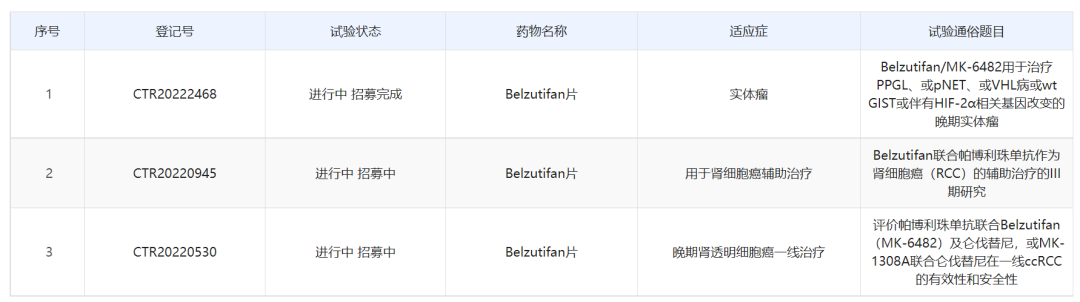
Image source: chinadrugtrialsc
VHL Syndrome (von Hippel-Lindau Syndrome) is a rare systemic condition that can lead to recurrent tumors in the kidneys, central nervous system, and pancreas. It is hoped that Belzutifan will be approved in China as soon as possible, providing patients with more treatment options.
References:
CDE Official Website

Editor: Bai Ji
Disclaimer: This article is a reprint from PharmNet. The images and text are the property of the original author, and the purpose of the reprint is to convey more information. It does not represent the views of this platform. If there are any issues regarding the content, copyright, or other aspects, please leave a message on this platform, and we will address it promptly.