

Global Pharma Giants Shift Away from CDMOs Amid Strategic Supply Chain Restructuring

Catalent
Integrated Services, Drug Delivery Technology, and Manufacturing Solutions Provider

AstraZeneca
Biopharmaceutical Manufacturer
Novo Nordisk
Insulin Developer and Manufacturer

AbbVie
Innovative Drug Developer
Daiichi-Sankyo
Pharmaceutical R&D Developer
⬆️Scan the QR code to register for the conference
In 2024, the CXO industry may witness a historic transformation.
On the one hand, the aftershocks triggered by the Wuxi AppTec风波 are still continuing; on the other hand,Several world-renowned enterprises are increasing their own production capacity, seemingly aiming to "decouple" from third-party contract manufacturing organizations:
On January 25, AbbVie announced an investment of $223 million to expand its Singapore production facility to enhance its manufacturing capabilities.
On February 5, Novo Nordisk's largest shareholder announced the acquisition of CDMO giant Catalent for $16.5 billion.
AstraZeneca announced on February 6: a $300 million investment will be made into a production base in Maryland, primarily for cell therapy, with potential expansion into other areas later. During the briefing, AstraZeneca's management explained: over the past few years, our investment in production facilities has been significantly lacking compared to our peers. Recent trends indicate,"Having a self-sufficient supply chain is becoming increasingly important. Many times, companies can't keep up with their growth ambitions due to insufficient investment in supply."
AstraZeneca Reveals Significant Increase in Capital Expenditure for 2024, Rising 50% from USD 1.4 Billion in 2023, to Further Invest in Manufacturing Capabilities in Areas Such as Intermediates, Inhalation Formulations, and Cell Therapy.
On February 15, Daiichi Sankyo announced that it would invest 1 billion euros to expand its ADC production base in Munich, Germany, to meet potential growth demands.

Novo Nordisk Shakes Up AstraZeneca
AstraZeneca's sense of urgency is partly due to Novo Nordisk.
On February 5, major shareholder of Novo Nordisk announced that it would acquire CDMO giant Catalent for $16.5 billion. As part of the deal, Novo Nordisk will purchase three filling plants located in Italy, Belgium, and Indiana, USA, for $11 billion.(For more details, please see:Semaglutide Production Capacity to Be Maxed Out Soon, Chinese Pharmaceutical Companies in a Panic)
This deal itself is not difficult to understand. Novo Nordisk's semaglutide relies mainly on Catalent, Inc. for filling globally. Currently, Novo Nordisk is in fierce competition with Eli Lilly, and global demand is rapidly expanding, with drug supply being the decisive factor. In a rush, Novo Nordisk directly acquired Catalent, Inc.
This is completely inconsistent with the traditional division of labor in global pharmaceutical industry cooperation over the past 20-plus years.Catalent is one of the top five CDMOs globally, with over 40 factories worldwide and nearly 13,500 employees, supplying more than a hundred pharmaceutical companies. It is now acquired by Novo Nordisk.It is highly likely that the majority of production lines are dedicated to manufacturing semaglutide.
At Eli Lilly's earnings call on February 6, Eli Lilly's Chief Financial Officer stated: Catalent is the manufacturer of the company's tirzepatide, and the company will urge it to fulfill its contractual obligations.
In fact, AstraZeneca is the most affected party in this acquisition.
AstraZeneca is currently one of Catalent's major clients, with eight well-known drugs, including metformin, dapagliflozin, saxagliptin, and durvalumab, being produced by them. Just after Novo Nordisk announced the deal, AstraZeneca’s CEO immediately told the media: “We support an antitrust investigation into the Novo Nordisk deal.”
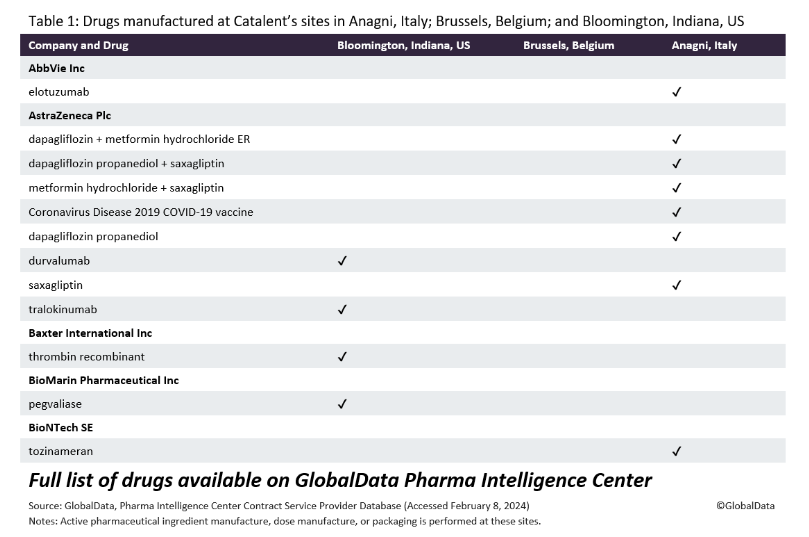
Medicines supplied by Catalent. Source: GlobalData
AstraZeneca has already begun preparations on two fronts. During the teleconference on February 8th,AstraZeneca announced a major capacity expansion for 2024, with total capital expenditure reaching $2 billion.In addition to the cell therapy field, it will also invest in expanding its active pharmaceutical ingredient (API) plant in Ireland, build a new inhalation drug factory in Qingdao, China, and add a new production line for the diabetes drug dapagliflozin + metformin hydrochloride at its Jiangsu plant to reduce reliance on CDMOs.
According to foreign media reports, sources say that Novo Nordisk is still seeking its next acquisition targeting CDMO companies.
Novo Nordisk has gained enormous profits with semaglutide, surpassing the parent company of LV in market value to become the largest in Europe, and they have plenty of money in hand.If Novo Nordisk conducts further acquisitions of other large CDMO enterprises, it could potentially reshape the global pharmaceutical production landscape.
Novo Nordisk's actions have drawn the attention of regulators. The European Medicines Agency (EMA) stated that it will launch an investigation into the potential risk of drug shortages. Catalent has publicly committed that existing contract services will not be interrupted.
It's hard to say whether we will continue to accept foreign contracts.

CDMO Gets a Wake-Up Call
Novo Nordisk’s big purchase set off alarm bells for other pharmaceutical companies.Recently, companies that have built their own production capacity also include Daiichi-Sankyo and AbbVie.
Daiichi Sankyo plans to expand its ADC production facilities. ADC drugs are one of the hottest fields at present, and Daiichi Sankyo is undoubtedly the leader in this field. Its trastuzumab deruxtecan, developed in collaboration with AstraZeneca, topped the list of best-selling ADC drugs last year, achieving sales of over 1.5 billion US dollars in three quarters.
Analysts expect that by 2029, Daiichi Sankyo's ADC products will reach an annual global sales of $11 billion, ranking first, nearly twice the sales of the second-place Seagen.
The production of ADC drugs is very complex, requiring separate production of the antibody, linker, and toxin components, which are then combined. The process involves many steps and has extremely high requirements for preparation and production techniques. Therefore, many companies developing ADC drugs seek contract manufacturing.
It is claimed that 70% to 80% of ADCs globally are outsourced to CDMOs for production. According to statistics, as of June 2023,Of the 15 ADCs currently on the market, 13 have adopted outsourcing services, including the star drug Trastuzumab Deruxtecan.
Originally, this kind of interdependence in the industry was harmonious. In 2021, Daiichi Sankyo even stated externally: within the next five years, it would invest 2.3 billion US dollars in the supply chain.A large amount of spending will be paid to CDMO organizations.
"CXO companies that 'sell water' will make more money than innovative drug companies that 'dig for gold'," Over the past few years, the entire industry seems to have formed this consensus. CDMO companies in and outside of China have also been expanding, all wanting to earn this 'water-selling' money.
Times have changed, and the actions of big pharmaceutical companies have dealt a blow to CDMOs.

Another disappointment for CDMOs comes from AbbVie. On January 25, AbbVie announced a $223 million investment to expand its production base in Singapore, enhancing its manufacturing capabilities. The expansion is set to begin in the second half of 2024 and is expected to commence operations in 2026.
Foreign media mentioned that this expansion is not only for the production of AbbVie's marketed products but also for the production of immunology and oncology drugs in clinical trials.
Even clinical small-scale and pilot trials rely on its own production capacity, showing AbbVie's determination to firmly keep its production capabilities in-house.
In general trend, multinational pharmaceutical companies with substantial capital are unwilling to be constrained by CDMO companies, or they may choose to build their own production capacity for risk aversion. This could be the trend for some time in the future.
The era of the CXO industry making money easily is fading away.
By reporter Li Ao
Editor: Jiang Yun, Jia Ting
Operations|Han Jinrui
Image source: Visual China
Statement: Original content by Jian Shi Ju, please do not reprint without permission.



Jiuyuan Gene IPO Prospectus Filed, Secret Relationship with Huadong Medicine Exposed
New Development | WuXi AppTec Subsidiary Receives U.S. Approval to Manufacture T-Cell Therapy

Scan to add me: Join the group for communication, informed exposure, and reprint authorization.
If there are any issues with the content, please contact us by email:
jianshiju@boyamedia.com
For business cooperation, please contact: 13288688512