BMS Partners with Zai Lab to Revitalize Opdivo in China
Zai Lab
Innovative Global Biopharmaceutical Company
Bristol-Myers Squibb
Biopharmaceutical and Nutritional Product R&D and Sales
"Peak upon launch" could be said to be the true portrayal of Opdivo's campaign in the Chinese market.
In 2018, O Drug became the first PD-1 drug to be launched in China, enjoying immense popularity at the time.
On the first day of its market launch, Opdivo's sales exceeded 50 million yuan; by the end of September that year, in just two months, sales reached 190 million yuan, surpassing Keytruda's 150 million yuan.
However, the advantage did not last long. Afterwards, Opdivo was surpassed by Keytruda. With the gradual market entry of domestically produced PD-1 inhibitors, Opdivo's situation became even more challenging. As shown in the figure below, its market share in hospitals once dropped to 3%.
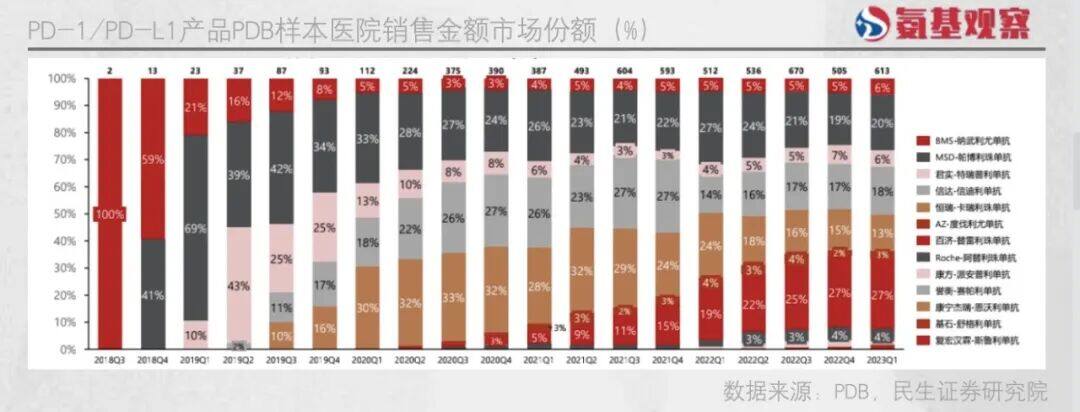
In contrast, although K drug has also been squeezed by domestically produced PD-1, its market share still remains around 20%. From past performance, O drug has obviously been failing.
However, this does not mean that Opdivo has completely lost its chance in the Chinese market. After all, past failures were more due to strategic deviations by Bristol-Myers Squibb rather than issues with the drug itself.
In fact, in gastrointestinal tumors and multiple types of cancer,Adjuvant/Neoadjuvant TherapyField,O drug's exploration is at the forefront globally, withSignificant CompetitionExcellentMomentum. This is the confidence behind its comeback.
Now, Bristol-Myers Squibb has also taken a critical step in making changes. Recently,According to The Paper, Bristol-Myers SquibbRecently reached a strategic cooperation agreement with Zai Lab.
According to the agreement, Zai Lab will be responsible for the commercialization of Opdivo in 10 provinces including Yunnan, Guizhou, Guangxi, Inner Mongolia, Xinjiang, Gansu, Ningxia, Qinghai, Hebei, and Shanxi.
In other words, Bristol-Myers Squibb hopesWith the support of Zai Lab, can O-yao stage a comeback? Could this be the beginning of O-yao's turnaround in the Chinese market?
/ 01 /
Bet on the Wrong Direction
Although in the overseas market, O drug still lags behind K drug, its performance is not too bad.
In 2023, Opdivo brought $9.009 billion to Bristol-Myers Squibb, increasing by 9% compared to 2022. Including Ono Pharmaceutical's sales in Japan, Opdivo’s total sales last year surpassed the $10 billion mark for the first time, making it the 10th highest-selling drug globally.
This performance is due to the fact that Opdivo (O药) has broken through the dominance of Keytruda (K药) with a differentiated strategy.
In the field of gastrointestinal tumors, Opdivo (O药) has maintained a strong position; in the first-line treatment of non-small cell lung cancer, the company's combination of "Opdivo + Yervoy" (O药+Y药) has brought certain incremental benefits by eliminating chemotherapy.
For the growth in sales in 2023, Bristol-Myers Squibb stated that the core reasons were first-line lung cancer and gastrointestinal tumors.
In China, Bristol-Myers Squibb has also continued a similar strategy: focusing on gastrointestinal tumors.
Following the unveiling of the non-small cell lung cancer second-line therapy indication, Bristol-Myers Squibb's subsequent indications have primarily focused on gastrointestinal tumors.
From 2020 to 2022, among the five indications approved for the company, four were for gastrointestinal tumors. As shown in the figure below, of the nine currently approved indications for Opdivo (O drug), gastrointestinal tumors account for half.
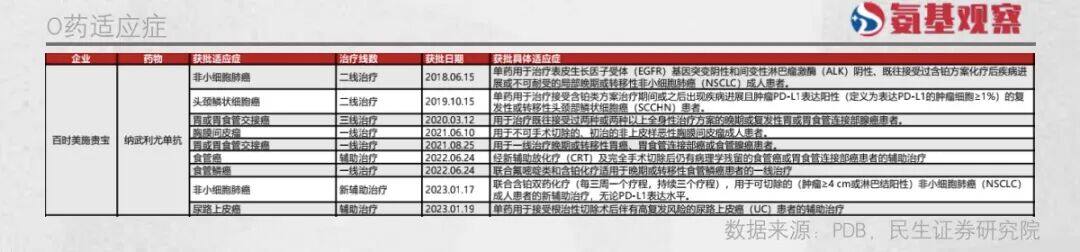
It is understandable that, due to dietary and other habit-related issues, China is one of the regions with the highest incidence of gastrointestinal tumors globally. However, because of this, domestically produced PD-1 inhibitors have also been heavily deployed around gastrointestinal tumors. This has also led to a situation where, although both have faced fierce competition, the circumstances for Opdivo (O drug) and Keytruda (K drug) are completely different.
In China, Keytruda also initially targeted lung cancer and obtained three first-line therapy indications for non-small cell lung cancer in 2019. In terms of competition, Hengrui Medicine achieved one of these indications in 2020, while the other two indications would not see competitors until after 2021. This has given Keytruda more time to establish a first-mover advantage.
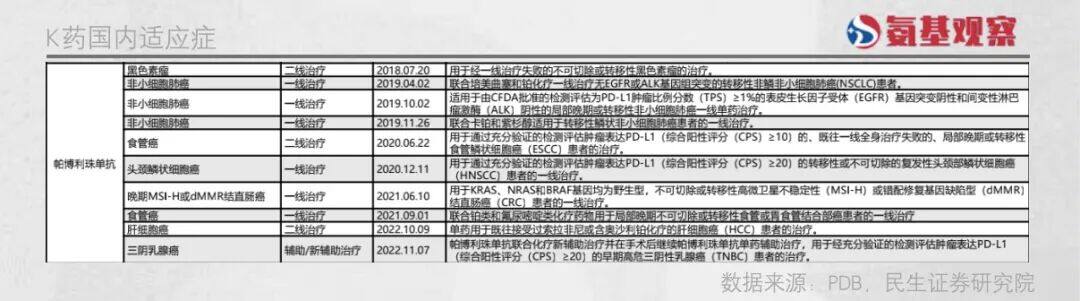
In contrast, the situation for O-medicine is entirely different. For instance, in the field of first-line treatment for gastric or gastroesophageal junction cancer, O-medicine was approved in August 2021. However, in June 2022, Innovent Biologics' Sintilimab received approval for the same indication, directly competing with it.
In the indication for first-line treatment of esophageal squamous cell carcinoma, Opdivo (O drug) is a latecomer. PD-1 inhibitors from Hengrui Medicine, Junshi Biosciences, and Merck all entered the field earlier.
Without establishing an early advantage in gastrointestinal tumors, Opdivo (O药) naturally struggles to replicate its overseas development trajectory.
/ 02 /
The price adjustment lagged behind.
More importantly, Bristol-Myers Squibb's performance in terms of commercialization also seems to be unsatisfactory.
Although they are called the "O, K" duo, the presence of O drug in China seems not very strong. In the eyes of many oncologists or subconsciously, K drug is regarded as the "KING" among immunotherapy drugs.
The reasons for this phenomenon are multifaceted, but it is indeed a fact that Bristol-Myers Squibb's commercialization strategy needs improvement. This can be generally observed from the slower price adjustment measures of Opdivo.
Whether it's Keytruda or Opdivo, since both have chosen not to enter the medical insurance system, patients need to pay out of pocket. Given the significant price difference of domestically produced PD-1 drugs, it is inevitable that imported drugs will have to lower their prices.
K drug, which is not covered by medical insurance, quickly made a targeted strategy and adjusted its drug donation policy in 2021:
The first "2+2" remains unchanged, followed by an upgrade from "2+3" to "2+Lifetime," meaning patients only need to pay for four courses of medication to receive assistance until disease progression.
This means that K drug can achieve a lifetime guarantee with a cap of 140,000. This pricing strategy also allowed K drug to successfully fend off the encirclement of domestically produced PD-1 drugs.
In contrast, the price adjustment strategy related to Opdivo was not followed up in a timely manner. It was not until November 2023 that Opdivo updated its gastric and esophageal cancer assistance program:
The original aid program was about 140,000 RMB per year, while the new plan offers 140,000 RMB for two years, reducing the patients' burden by up to 50% compared to the original plan.
In other words, prior to this, the annual cost of using O药 (Opdivo) was actually much higher than other PD-1 inhibitors. Lacking a significant brand advantage and without a competitive price advantage, it is not difficult to understand why O药's (Opdivo) market share in China has continued to shrink.
/ 03 /
Adapting to the Shift in Times
Of course, the story of Opdivo in the Chinese market is not over.
For the epoch-making anticancer drug PD-1, many indications remain in a blue ocean state amidst intense competition. Therefore, an effective clinical development strategy is also key to a drug's comeback.
For Oy, its exploration in the adjuvant/neoadjuvant treatment field is at a globally leading position. This is also where its advantage lies in the Chinese market.
For example, in June 2022, Opdivo (O药) was approved for two indications in esophageal cancer: as adjuvant treatment for patients with esophageal cancer or gastroesophageal junction cancer who have residual pathological disease after neoadjuvant chemoradiotherapy (CRT) and complete surgical resection, and in combination with fluoropyrimidine- and platinum-containing chemotherapy for first-line treatment of patients with advanced or metastatic esophageal squamous cell carcinoma.
This means that Opdivo (O药) combined with chemotherapy has become the first and only PD-1 drug in China to cover both adjuvant treatment for esophageal cancer and first-line treatment for advanced stages. Its foresight in adjuvant/neoadjuvant treatment will become a major advantage of Opdivo. The overseas sales performance already speaks volumes.
However, fundamentally speaking, the competitive environment for Opdivo has changed.
China's innovative pharmaceutical companies are replicating the sales strategies of foreign pharmaceutical firms and advancing rapidly. In fact, many medical affairs, marketing personnel, and field sales representatives are recruited directly from foreign pharmaceutical companies.
Against this backdrop, the large sales teams of Chinese pharmaceutical companies will put pressure on overseas pharmaceutical companies. In fact, Bristol-Myers Squibb has chosen Zai Lab, a new-generation pharmaceutical company that has already proven itself in terms of commercialization.
Overall, in an environment where local forces are significantly strengthened, how to achieve a more efficient approach to promote the commercialization of core pipelines in the China region has become a question that multinational pharmaceutical giants must consider.
At present, the "if you can't beat them, join them" marriage seems to have become the only option. Last year, GlaxoSmithKline transferred the China rights of its shingles vaccine to ZF Bio; Pfizer also handed over the China rights of its 13-valent pneumococcal vaccine to Beijing Keyuan.
This time, Bristol-Myers Squibb has handed over the commercialization work of Opdivo in some provinces and cities to Zai Lab, which is, to some extent, a choice that follows this trend.As mentioned above, Zai Lab is one of the few Chinese pharmaceutical companies that has proven itself at the commercialization level.
With the further strengthening of the sales process, there is still potential in terms of indications.The dominant O-medicine inevitably has even greater room for imagination.In the market's view, this could be the beginning of Opdivo's counterattack in the Chinese market.