

Two BCMA-Targeting Bispecific Antibody Therapies Advance Toward Commercialization in Relapsed/Refractory Multiple Myeloma

Johnson & Johnson
Medical Device R&D and Manufacturer

February 26, 2024
eMedClub News
Recently,Regeneron Pharmaceuticals announced that the FDA has accepted the Biologics License Application (BLA) for its bispecific antibody therapy linvoseltamab, which targets BCMA and CD3, granting it Priority Review. This therapy aims to treat adult patients with relapsed/refractory (R/R) multiple myeloma (MM) whose disease has progressed after receiving at least three prior therapies. The PDUFA goal date for this application is set for August 22, 2024.
The application was submitted based on the positive results of the pivotal Phase 1/2 clinical trial, LINKER-MM1. According to data released in December last year, when the median follow-up time was 11 months, patients who received the 200 mg dose of linvoseltamab in the Phase 1/2 clinical trial (involving 117 patients) demonstratedAn objective response rate of 71%,Among them, 46% of patients achieved complete remission or better outcomes.

The 6th International Summit on the Development of Novel Antibody Drugs
The Development Space of ADC Drugs
target、linker&payload
Global ADC Drug Market Investment and Cooperation Trends
Development of Antibody Drugs Targeting Claudin18.2
Construction and Application of an Innovative ADC Drug Discovery Platform
Development Strategies for Immune Cell Engager Bispecific Antibodies
Exploration of the Application of mRNA Technology in Antibody Drug Development
Clinical Challenges in Frontline Treatment Development
Preclinical Analysis and Quality Control Strategies for ADC Drugs
Addressing the Challenge of Light Chain Mismatch in Bispecific/Multispecific Antibodies
AI Technology Empowers Antibody Drug Discovery and Design
Research Progress in GPCR-Targeted Antibody Drugs

999 SheetsFree single tickets,
Limited Time Offer!
Cooperation, Speeches, Synchronous Recruitment
As of the latest data cutoff date, all patients receiving the 200 mg dose treatment experienced adverse events (AEs). Among them, 85% of patients had ≥ Grade 3 adverse events (AEs). The most common adverse event was cytokine release syndrome (CRS), which affected 46% of patients. Of these CRS cases, the majority (35%) were Grade 1, 10% were Grade 2, and only one case (1%) was Grade 3 CRS.
In addition,FDA has recently approved Johnson & Johnson's supplemental Biologics License Application for the BCMA\CD3-targeted bispecific antibody Tecvayli.Newly approved for use once every two weeks, specifically for the treatment of patients with relapsed or refractory multiple myeloma. This adjustment is based on the results of a phase I/II study, which initially recommended that patients receive Tecvayli treatment once a week.Subsequently, the treatment frequency was changed to once every two weeks.Only those patients who achieve and maintain complete remission (CR) for at least six months are eligible for this reduced dosing regimen.
In June 2023, Johnson & Johnson announced the long-term data of MajesTEC-1, showing that Tecvayli could still maintain a deep response in patients achieving complete remission even after reducing the dosing frequency.Among 165 RRMM patients who received weekly subcutaneous injections of teclistamab,The overall response rate reached 63%. Notably, 58.8% of patients achieved a very good partial response (VGPR) or better, and 39.4% of patients achieved a complete response (CR) or better.
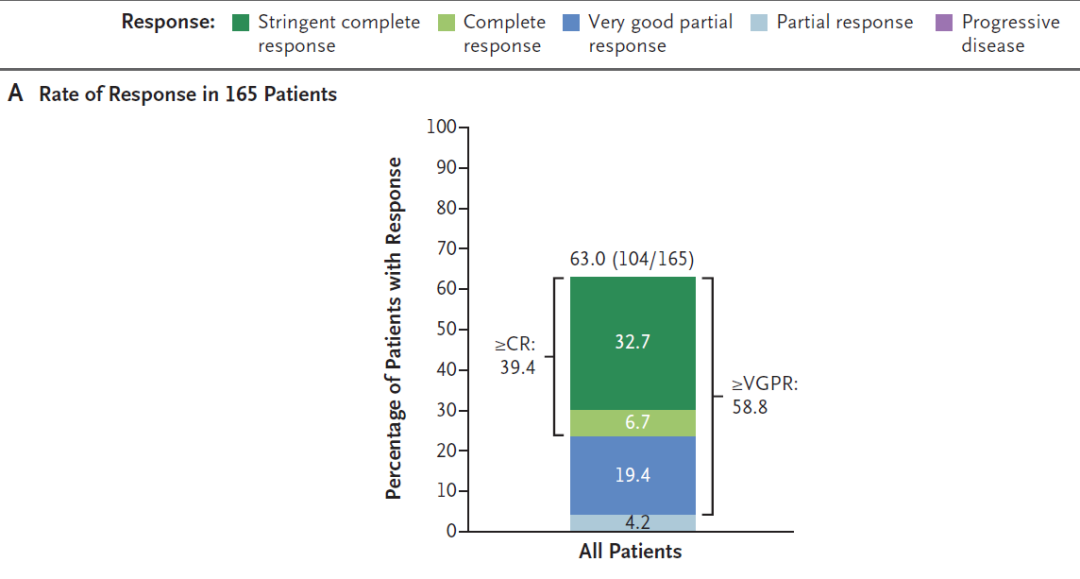
▲Teclistamab Response Rate Data in the MajesTEC-1 Trial
After a median follow-up of approximately 12 months following the switch to a once-every-two-weeks regimen, the majority of patients continued to respond to Tecvayli, and a reduction in the incidence of grade 3 or higher infections was observed post-switch.

The biweekly dosing regimen was considered safe, with no new concerning side effect signals emerging. Tecvayli, as a bispecific antibody, can simultaneously target the BCMA protein and CD3 receptor, both of which are hallmark features of T-cell malignancies. The therapy received market approval through the FDA's accelerated approval pathway in October 2022.
New Competitive Landscape in Multiple Myeloma
eMedClub
As Two Bispecific Antibodies Gradually Enter Commercialization, the Field of Multiple Myeloma is Also Set to Witness a New Transformation. With the rapid development of biopharmaceuticals today, treatment options for multiple myeloma are becoming increasingly diverse, among which CAR-T and bispecific antibody therapies have gained particular attention.
CAR-T Therapy Demonstrates Extremely High Efficacy with an Objective Response Rate Close to 100%, Thanks to Its High Target Specificity and Personalized Customization. Additionally, the Persistence of CAR-T Cells in the Body Makes Them a Strong Candidate for Long-Term Treatment. However, High Costs and Potential Immune-Related Risks Remain Challenges.
Bispecific antibody therapy has garnered attention due to its dual mechanism of action, simple administration process, and relatively high safety. By simultaneously targeting two antigens, bispecific antibody therapy can effectively inhibit tumor growth, and its relatively straightforward treatment process reduces the risk of adverse reactions. However, compared to cell therapy, this therapy is less effective and requires long-term administration. Therefore, in the field of multiple myeloma, these two innovative therapies each have their own advantages.
Looking ahead, the competitive landscape of the multiple myeloma market will be doubly influenced by technological innovation and integrated treatment strategies. As new drugs and technologies continue to emerge, market competition will become increasingly intense. Meanwhile, patients will place greater emphasis on treatment efficacy and personalization, opting for the most suitable treatment plans for themselves.
Overall, CAR-T and bispecific antibody therapies each have their own advantages in the treatment of multiple myeloma. The future market competition landscape will continue to evolve with technological advancements and changes in patient needs. Complementary use of these therapies may become the main trend. Personalized treatment and comprehensive treatment will take the lead, while cooperation and competition will jointly drive the continuous prosperity of the market.


Dian Dian "Share”、“Like" and "In Progress",Give me a little charge~