

Breakthrough! China's First CAR-T Cell Therapy Approved for Market by Fosun Kite

Fosun Kairos
Developer of Tumor Immune Cell Therapy Technologies and Products
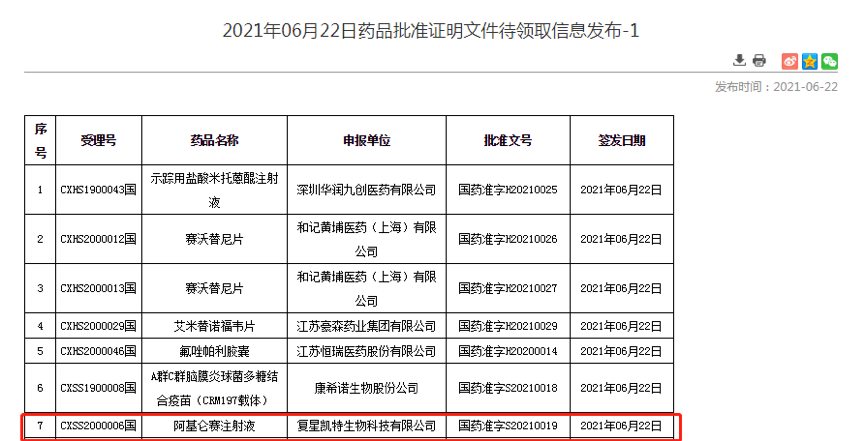
Screenshot from NMPA
This also means that China has welcomed the first approved CAR-T cell therapy to hit the market. With this, China’s CAR-T therapy has finally broken through the dawn and stepped into the commercialization phase.
Recently, Fosun Kite Biotechnology Co., Ltd. also announced that it has received clinical approval from the National Medical Products Administration (NMPA) for its CD19-targeted autologous CAR-T cell therapy product, Axicabtagene Ciloleucel Injection (product code FKC876), to treat relapsed or refractory indolent non-Hodgkin lymphoma (r/r iNHL) after receiving second-line or higher systemic treatment, including follicular lymphoma (FL) and marginal zone lymphoma (MZL). This will be the second indication approved in China for Axicabtagene Ciloleucel Injection.
Yescarta is an anti-CD19 CAR-T cell therapy, genetically engineered to modify autologous T cells to express molecules targeting the B-cell tumor antigen CD19, mediated by activated T cells to kill tumor cells. In 2017, Yescarta was approved by the FDA for the treatment of refractory or relapsed large B-cell lymphoma, including diffuse large B-cell lymphoma (DLBCL), primary mediastinal large B-cell lymphoma (PMBCL), and transformed follicular lymphoma (TFL), becoming the world’s first CAR-T drug approved for non-Hodgkin lymphoma (NHL). Subsequently, Yescarta received approval from the European EMA for the treatment of DLBCL and PMBCL. In March this year, the FDA once again approved Yescarta for the treatment of indolent non-Hodgkin lymphoma.
Public information shows that Axicabtagene Ciloleucel Injection is a CD19-targeted autologous CAR-T cell therapy product introduced by Fosun Kite, a subsidiary of Fosun Pharma, from Kite Pharma, a subsidiary of Gilead Sciences. Fosun Kite has been authorized to localize the production of Yescarta technology in China. According to the agreement, Fosun Kite holds commercial rights in China, including Hong Kong and Macao.
It is reported that the approval of Axicabtagene Ciloleucel Injection this time is based on a registration clinical trial study named ZUMA-1. Long-term follow-up data from 101 adult patients with relapsed/refractory large B-cell lymphoma showed that, with a follow-up period ≥4 years (median, 51.1 months), treatment with Yescarta brought durable remission to patients. The median overall survival (OS) was 25.8 months, and the 4-year OS rate was 44%.
But the approval of Axicabtagene Ciloleucel Injection in China has not been smooth.
In 2018, Fosun Kite's Axicabtagene Ciloleucel Injection was approved for clinical trials; the new drug application was officially accepted by NMPA in 2020 and included in the priority review process; in January 2021, Axicabtagene Ciloleucel Injection, which was supposed to be approved for marketing, was delayed due to other issues. After a 5-month supplementary application process, Axicabtagene Ciloleucel Injection was finally officially approved.
As is known to all, CAR-T cell therapy is often priced relatively high due to its high cost. For instance, Kymriah charges $475,000 for a one-time treatment, and Yescarta costs $373,000, both far exceeding the current standard charges for traditional treatments. Consequently, very few patients can afford this therapy, which is also one of the main reasons for its low sales volume.
Moreover, since the FDA approved the first CAR-T therapy in 2017, less than four years have passed and already six cell therapies have been successively approved. However, with four CD19-targeted CAR-T therapies available for the same indication, the market has become highly competitive.
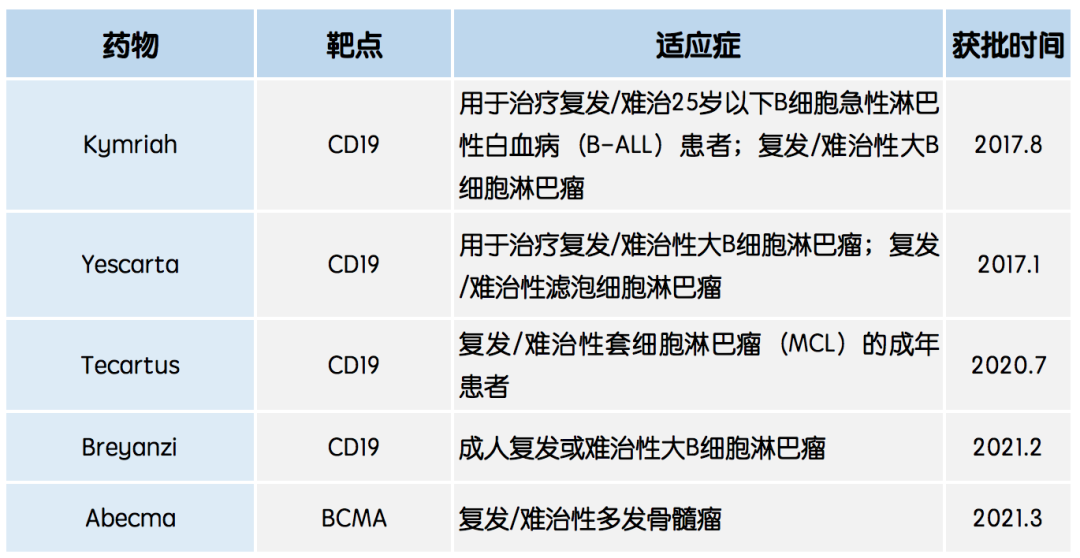
Target and Indications of CAR-T Products Approved Worldwide
According to Clinical Trials statistics, as of the end of May 2021, there were 1,301 CAR-T clinical trials underway globally. The number of CAR-T clinical trials in China has surged since 2016, reaching 478 so far, ranking first globally. Among them, CAR-T therapies such as LCAR-B38M from Legend Biotech, CT053 from CARsgen Therapeutics, and CNCT19 from Hekin Bio have made rapid progress and have been designated as breakthrough therapies by the CDE. Additionally, the CD19 CAR-T product Relmacabtagene Autoleucel Injection, introduced by JW Therapeutics, has submitted an application for market approval to the NMPA for relapsed or refractory B-cell non-Hodgkin lymphoma and is expected to become the second approved CAR-T product in China.
However, overall, most CAR-T clinical trials in China target CD19 and BCMA, with the main indications focusing on three categories: B-cell lymphoma, non-Hodgkin's lymphoma, and leukemia. The competition is intense, and there is significant homogeneity.
It is worth mentioning that Axicabtagene Ciloleucel Injection has become the first CAR-T product in China. Although its pricing has not been announced yet, as an imported product with substantial financial investment, it is very likely that its price in China will not be lower than the $373,000 of Yescarta. Moreover, CAR-T cell therapy has already been included in medical insurance abroad, significantly reducing the cost burden for patients. However, it is currently widely believed in the industry that it is unrealistic for China's medical insurance to cover CAR-T therapies. Therefore, the market performance of this drug in China still needs further validation.
Dr. Wang Liqun, CEO of Fosun Kite, also stated: "As a pioneer in the industrialization of China's immune cell therapy field, Fosun Kite believes that if Axicabtagene Ciloleucel Injection can be approved for marketing in China, it will bring revolutionary treatment options to Chinese cancer patients. We also hope to actively cooperate with governments at all levels, hospitals, charitable funds, commercial insurance companies, and others to explore patient assistance programs and innovative payment models, reducing the financial burden on patients and benefiting more lymphoma patients."
Overall, as the first CAR-T cell therapy product approved in China, the approval and market launch of Axicabtagene Ciloleucel Injection is of great significance. However, the increasingly fierce competition in China's CAR-T industry and the high cost are practical issues that players must consider during the commercialization process.