Merck's ADC Portfolio: Partnering with Kelun and Daiichi Sankyo to Pioneer the PD-1 + ADC Era

MSD
Pharmaceutical R&D and Manufacturer
Daiichi-Sankyo
Pharmaceutical R&D Developer
Kelun-Biotech
Innovative Drug Developer

Thanks to the tremendous success of Keytruda (K drug, pembrolizumab), MSD has become one of the most successful pharmaceutical companies in the field of oncology. According to MSD's 2023 annual report, the company's total revenue for the year was $60.1 billion, with Keytruda’s annual sales reaching $25 billion, accounting for nearly half of the total revenue.
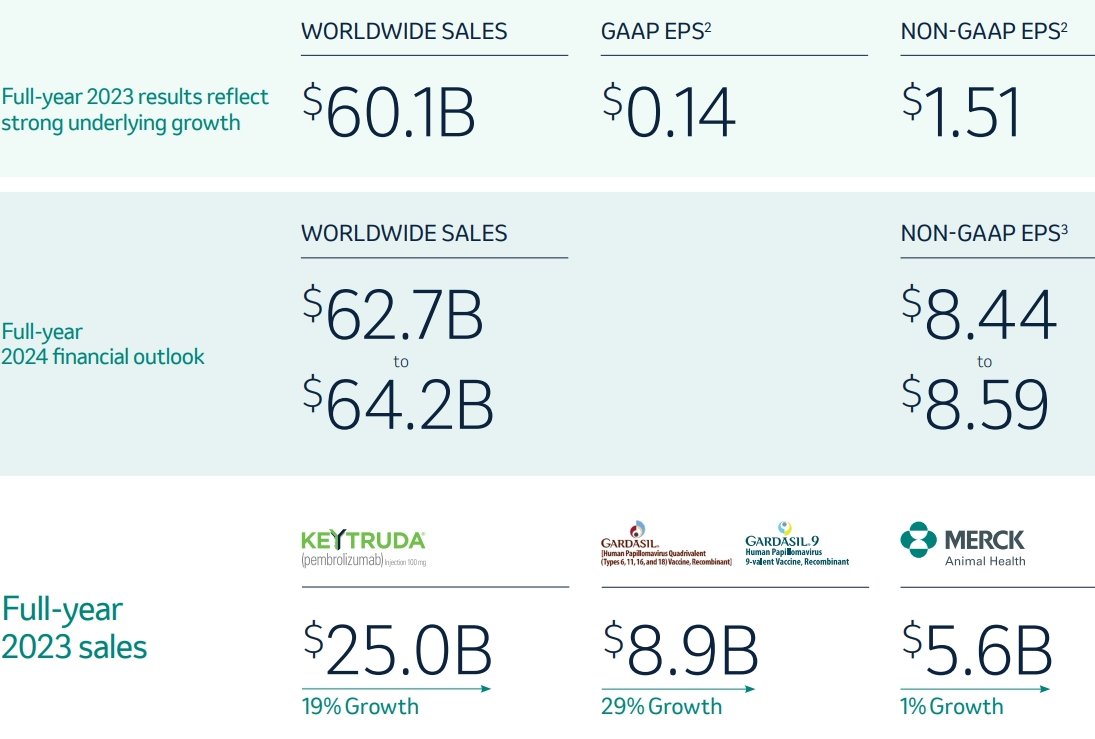
Image Source: MSD Official Website
However, despite showing remarkable efficacy in many cancer treatments, the limitations of immunotherapy cannot be ignored. Its biggest drawback is that it has a high response rate in only a few types of cancers. Therefore, MSD continues to explore combination therapies for Keytruda (K药) to expand its application scenarios. On the other hand, the core patent for Keytruda will expire in 2028, and MSD urgently needs to find the next "blockbuster" in the oncology field to maintain its leading position in the market.
Combination Therapy
PD-1+ADC Shows Promise
As of now, K medicine has been approved for 45 indications in the United States, involving 18 types of cancer. In 2018, K medicine was approved for marketing in China, and currently, it has been approved for 13 indications in China, including monotherapy or combination therapy for melanoma, non-small cell lung cancer, esophageal cancer, head and neck squamous cell carcinoma, colorectal cancer, etc.
In terms of combination therapy, MSD has explored its combination with various types of drugs such as chemotherapy, immunosuppressants, oncolytic viruses, ADCs, and mRNA.
Among them, K medicine + chemotherapy is the most explored or the combination therapy that has received the most regulatory approvals. As early as May 2017, the FDA approved K medicine in combination with pemetrexed and carboplatin for first-line treatment of metastatic non-squamous non-small cell lung cancer (NSCLC). Since then, various K medicine + chemotherapy combination regimens have received regulatory approval. However, this does not apply to all cancer types. For example, in the KEYNOTE-361 trial, K medicine failed to outperform standard chemotherapy in improving OS and PFS in patients with advanced bladder cancer.
Moreover, the "Cola Therapy" consisting of MSD's Keytruda and Eisai's Lenvima was once highly anticipated among PD-1 combination therapies. It received FDA approval for multiple indications, including renal cell carcinoma and endometrial cancer. However, this combination therapy later encountered setbacks in several Phase 3 clinical trials, casting a shadow of failure.
ADCs greatly expand the therapeutic window of cytotoxins in tumor tissues and can effectively reduce the toxic side effects caused by systemic chemotherapy. If Keytruda is used in combination with ADCs, it is expected to achieve better results than when combined with chemotherapy or targeted therapy.
On December 15, MSD announced that the FDA had granted early approval for the combination of Keytruda (pembrolizumab) and Nection-4 ADC (Padcev) as a first-line treatment for locally advanced or metastatic urothelial carcinoma. This marks the world's first approved "PD-1 + ADC" combination therapy.
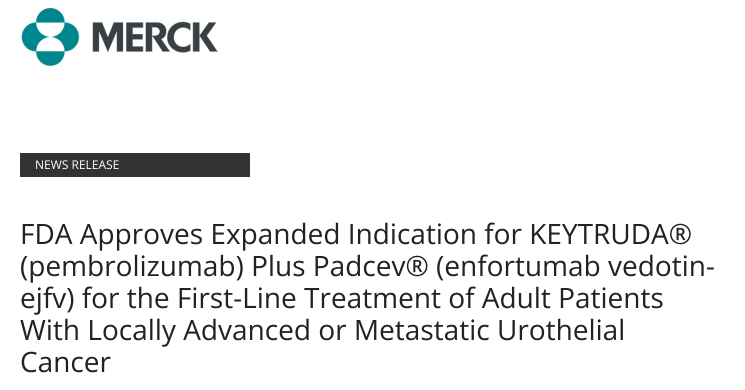
Image Source: Screenshot from MSD's official website
Padcev is the world’s first approved Nectin-4 ADC and was previously approved as a monotherapy for patients with locally advanced or metastatic urothelial carcinoma (la/mUC) who have been treated with a PD-1/PD-L1 inhibitor and platinum-based chemotherapy. This approval is for its combination therapy with Keytruda. Data shows that the OS of patients on the combination therapy is nearly twice that of the chemotherapy group, reducing the risk of death by 53%.
The combination with Padcev is only the first milestone in Merck's Keytruda + ADC combination strategy, and Merck is currently conducting multiple clinical studies on Keytruda + ADC:
In 2020 and 2021, MSD reached three clinical collaborations with Daiichi Sankyo/AstraZeneca on TROPION-Lung02, TROPION-Lung07, and TROPION-Lung08 studies, aiming to evaluate the efficacy of Dato-DXd (Trop2 ADC) combined with Keytruda in treating NSCLC.
In 2021, MSD reached a cooperation agreement with Gilead to jointly advance the first-line treatment of triple-negative breast cancer using Keytruda and Trodelvy (Trop2 ADC). In 2022, MSD signed two clinical trial collaboration and support agreements with Gilead to evaluate the efficacy of Trodelvy combined with Keytruda for first-line treatment of NSCLC.
In 2023, MSD and Kelun-Biotech jointly announced that multiple SKB264+K drug combination therapies are about to launch international multi-center Phase 3 clinical trials, including lung cancer and breast cancer. In February 2024, MSD announced the initiation of a pivotal Phase 3 clinical trial of SKB264 combined with K drug for metastatic NSCLC with PD-L1 expression greater than or equal to 50%.
After seeing the positive signals released by the corresponding clinical trials, MSD is more optimistic about the potential of ADC. It not only aims to develop combination regimens of Keytruda with other companies' ADCs but also wants to have its own ADC.
Full-scale Layout
$40 Billion Quickly Builds ADC Army
At last year's investor meeting, MSD divided its oncology pipeline into three categories: cancer immunotherapy represented by K medicine, precision targeted therapy represented by LYNPARZA (olaparib) and LENVIMA (lenvatinib), and tissue-targeted therapy represented by ADC.
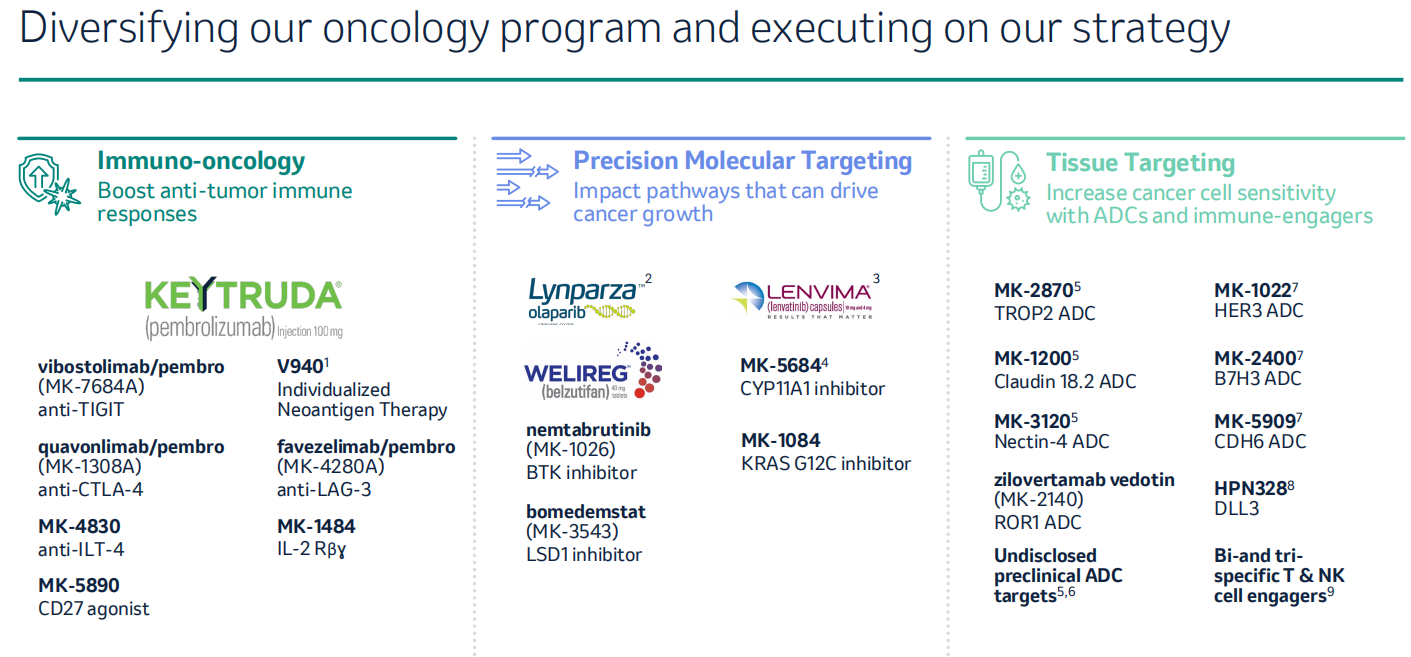
Source of the image: MSD 2023Q4 PPT
Currently, both classes already have blockbuster drugs, while tissue-targeted therapies still lack commercialized products. However, it can be seen from the recent frequent moves that MSD is tilting resources and vigorously deploying in this field.
MSD's first foray into ADC was in September 2020, when it partnered with Seagen to co-develop the LIV-1 ADC drug ladiratuzumab vedotin and made a $1 billion equity investment in Seagen. It later attempted to expand its ADC pipeline through a major acquisition; however, after failing to acquire Seagen in 2022, it shifted its focus to Kelun-Biotech and Daiichi Sankyo’s ADC technology platforms, rapidly expanding its ADC pipeline through multiple collaborations.
Table 1 Summary of MSD's Transactions in the ADC Field
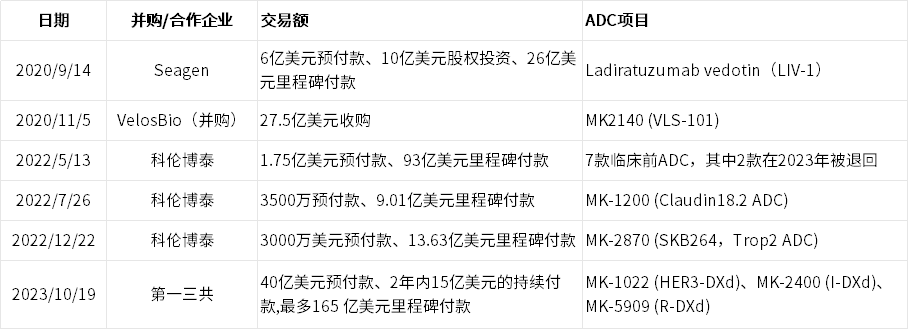
Source: Boyao整理 according to publicly available corporate information
Several major deals have enabled MSD to rapidly acquire 12 ADC pipelines under development for nearly $40 billion. According to the latest data disclosed by MSD, seven ADC pipelines are currently advancing in clinical studies.
Table 2 Overview of MSD's ADC Projects in Clinical Stage
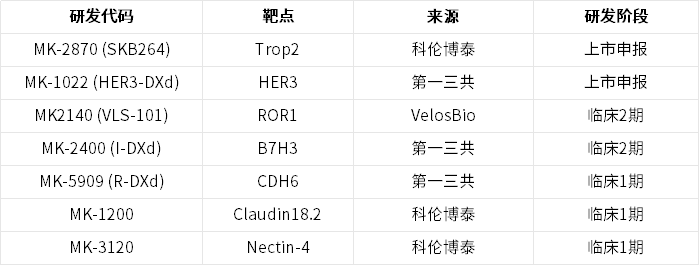
Source: Boya compiled based on publicly available corporate information
These 7 ADCs come from 3 technical platforms, targeting 7 different targets, which is beneficial for complementarity and risk diversification. A brief introduction of each project is provided below.
MK-2870(SKB264)
The ADC R&D platform OptiDC, developed by Kelun-Biotech, is composed of a humanized anti-TROP2 monoclonal antibody with high affinity and targeting capability. It is linked via the optimized CL2A linker to the proprietary small-molecule toxin T030 (a topoisomerase I inhibitor), with a drug-to-antibody ratio (DAR) of 7.4.
Currently, MSD has launched three pivotal Phase 3 clinical trials around SKB264, including SKB264 monotherapy as first-line treatment for EGFR-mutated advanced or metastatic NSCLC, monotherapy as second-line treatment for endometrial cancer (EC), and combination with Keytruda as first-line treatment for PD-L1 high expression (TPS≥50%) metastatic NSCLC.
Gilead’s Trodelvy is the world’s first Trop2 ADC, but it failed in a Phase 3 clinical trial for non-small cell lung cancer. SKB264 has initiated two Phase 3 clinical trials targeting NSCLC and is expected to achieve a breakthrough in the lung cancer field.
MK-1022(HER3-DXd)
Designed using Daiichi Sankyo's proprietary DXd ADC technology, it consists of a fully humanized anti-HER3 IgG1 monoclonal antibody linked via a cleavable tetrapeptide linker to a topoisomerase I inhibitor payload (a derivative of exatecan, DXd).
In December 2023, the Biologics License Application (BLA) for HER3-DXd was accepted by the U.S. FDA and granted Priority Review for the treatment of adult patients with locally advanced or metastatic EGFR-mutated non-small cell lung cancer (NSCLC) who have received two or more prior systemic therapies. The Prescription Drug User Fee Act (PDUFA) date is June 26, 2024.
This BLA is based on the results of the HERTHENA-Lung01 study: HER3-DXd demonstrated durable and clinically meaningful efficacy in 225 patients with EGFR-mutated locally advanced or metastatic NSCLC whose disease had progressed after prior treatment with EGFR TKI and platinum-based chemotherapy. The objective response rate (ORR) was 29.8% (95% CI: 23.9–36.2), including 1 complete response (CR) and 66 partial responses (PR). The median duration of response (DOR) was 6.4 months (95% CI: 4.9–7.8).
MK2140(VLS-101)
From VelosBio, also known as Zilovertamab vedotin, a monoclonal antibody targeting ROR1 conjugated with Monomethyl auristatin E (MMAE). The FDA has granted MK2140 Orphan Drug Designation and Fast Track Designation for the treatment of mantle cell lymphoma (MCL).
At ESMO 2021, MSD announced the Phase I, first-in-human dose escalation study results of MK-2140 in treating patients with malignant lymphatic system tumors. The data showed that the candidate drug induced objective tumor responses (ORR of 47%) in 7 out of 15 patients with mantle cell lymphoma, including 4 partial responses and 3 complete responses. Among 5 patients with diffuse large B-cell lymphoma, 3 achieved objective responses (ORR of 60%), with 1 partial response and 2 complete responses. According to the Clinicaltrials.gov website, MK-2140 is currently undergoing multiple Phase II/III clinical trials globally. A multicenter Phase II/III clinical trial for the indication of relapsed or refractory diffuse large B-cell lymphoma (DLBCL) was initiated in December 2021.
MK-2400(I-DXd)
Designed using Daiichi Sankyo's proprietary DXd ADC technology, it consists of a humanized anti-B7-H3 IgG1 monoclonal antibody linked via a cleavable tetrapeptide linker to a topoisomerase I inhibitor payload (a derivative of exatecan, DXd).
Currently, I-DXd is being evaluated in a Phase 2 clinical trial named IDeate-01 for the treatment of patients with previously treated extensive-stage small cell lung cancer (SCLC). At the IASLC 2023 World Conference on Lung Cancer, Daiichi Sankyo presented updated results from a subgroup analysis of the Phase 1/2 trial of DS-7300 in SCLC. The data showed that I-DXd achieved an objective response rate of 52.4%, a median progression-free survival of 5.6 months, and a median overall survival of 12.2 months.
MK-5909(R-DXd)
Designed using Daiichi Sankyo's proprietary DXd ADC technology, it consists of a humanized anti-CDH6 IgG1 monoclonal antibody linked through a cleavable tetrapeptide linker to multiple topoisomerase I inhibitor payloads (a derivative of exatecan, DXd).
DXd is currently in a Phase I study for the treatment of patients with previously treated ovarian cancer. At the ESMO 2023 conference, Daiichi Sankyo presented subgroup analysis results from the first-in-human Phase I study, showing an encouraging objective response rate of 46% and a disease control rate of 98% with R-DXd in patients with heavily pretreated ovarian cancer, with a median duration of response of 11.2 months.
MK-1200(Claudin18.2 ADC)
Derived from Kelun-Biotech's ADC R&D platform, it is a third-generation ADC drug targeting Claudin 18.2, utilizing a topoisomerase I (TOPO1) inhibitor toxin with a DAR value of 7.8. It is currently in Phase 1 clinical trials.
MK-3120(Nectin-4 ADC)
The ADC development platform from Kelun-Biotech is an ADC targeting Nectin-4. In April 2023, Kelun-Biotech initiated a Phase I clinical trial of this drug to evaluate its safety, tolerability, pharmacokinetics, and preliminary efficacy in subjects with advanced solid tumors.
Summary
Currently, Keytruda is MSD's most important source of income, accounting for 41.6% of MSD's total revenue. This also means that once Keytruda faces the "patent cliff," MSD's performance will encounter significant challenges. At present, ADC is considered by MSD as the next key product to take over in the oncology field, for which it has heavily invested to acquire multiple ADC assets. From the disclosed clinical-stage ADCs, there are seven projects targeting seven different antigens, almost covering all the popular and promising ADC targets. Moreover, these projects come from three ADC technology platforms, which helps with complementarity and risk mitigation. Apart from MSD, other pharmaceutical giants have also been actively "snapping up" ADC projects in recent years: Pfizer’s $43 billion acquisition of Seagen, AbbVie’s $10.1 billion purchase of ImmunoGen, and AstraZeneca, GSK, Johnson & Johnson, among others, have all made substantial investments in ADC projects.
In the past, MSD led the way in cancer immunotherapy with Keytruda, becoming the most successful pharmaceutical company in the oncology field. In the highly anticipated next frontier of cancer treatment—the ADC therapy—MSD has once again taken the lead by securing the first approved PD-1 + ADC combination therapy to reach the market and has established a robust ADC pipeline. Whether MSD can continue to maintain its leading position in the oncology field remains to be seen.
References:
MSD 2023 Annual Report
Kelun-Biotech: Kelun-Biotech and MSD Trigger Related Clinical Milestone Payments for Core Product SKB264 (MK-2870)
Daiichi Sankyo: HER3-DXd Granted Priority Review in the U.S. for the Treatment of Patients with Locally Advanced or Metastatic Epidermal Growth Factor Receptor (EGFR) Mutant Non-Small Cell Lung Cancer Previously Treated
Daiichi Sankyo: I-DXd Demonstrates Durable Efficacy in Early Clinical Studies for Patients with Advanced Small Cell Lung Cancer
Daiichi Sankyo: Raludotatug Deruxtecan Continues to Show Promising Clinical Efficacy in Early Studies for the Treatment of Advanced Ovarian Cancer


Editorial Responsibility: Liu Li
Disclaimer: This article is a reprint from PharmNet. The images and text are the property of the original author, and the purpose of the reprint is to convey more information. It does not represent the views of this platform. If there are any issues regarding the content, copyright, or other aspects, please leave a message on this platform, and we will address it promptly.